




01. Edit your dv 600 online
Type text, add images, blackout confidential details, add comments, highlights and more.

Type text, add images, blackout confidential details, add comments, highlights and more.

Draw your signature, type it, upload its image, or use your mobile device as a signature pad.

Send it via email, link, or fax. You can also download it, export it or print it out.
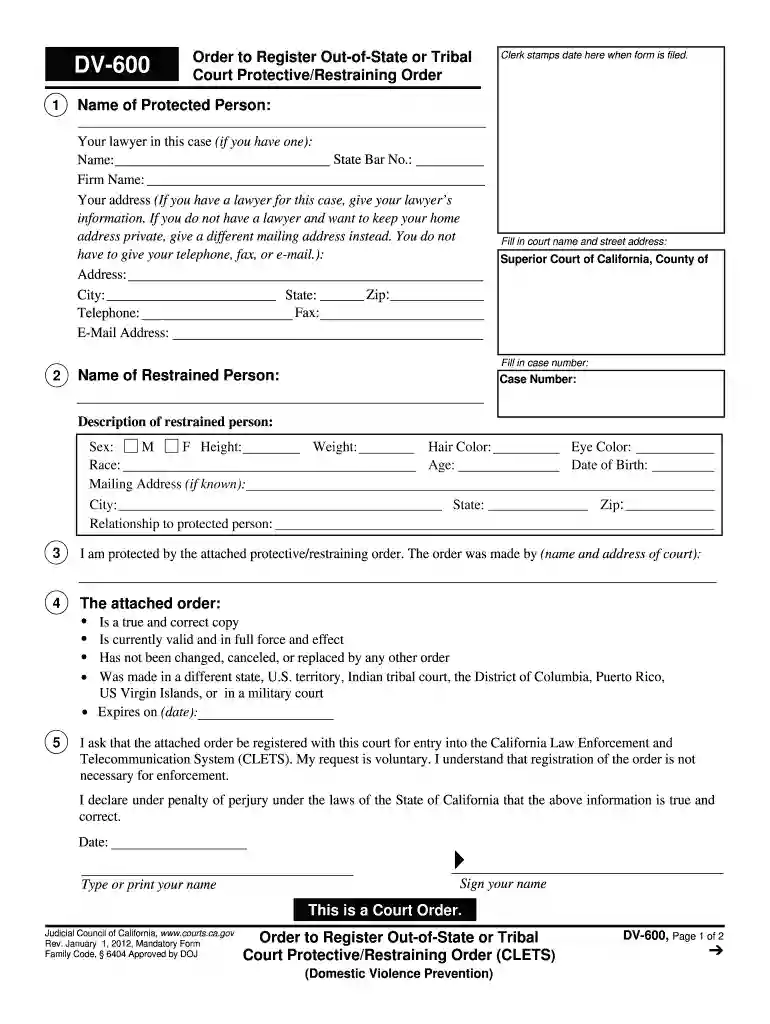
The DV-600 form, known as the "California Courts - State of California - courts ca," is a legal document used for registering an out-of-state or tribal court protective or restraining order within California. The purpose of the form is to ensure the enforceability of protective orders across state lines, providing continuity and safety for individuals who move to or reside in California. By completing and submitting the DV-600, the protected person formally records the order in California's system, which helps local law enforcement agencies to recognize and enforce the terms.
The DV-600 form consists of multiple sections that require detailed information. Key elements include:
Protected Person's Information: This section requires personal details such as the name, address, and contact information of the individual receiving protection.
Restrained Person's Information: Details about the person against whom the order is issued are included in this section, such as their name, description, and any relevant identifiers.
Attached Order Details: There is a declaration that confirms the validity and terms of the protective or restraining order being registered.
These sections collectively ensure the accuracy and enforceability of the registered order within California.
Understanding key legal terms is essential when dealing with the DV-600 form:
Protective Order: Also known as a restraining order, it is a legal decree issued to protect an individual from harassment, abuse, or threats from another person.
Out-of-State Order: Refers to any legal order issued outside the jurisdiction of California seeking enforcement within the state.
Registration: The process of formally recording the details of a legal order within California's legal system for enforcement purposes.
These terms are fundamental in grasping the form's purpose and legal implications.
To obtain the DV-600 form, individuals can follow these steps:
Access Online Resources: The California Courts website provides the necessary forms available for download. You can find the DV-600 along with instructions for completion.
Visit a Local Courthouse: Physical copies of the form are generally available at local courthouses across California, where assistance with filling out the form can also be requested.
Legal Assistance: Consulting a legal professional or advocate familiar with California's legal system can help in obtaining the form and ensuring it is correctly completed.
Completing the DV-600 involves several important steps:
Fill in Personal Details: Enter the accurate personal information of both the protected and restrained persons.
Review Order Details: Ensure that the attached protective order information is correct and matches the original document issued by the out-of-state or tribal court.
Provide a Declaration: A section is included to verify the authenticity and current validity of the protective order to be registered.
Submit the Form: After filling out the form, submit it to the appropriate California court, either online or in person, depending on the court's submission procedures.
Careful attention to detail during each step is crucial for successful registration.
The legal use of the DV-600 form is specific to the registration process of out-of-state protective orders. It empowers California courts to enforce these orders as though they were originally issued within the state. This legal recognition is critical for:
Protection Continuity: Ensuring the protective order remains valid and enforceable even when a protected individual relocates to California.
Cooperation with Law Enforcement: Enables local authorities to act swiftly in situations where the terms of the order are violated.
The form is an essential tool in the interstate justice administration concerning protective orders.
California has specific regulations that govern the use and submission of the DV-600 form:
No Hearing Required: Unlike many court processes, the registration of a protective order via the DV-600 does not need a court hearing, streamlining the enforcement of protection measures.
Non-expiration of Orders: Protective orders registered in California remain enforceable until the end date specified in the original order, ensuring that out-of-state protections align with California regulations.
These rules simplify the protective order registration process, maintaining its efficacy within California's legal framework.
The DV-600 is primarily utilized by individuals relocating to California who have existing protective or restraining orders. Typical users include:
Domestic Violence Survivors: Individuals seeking safety from an abusive partner or family member once in California.
Legal Advocates: Representatives aiding clients in securing continued protection under California law.
By engaging with the DV-600 form, these individuals ensure legal protection continuity and enforcement regardless of geographic boundaries.


We've got more versions of the dv 600 form. Select the right dv 600 version from the list and start editing it straight away!
At DocHub, your data security is our priority. We follow HIPAA, SOC2, GDPR, and other standards, so you can work on your documents with confidence.
This international panel was nominated by the governments of the 30 countries listed below, the. UN, EU, and OECD. Australia: Bronwyn Fox, the University of New.
by E Campbell 2017 Cited by 83 This paper will focus on the ways in which batterers take advantage of custody proceedings in family court to continue to abuse their victims.
I ask that the attached order be registered with this court for entry into the California Law Enforcement and. Telecommunication System (CLETS). My request is


