




01. Edit your form online
Type text, add images, blackout confidential details, add comments, highlights and more.

Type text, add images, blackout confidential details, add comments, highlights and more.

Draw your signature, type it, upload its image, or use your mobile device as a signature pad.

Send it via email, link, or fax. You can also download it, export it or print it out.
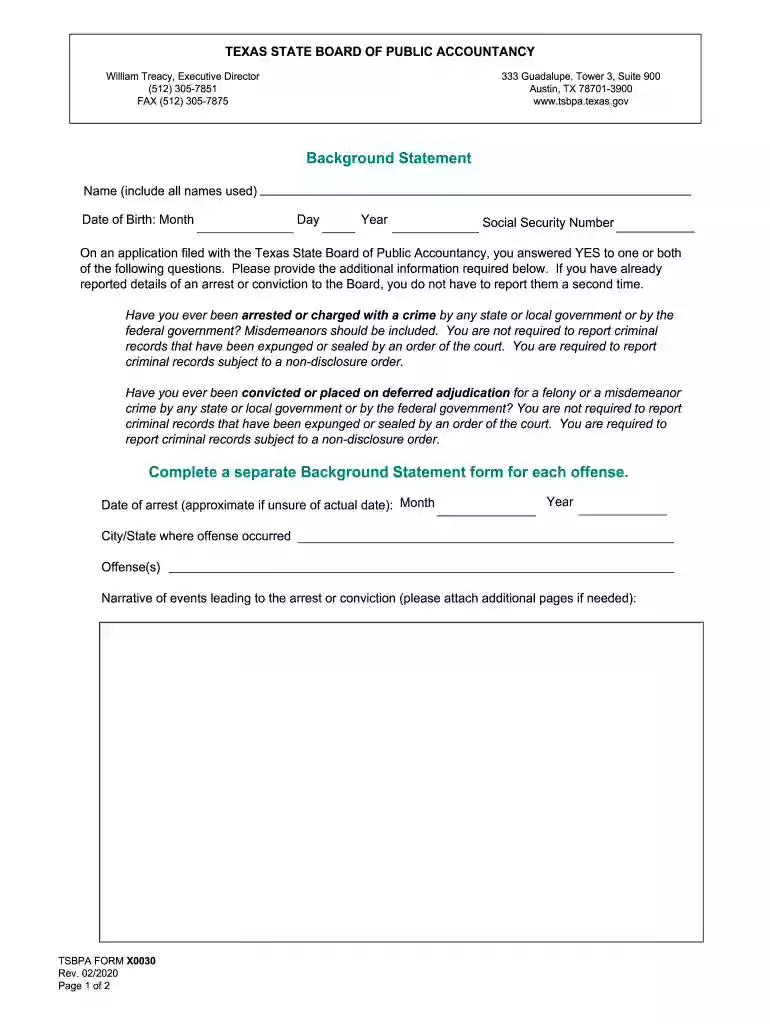
The Background Statement for the Texas State Board of Public Accountancy is a critical document required for individuals seeking licensure. It is designed to assess an applicant’s history, specifically regarding any legal transgressions, to ensure transparency and integrity within the accounting profession. Applicants are mandated to disclose past arrests or convictions, although expunged records are exempt. The form also calls for detailed information on offenses, involved court actions, and any rehabilitation measures undertaken by the applicant. This ensures that the board can thoroughly evaluate the ethical standards of applicants before granting them the authority to practice.
A comprehensive understanding of this form involves recognizing its essential components, which include:
Prospective accountants can access the Background Statement through the Texas State Board of Public Accountancy’s website. Here’s how to obtain it:
Accurate completion of the Background Statement involves several steps:
The significance of this form extends beyond mere compliance. It plays an instrumental role in safeguarding the profession's credibility by:
To submit a complete and valid Background Statement, applicants must meet specific criteria and adhere to disclosure guidelines:
Legal compliance is a primary concern for applicants filling out the Background Statement:
Consider how the Background Statement could manifest in different situations:
This document is a critical evaluative tool ensuring only those who demonstrate ethical fortitude and legal compliance receive licensure, thus maintaining the trust and dignity of the accounting profession in Texas.
We've got more versions of the Background Statement - Texas State Board of Public form. Select the right Background Statement - Texas State Board of Public version from the list and start editing it straight away!
At DocHub, your data security is our priority. We follow HIPAA, SOC2, GDPR, and other standards, so you can work on your documents with confidence.
TSTA President Donna New Haschke looks back at our proud history and at the challenges public education faces today in the state legislature. 10 Power,
The Board has a statutory obligation(Section 901.253) to review the background of each person permitted to take the CPA Exam and awarded a Texas CPA certificate
The cost of this service is $10.00 plus a $31.50 fee for the State and National Criminal History Record Information. Fees associated with the F.A.S.T.


