




01. Edit your form online
Type text, add images, blackout confidential details, add comments, highlights and more.

Type text, add images, blackout confidential details, add comments, highlights and more.

Draw your signature, type it, upload its image, or use your mobile device as a signature pad.

Send it via email, link, or fax. You can also download it, export it or print it out.
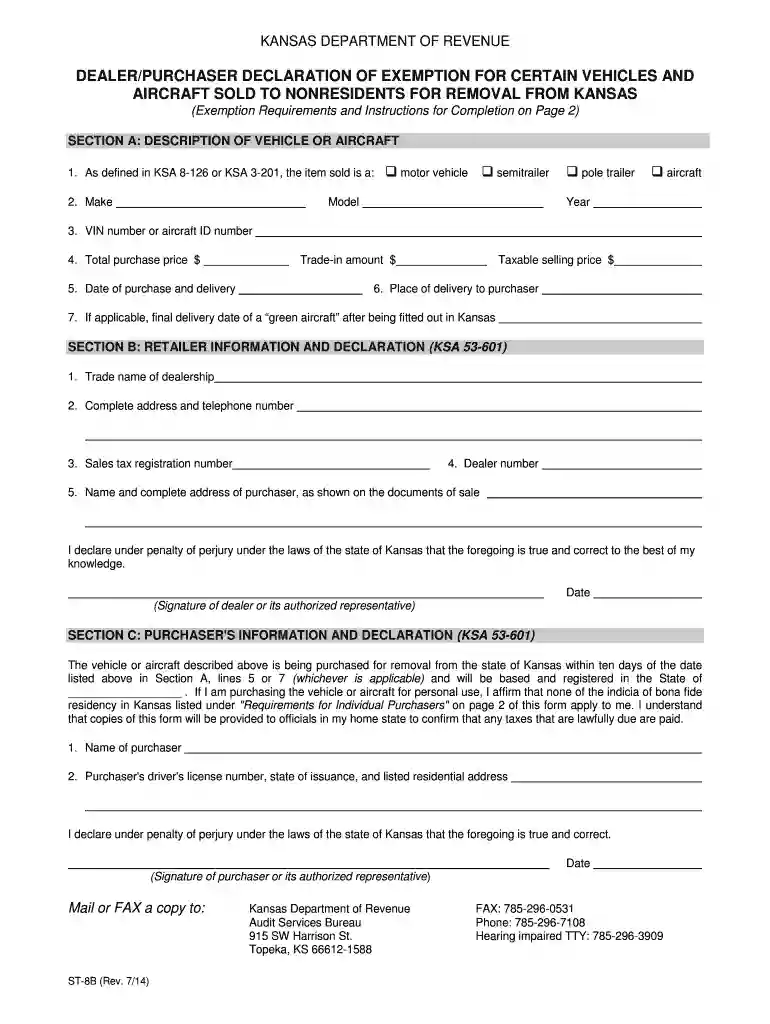
The "Affidavit of Delivery of a Motor Vehicle, Semitrailer, Pole Trailer, or Aircraft to a Nonresident of Kansas" serves as an official declaration utilized by nonresident purchasers. This affidavit is specifically designed for those acquiring certain vehicles, trailers, or aircraft in Kansas with the intent to transport them out of the state. By submitting this document, the purchaser claims exemption from Kansas sales tax, asserting that the purchased item will be removed from Kansas within a designated timeframe. The affidavit further verifies that the transaction meets the specified criteria under Kansas law, making it a critical component for ensuring compliance with tax regulations.
The affidavit comprises several essential sections that must be completed to fulfill Kansas legal requirements:
Each of these sections plays a pivotal role in accurately documenting the transaction and ensuring that both parties understand their responsibilities.
To use the affidavit effectively, the purchaser must adhere to a series of steps that include:
Adhering to these steps ensures the affidavit is properly utilized and legally binding.
Completing the affidavit involves the following detailed steps:
Each step should be performed meticulously to avoid issues with tax authorities.
This affidavit is predominantly used by:
These users rely on the affidavit to avoid Kansas sales tax legally.


Legal use encompasses the affidavit's role in tax exemption procedures under Kansas law. It requires compliance with residency criteria and mandates that purchased items must be removed from the state within ten days. The affidavit serves as proof to Kansas authorities that the transaction meets all statutory requirements for sales tax exemption based on nonresidency.
Kansas imposes specific rules for the affidavit's utilization:
Understanding these rules is essential for lawful exemption execution.
Examples include scenarios where:
These examples illustrate the affidavit's applicability in diverse purchase contexts.
When completing the affidavit, several documents must be prepared:
Having these documents ensures all parties are covered under the necessary legal frameworks.
Eligible parties for utilizing this affidavit include:
Meeting these criteria is requisite to claim tax exemptions successfully.

Options for submitting the affidavit:
Meeting deadlines for filing ensures compliance and the avoidance of penalties.
Failure to comply with the affidavit requirements can result in:
Understanding these penalties highlights the importance of accurate affidavit submission.
We've got more versions of the Affidavit of Delivery of a Motor Vehicle Semitrailer Pole Trailer or Aircraft to a Nonresident of Ka form. Select the right Affidavit of Delivery of a Motor Vehicle Semitrailer Pole Trailer or Aircraft to a Nonresident of Ka version from the list and start editing it straight away!
At DocHub, your data security is our priority. We follow HIPAA, SOC2, GDPR, and other standards, so you can work on your documents with confidence.
Jan 1, 2023 Affidavit of Delivery of a Motor Vehicle, Semitrailer, Pole Trailer or Aircraft to a Nonresident of Kansas (ST-8B) Bracket Cards - Sales tax
Sep 6, 2024 CERTIFICATION OF NON-SEGREGATED FACILITIES. The contractor, by submitting a proposal, certifies that he/she is in compliance with the Code of


