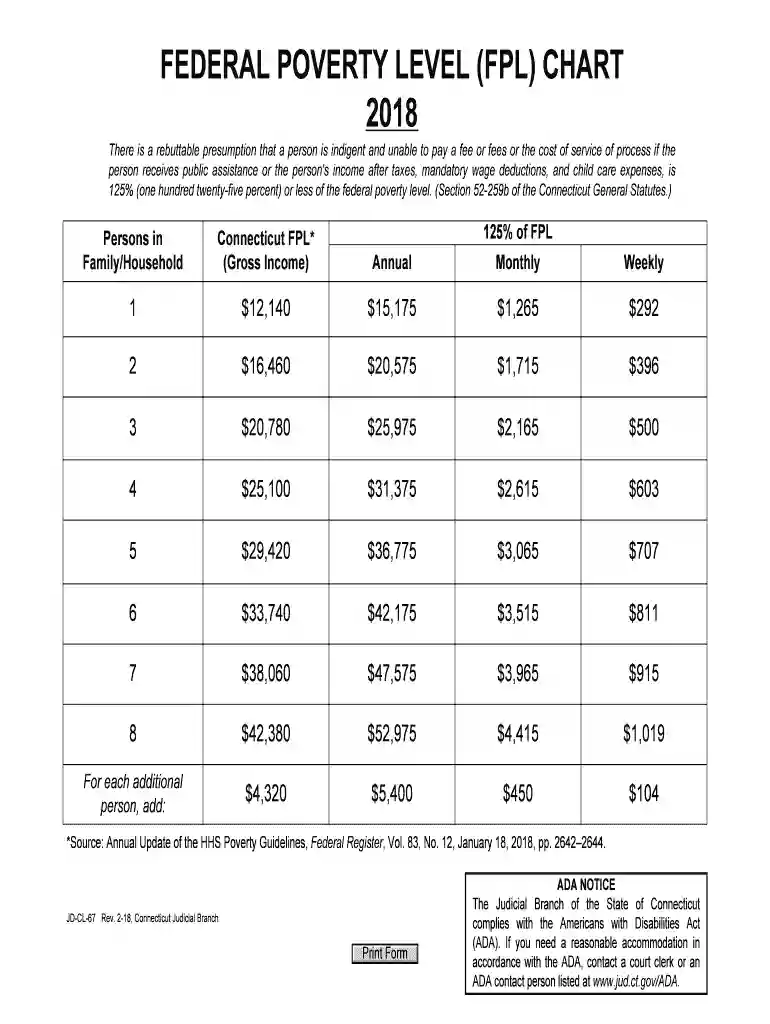
Federal poverty level - Connecticut Judicial Branch - CT 2026

Get Form
federal poverty level - Connecticut Judicial Branch - CT Preview on Page 1

Here's how it works

01. Edit your form online
Type text, add images, blackout confidential details, add comments, highlights and more.

02. Sign it in a few clicks
Draw your signature, type it, upload its image, or use your mobile device as a signature pad.

03. Share your form with others
Send it via email, link, or fax. You can also download it, export it or print it out.

Definition and Meaning of the Federal Poverty Level in Connecticut

The federal poverty level (FPL) is a measure used to determine eligibility for various public assistance programs. In Connecticut, the judicial branch uses this to gauge income thresholds for individuals and families in need, aligning with federal guidelines. This level is pivotal in identifying those presumed indigent, one hundred and twenty-five percent or below of the FPL, which allows for eligibility in certain legal financial assistance applications.

How to Use the Federal Poverty Level in the Connecticut Judicial Branch

To use the FPL when dealing with the Connecticut Judicial Branch, it’s essential to understand the income limits and household size criteria. This involves checking the annual, monthly, or weekly income metrics as outlined by the FPL chart for Connecticut. These figures help in assessing whether an individual or family qualifies for court fee waivers or other related legal aid services.

Steps to Complete Requirements Based on the Federal Poverty Level

  1. Determine Household Size: Count all members within the household, including dependents.
  2. Calculate Total Household Income: Include all sources of income for members of the household.
  3. Refer to the FPL Chart: Match the income figures to the respective household size on the FPL chart.
  4. Evaluate Eligibility: Use the chart to confirm if the income aligns with the eligibility criteria for aid.
  5. Submit Documentation: Present necessary documentation that supports the household size and income.

Key Elements of the Federal Poverty Level Guide in Connecticut

  • Income Thresholds: Specific income limits categorizing eligibility for assistance.
  • Household Size: The total number of individuals within a household affecting eligibility.
  • Eligibility Assessment: Procedures to determine whether a person or family meets the FPL standards.
  • Documentation Requirements: Necessary paperwork to prove income and household size.

State-Specific Rules for the Federal Poverty Level in Connecticut

Connecticut adheres to specific guidelines that may differ slightly from federal standards, emphasizing local household economic conditions. These include regional living costs and statewide median income considerations, which influence the application of FPL in judicial contexts. Connecticut requires a thorough verification process for indigent status using these thresholds.

Examples of Using the Federal Poverty Level in Connecticut Judicial Branch Contexts

  • Court Fee Waivers: Individuals earning below one hundred and twenty-five percent of the FPL can apply for court services without fees.
  • Legal Aid Qualification: Applicants can receive legal representation support if their income matches the FPL criteria.
  • Public Assistance Programs: Eligibility for programs such as SNAP is often tied to falling below the FPL.

Required Documents for Assessing the Federal Poverty Level

  • Proof of Income: Pay stubs, tax returns, or government benefit statements.
  • Identification for All Household Members: Such as birth certificates or social security cards.
  • Proof of Residency: Utility bills or lease agreements showing Connecticut residence.

Legal Use of the Federal Poverty Level in the Connecticut Judicial Branch

The FPL is legally mandated to provide equitable access to justice for low-income individuals. By federal and state laws, this is applied to assess needs in legal scenarios, ensuring court systems recognize financial incapacity for certain costs. The judicial branch uses these standards to minimize barriers for economically disadvantaged citizens seeking justice.


Eligibility Criteria Using the Federal Poverty Level

  • Income Criteria: Confirmation that household income is at or below the designated percentage of FPL.
  • Household Size Consideration: Evaluates how household composition affects financial capacity.
  • Other Assets: Occasionally, certain assets might also be assessed to ensure comprehensive economic status evaluation.
decoration image ratings of Dochub

See more federal poverty level - Connecticut Judicial Branch - CT versions

We've got more versions of the federal poverty level - Connecticut Judicial Branch - CT form. Select the right federal poverty level - Connecticut Judicial Branch - CT version from the list and start editing it straight away!
Versions Form popularity Fillable & printable
2021 4.8 Satisfied (228 Votes)
2019 4.4 Satisfied (104 Votes)
2018 4.4 Satisfied (56 Votes)
2016 4.4 Satisfied (318 Votes)
2015 4 Satisfied (48 Votes)
be ready to get more

Complete this form in 5 minutes or less

Get form

Got questions?

We have answers to the most popular questions from our customers. If you can't find an answer to your question, please contact us.
Contact us
Federal poverty levels for the 48 contiguous states and D.C. Household size (individuals)2023 income numbers2025 income numbers 2 $19,720 $21,150 3 $24,860 $26,650 4 $30,000 $32,150 5 $35,140 $37,6505 more rows Jan 23, 2025
How to read the table ​Persons in Family Household​Poverty Guideline​MAGI Household Income
ing to the most recent report issued in January 2023, the poverty threshold for a family of four is $29,960. For an individual, the poverty threshold is $14,891. The US Department of Health and Human Services (HHS) issues its poverty guidelines based on the Census Bureaus poverty thresholds.
Federal Poverty Guidelines for 2025 Annual Income Persons in Family600% 1 $93,900.00 2 $126,900.00 3 $159,900.00 4 $192,900.004 more rows

Security and compliance

At DocHub, your data security is our priority. We follow HIPAA, SOC2, GDPR, and other standards, so you can work on your documents with confidence.

Learn more
ccpa2
pci-dss
gdpr-compliance
hipaa
soc-compliance
be ready to get more

Complete this form in 5 minutes or less

Get form