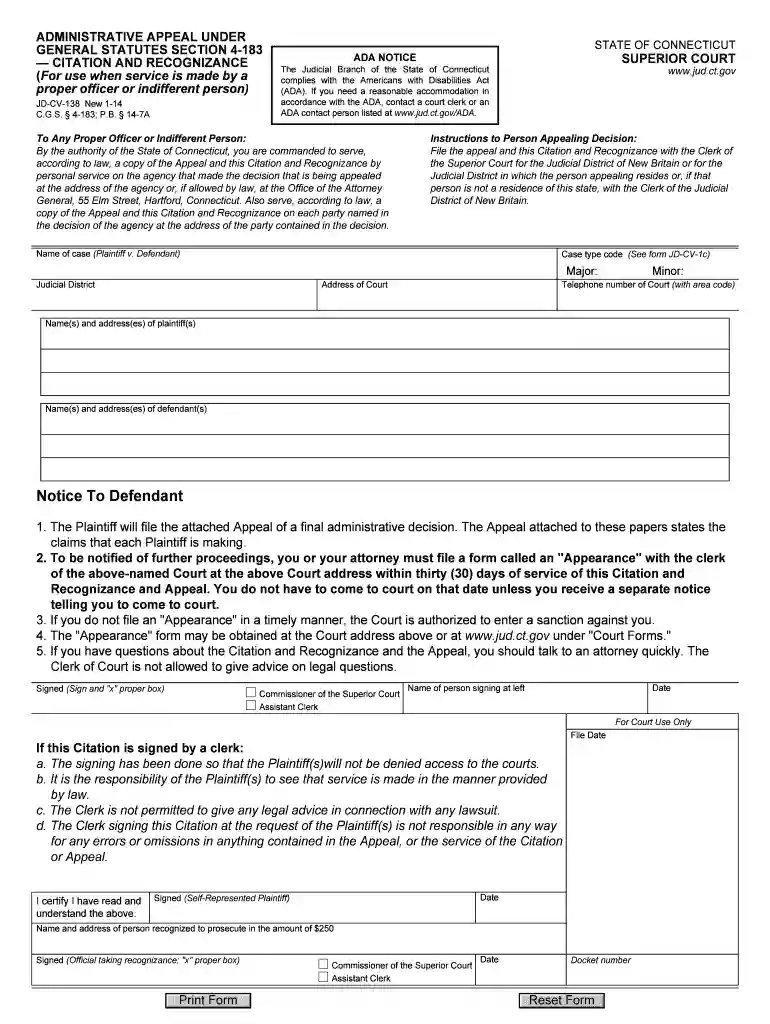
Citation and recognizance - Connecticut Judicial Branch - CT - jud ct 2026

Get Form
Citation and recognizance - Connecticut Judicial Branch - CT - jud ct Preview on Page 1

Here's how it works

01. Edit your form online
Type text, add images, blackout confidential details, add comments, highlights and more.

02. Sign it in a few clicks
Draw your signature, type it, upload its image, or use your mobile device as a signature pad.

03. Share your form with others
Send it via email, link, or fax. You can also download it, export it or print it out.

Definition & Meaning

The "Citation and Recognizance" form from the Connecticut Judicial Branch is a legal document primarily used in the state's judicial system. This form is often associated with the process of arrest where an individual is required to appear in court at a specified date and assures their presence by agreeing to certain conditions. "Citation" refers to a legal summons that requires an individual to appear in court. "Recognizance," on the other hand, involves a commitment where the individual promises to abide by specific conditions without needing to pay bail. This form is critical in ensuring the judicial process proceeds smoothly and that individuals comply with legal requirements.

Key Elements of the Form

Understanding the components of the Citation and Recognizance form can facilitate its correct completion and submission. The following are critical elements typically included in the form:

  • Defendant Information: Full name, address, contact information, and identification details.
  • Court Details: Information about the court where the individual is summoned, including the court name, address, and case number.
  • Offense Description: Details of the alleged offense(s), including the legal statute number.
  • Hearing Date: The specified date and time when the individual must appear in court.
  • Recognizance Conditions: Specific conditions the defendant must adhere to, often outlined explicitly.
  • Signature Section: Areas where the involved parties, including the defendant, must sign to confirm they understand and agree to the terms specified.

Steps to Complete the Form

Completing the Citation and Recognizance form accurately is crucial. Below is a structured guide to assist individuals through the process:

  1. Personal Information: Fill out your full legal name, date of birth, and contact details.
  2. Review Charges: Review the offense description and associated legal statute numbers provided on the form.
  3. Understand Conditions: Carefully read and understand the recognizance conditions listed. If in doubt, legal counsel can provide clarity.
  4. Sign the Document: Ensure that all relevant parties, including any legal representatives, sign in the designated spaces.
  5. Keep Copies: Make and retain copies of the completed form for personal records and legal proof.
  6. Submit Form: Submit the form to the required court as indicated. Submission methods can include in-person delivery or through legal counsel.

Legal Use in Connecticut

In Connecticut, the Citation and Recognizance form has a specific role in pre-trial procedures. Its primary function is to ensure that defendants return to court for their scheduled appearances without maintaining police custody. The form is used in both criminal and certain civil cases where the court deems a recognizance release applicable based on the defendant's flight risk and nature of the alleged crime. Understanding how this form functions within Connecticut's judicial framework can be facilitated by consulting legal professionals who specialize in state-specific legal processes.

State-Specific Rules

Connecticut's rules concerning the use of the Citation and Recognizance form are embedded within the state's criminal procedure laws. Here are several state-specific considerations:

  • Court Discretion: Connecticut courts hold the discretion to issue the recognizance form based on several factors, including the defendant's criminal history and ties to the community.
  • Procedure Compliance: Non-compliance with the conditions of recognizance can result in additional charges or the revocation of the recognizance agreement.
  • No Bail Requirement: In many cases, this form allows defendants to avoid paying bail, provided they agree to certain stipulations mandated by the court.

Important Terms Related to the Form

Grasping the terminology associated with the Citation and Recognizance can greatly clarify legal proceedings:

  • Surety: A party that takes responsibility for another's performance on a promise, often vital in recognizance terms.
  • Breach of Recognizance: Failing to comply with any stipulations outlined in the recognizance agreement.
  • Remand: If breach occurs, defendants might be returned to custody or face additional penalties until the court date.

Examples of Usage

Real-world application of the Citation and Recognizance form can vary depending on legal contexts:

  • Traffic Violations: Minor offenses may see the issuance of this form for the individual's acknowledgment to appear in court as opposed to being detained.
  • First-time Offenders: Individuals without previous criminal records might be granted recognizance, allowing avoidance of jail time pre-trial.
  • Non-violent Crimes: Courts may favor recognizance over bail for defendants accused of misdemeanor offenses, especially those deemed unlikely to flee.

Form Submission Methods

The Connecticut Judicial Branch offers several ways to submit the Citation and Recognizance form:

  • In-person Submission: Traditionally, defendants, or their legal representatives deliver the completed form directly to the courthouse.
  • Mail-in Submissions: Some jurisdictions allow forms to be mailed, provided they are postmarked by the submission deadline.
  • Digital Submissions: Emerging practices and platforms might offer the potential for electronic submissions; however, confirmation with specific court requirements is essential for legitimacy.

Proper submission ensures that all legal obligations are met and the defendant's agreement is verified, allowing their release under the specified conditions.

See more Citation and recognizance - Connecticut Judicial Branch - CT - jud ct versions

We've got more versions of the Citation and recognizance - Connecticut Judicial Branch - CT - jud ct form. Select the right Citation and recognizance - Connecticut Judicial Branch - CT - jud ct version from the list and start editing it straight away!
Versions Form popularity Fillable & printable
2020 4.8 Satisfied (175 Votes)
2015 4.2 Satisfied (62 Votes)
2014 4.4 Satisfied (170 Votes)
be ready to get more

Complete this form in 5 minutes or less

Get form

Got questions?

We have answers to the most popular questions from our customers. If you can't find an answer to your question, please contact us.
Contact us
You may pay your ticket or plead not guilty online at .jud.ct.gov. You may also call the Centralized Infractions Bureau at (860) 263-2750 to pay your ticket or plead not guilty.
If you do not pay in full or plead Not Guilty by the Answer Date, your case will be transferred to court. If your ticket is for a motor vehicle matter, we will notify the Department of Motor Vehicles that you have failed to pay or plead Not Guilty. The DMV will suspend your drivers license.
There are three types of Executions that you can seek to levy against a defendant that has not paid as ordered in a judgment. There are Property Executions, Wage Executions, and Financial Institution or Bank Executions.
A motion to open is appropriately filed in response to a judgment issued after default, if you have a good cause for challenging the judgment, or if a judgment was issued with an error due to a mistake. A Motion to Open is not appropriate when you disagree with the substance or reasoning of the judgment.
determining the guilt or innocence of persons accused of breaking the law; resolving disputes involving civil or personal rights; interpreting constitutional provisions of laws enacted by the legislature and deciding what is to be the law of the state when none exists for certain situations.

Security and compliance

At DocHub, your data security is our priority. We follow HIPAA, SOC2, GDPR, and other standards, so you can work on your documents with confidence.

Learn more
ccpa2
pci-dss
gdpr-compliance
hipaa
soc-compliance

People also ask

Records of traffic violations on driving histories are maintained for three years for most violations, although some serious violations may remain active on the history for ten years.

Related links