







Definition & Meaning
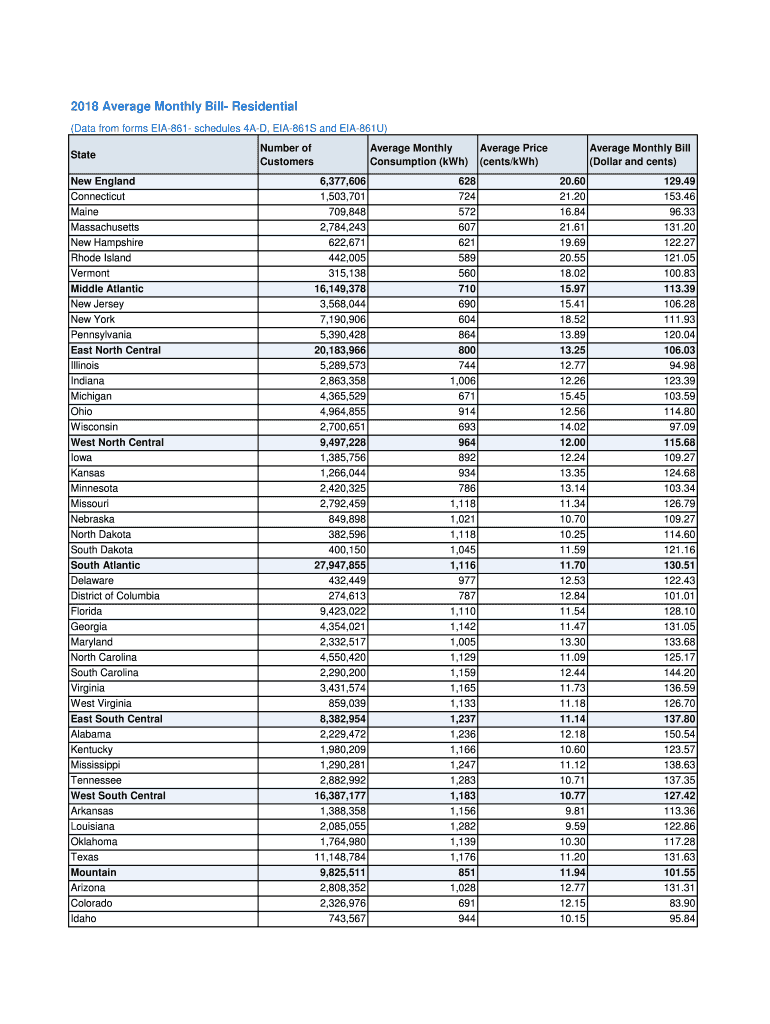
The "average-monthly-residential (1) - 2013 Average Monthly Bill" refers to the typical monthly cost incurred by residential electricity consumers in various states across the United States, as recorded in 2013. This data presents a snapshot of energy consumption patterns, prices per kilowatt-hour (kWh), and the overall financial burden of electricity on households. Understanding these metrics helps consumers and policymakers analyze trends, compare past and current energy costs, and develop strategies for efficient energy use.
Key Elements of the Average Monthly Bill
The average monthly bill comprises several components:
- Total Consumption in kWh: The total amount of electricity consumed within a month.
- Cost per kWh: The price of electricity, usually expressed in cents per kilowatt-hour, which varies by state and provider.
- Number of Customers: The total residential consumers served, providing insight into electricity usage patterns and demand.
Each component plays a crucial role in determining the total monthly electricity bill and provides valuable insights into consumer behavior and regional energy policies.
How to Use the Average-Monthly-Residential Bill
Consumers and analysts can utilize the average monthly bill data to:
- Benchmark Costs: Compare their current electricity bills against historical data to assess cost efficiency.
- Identify Trends: Analyze how energy consumption or costs have evolved over the years.
- Policy Development: Assist policymakers in crafting energy policies by understanding consumption patterns and pricing structures.
These applications empower stakeholders to make informed decisions and create strategies for better energy management.
Steps to Complete the Form
Capturing data from the "average-monthly-residential (1) - 2013 Average Monthly Bill" entails a systematic approach:
- Gather Necessary Data: Collect monthly consumption data, local electricity rates, and any state-specific regulations.
- Input Consumption Figures: Record kWh used each month for accurate billing.
- Calculate Total Costs: Multiply consumption by the rate to obtain the monthly cost.
- Review and Compare: Analyze against the previous year's data to see changes in consumption or cost.
This process enables consumers and businesses to effectively manage and plan for their energy expenses.
Examples of Using the Average Monthly Bill
Several practical uses can be derived from analyzing the average monthly bill:
- Budgeting: Households can use this data to set realistic monthly energy budgets.
- Energy Efficiency Programs: Energy providers may use past data to design programs that encourage reduced consumption.
- Market Analysis: Businesses can study energy costs to evaluate potential operational expenses in different regions.
Each scenario highlights how this data serves diverse user needs, fostering better financial and operational planning.
State-Specific Rules for the Average Monthly Bill
Regulations and pricing for electricity can differ significantly between states due to:
- Regional Energy Sources: States using renewable sources may have lower costs.
- State Regulations: Variations in taxes or subsidies affecting energy prices.
- Climate Impact: Regions with extreme temperatures might experience higher consumption and costs.
Understanding these differences is crucial for making informed decisions based on one’s geographical location.
Important Terms Related to the Average Monthly Bill
Familiarizing oneself with key terms enhances comprehension of the average monthly bill:
- Kilowatt-hour (kWh): A standard unit of energy; one kWh equals the energy consumption of a 1,000-watt appliance running for one hour.
- Demand Charges: Fees based on the peak power usage over a billing period.
- Tiered Rates: Pricing that increases as consumption reaches higher thresholds.
Gaining a strong grasp of these terms aids in better understanding and managing electricity expenses.
Digital vs. Paper Versions
Both digital and paper formats provide utility in accessing the average monthly bill data:
- Digital Version: Offers ease of access, distribution, and storage; allows quick data analysis with compatible software.
- Paper Version: Useful for physical record-keeping and when digital tools are not available.
The choice between these formats depends on individual preferences and resource availability, ensuring efficient data management.
Software Compatibility
Analyzing digital data requires compatible tools:
- Spreadsheet Applications: Like Excel, useful for organizing and analyzing detailed consumption and cost data.
- Accounting Software: Systems like QuickBooks can integrate electricity costs into broader financial management.
- Specialized Energy Tools: Software designed to model energy consumption can provide advanced insights.
Using compatible software enhances data analysis efficiency and accuracy, supporting comprehensive energy management practices.




