




01. Edit your form online
Type text, add images, blackout confidential details, add comments, highlights and more.

Type text, add images, blackout confidential details, add comments, highlights and more.

Draw your signature, type it, upload its image, or use your mobile device as a signature pad.

Send it via email, link, or fax. You can also download it, export it or print it out.
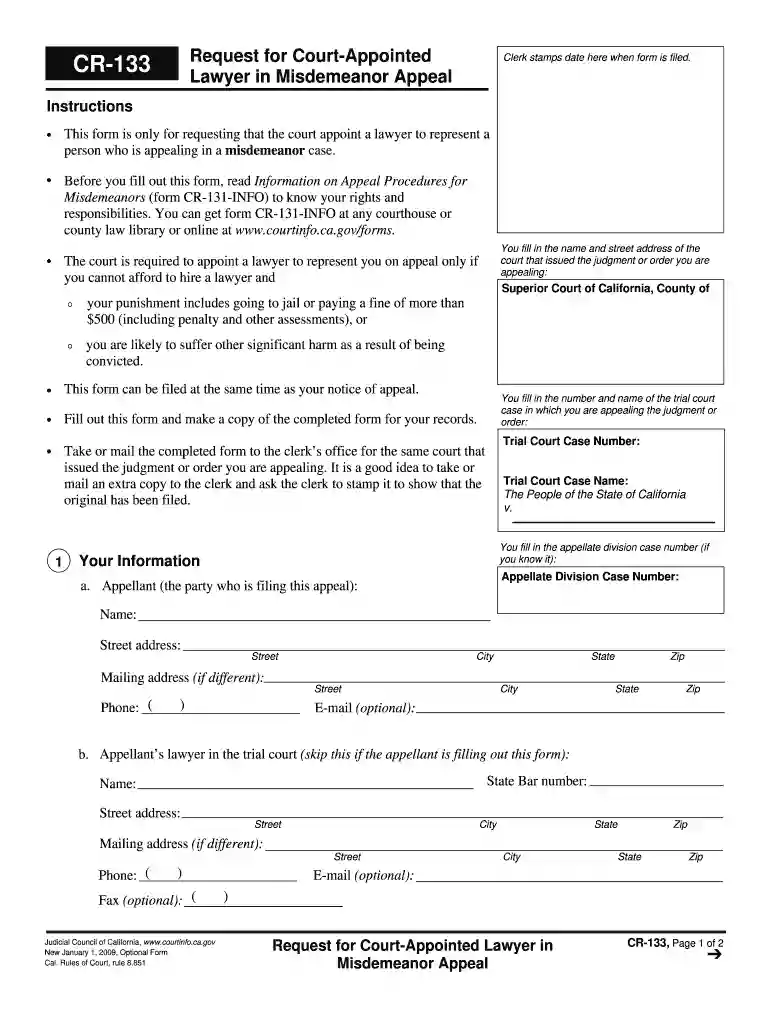
The CR-133 "misdemeanor appeal form" from 2009 serves as a legal document utilized for appealing a misdemeanor conviction in the United States. Primarily, this form offers individuals the opportunity to request a court-appointed attorney if they meet specific eligibility criteria. These criteria typically include financial inability to hire a private lawyer and demonstration of significant potential harm resulting from the conviction. Filing this form is a critical step for those seeking a reconsideration of the consequences stemming from their misdemeanor case.
Utilizing the CR-133 form involves several detailed steps. Individuals must begin by accurately completing sections that require personal information, including name and contact details. Additionally, information about the trial court that issued the initial decision and a comprehensive description of the punishment received are necessary. It is imperative to submit this form to the appropriate court where the original judgment was made. Applicants should ensure all information is complete and correct to avoid delays or rejections in the processing of their appeal.
Eligibility for using the CR-133 form hinges on conditions tied to financial status and the impact of the conviction. Applicants must provide documented evidence demonstrating their financial inability to afford private legal representation. Additional supporting documentation may be needed to establish that the misdemeanor conviction poses a significant threat to their personal or professional life. Thoroughly verifying eligibility ensures that time and resources are not wasted on an ineligible appeal.


The CR-133 form is typically used by individuals in the United States who have been convicted of a misdemeanor and are seeking to appeal their case. This form is particularly relevant for those who lacked representation during their trial or for those who require a court-appointed lawyer due to financial constraints. It is also important for anyone significantly affected by their misdemeanor conviction, providing them with a potential avenue to influence or overturn their judgment.

While the CR-133 form is used across the U.S., there may be state-specific variations in how it is processed. Some states could have additional requirements for documentation or differ in the procedural aspects of filing an appeal. Applicants should consult local court guidelines or seek legal advice to ensure compliance with specific state regulations. Understanding these differences helps in accurately tailoring submissions to meet local legal standards.
A practical example of using the CR-133 form involves a scenario where an individual received a misdemeanor conviction that threatens their employment. By filing the form with a complete set of financial and personal documentation, the individual successfully secures a court-appointed attorney. Another instance might involve a person unable to afford legal fees, leveraging the form to ask for legal counsel that can help challenge a conviction that unjustly affects their personal freedom or public record.
We've got more versions of the 133 misdemeanor appeal form 2009 form. Select the right 133 misdemeanor appeal form 2009 version from the list and start editing it straight away!
At DocHub, your data security is our priority. We follow HIPAA, SOC2, GDPR, and other standards, so you can work on your documents with confidence.
by NJ King 2019 Cited by 62 To develop law and regulate error in misdemeanor cases, particularly in prosecutions for the lowest-level offenses, courts may need to provide mechanisms for
Notice of Appeal (Misdemeanor). Effective: January 1, 2020 See form info Download CR-133. Request for Court-Appointed Lawyer in Misdemeanor Appeal.
Jun 27, 2012 133. Section 16508.1 of the Welfare and Institutions Code, as added by Section 24 of Chapter 287 of the Statutes of 2009, is repealed. SEC


