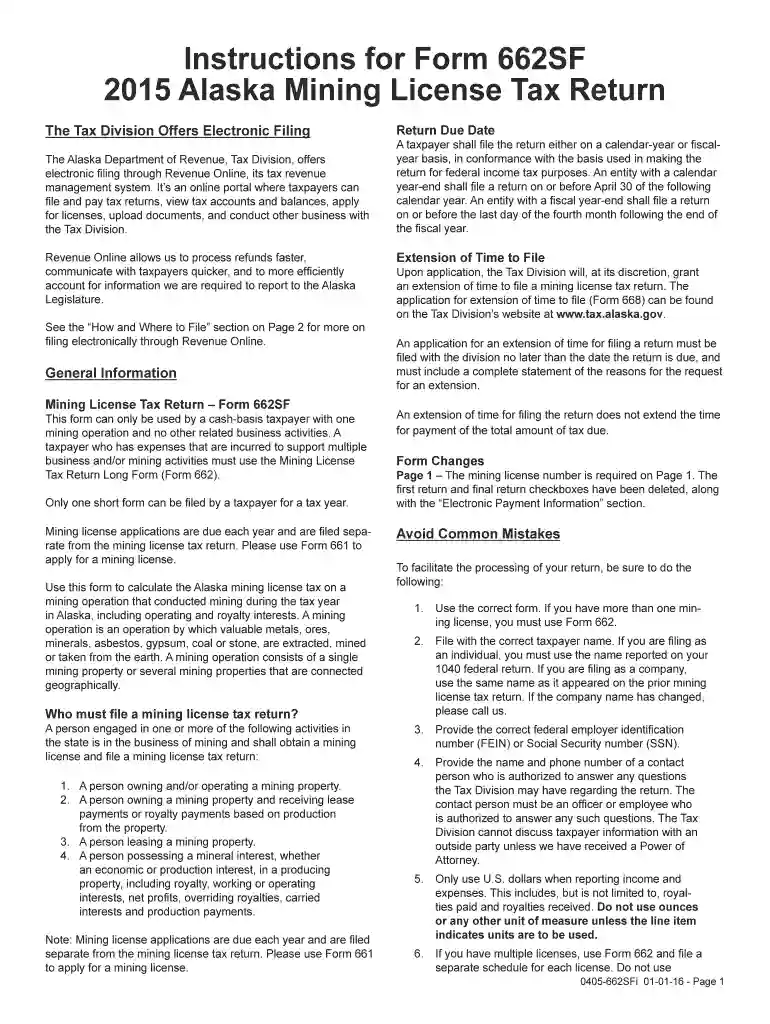
- tax alaska 2026

Get Form
- tax alaska Preview on Page 1

Here's how it works

01. Edit your form online
Type text, add images, blackout confidential details, add comments, highlights and more.

02. Sign it in a few clicks
Draw your signature, type it, upload its image, or use your mobile device as a signature pad.

03. Share your form with others
Send it via email, link, or fax. You can also download it, export it or print it out.

Definition and Meaning of Tax Alaska

In the context of Alaska, "Tax Alaska" refers to the various tax obligations and forms required by the state, particularly for businesses and individuals engaged in economic activities like mining. Alaska is unique in its tax structure, with no state-level sales or income tax. Instead, it generates revenue primarily through corporate taxes and the extraction industries, which are subject to specific tax forms like the Alaska Mining License Tax Return (Form 662SF). This form is a key document for those involved in mining operations in Alaska, specifically designed for reporting income and expenses associated with such activities.

How to Use the Alaska Mining License Tax Form

The primary purpose of the Alaska Mining License Tax Form is to report revenue and expenses related to mining operations. Users should first gather all necessary financial records, such as income from sold minerals and detailed lists of expenses incurred in the course of the operation. The form must be filled out accurately to reflect this financial activity, ensuring compliance with state tax obligations. Inaccurate or incomplete forms can lead to audits, fines, or additional penalties.

Steps to Complete the Alaska Mining License Tax Form

  1. Gather Financial Documentation:

    • Collect all income statements, invoices, payroll records, and receipts for expenses.
    • Include documents related to royalties and depletion deductions.
  2. Access Revenue Online:

    • Alaska provides an electronic filing system called Revenue Online, where these forms can be submitted.
  3. Complete the Form:

    • Follow the line-by-line guidance provided by the state to prevent common mistakes.
    • Carefully check entries for royalties, depletion, and other deductions.
  4. Review and Submit:

    • Reassess the completed form for any errors or omissions.
    • Submit the form electronically through Revenue Online well before the due date to avoid late fees.

Filing Deadlines and Important Dates

Understanding the deadlines is crucial for timely compliance:

  • The Alaska Mining License Tax Return must be filed by the 15th day of the fourth month following the close of the tax year.
  • Extensions can be requested if unable to meet the filing deadline.
  • Penalties apply for late filing or payment without an approved extension.

Required Documents for Filing

  • Income and Expense Documentation:

    • Include all documents that detail earnings from the mining operation and relevant costs.
  • Previous Year’s Tax Returns:

    • Helpful for ensuring consistency and accuracy in reporting.
  • Supporting Documentation for Deductions:

    • Necessary for justifying any deductions claimed, such as for depletion or royalty payments.

Legal Use of the Alaska Mining License Tax Form

The form is a critical component of legal compliance for mining operations in Alaska. It ensures operators contribute their fair share to state revenues. All information provided must be truthful and comprehensive. Fabricating or omitting essential data can result in severe legal consequences, including fines and legal action.

Penalties for Non-Compliance

Failure to comply with tax requirements or meet filing deadlines can result in significant penalties:

  • Late Fee Penalties:

    • Additional costs are imposed for delays in submission.
  • Interest Charges:

    • Accrue on unpaid taxes from the due date until payment is made.
  • Legal Action:

    • Persistent non-compliance may lead to further enforcement actions by the state tax authorities.

State-Specific Rules for Alaska Mining License Tax

Alaska’s taxation is tailored to its unique economic setting:

  • Exemption and Relief Provisions:

    • Certain small-scale miners may qualify for exemptions or reduced rates.
  • Sector-Specific Deductions:

    • Focused deductions are available for costs unique to mining operations, promoting industry growth while ensuring fair tax collection.

Steps for Ensuring Compliance

  • Regular Audits:

    • Conduct periodic internal reviews to match financial records with state requirements.
  • Consult Professionals:

    • Engage with tax consultants or legal advisors familiar with Alaska's tax laws to ensure adherence to regulations.

Overall, the Alaska Mining License Tax Form serves as a vital tool for managing state tax obligations in the mining sector. Understanding each aspect of the form thoroughly ensures compliance, minimizes the risk of penalties, and promotes smooth operations.

See more - tax alaska versions

We've got more versions of the - tax alaska form. Select the right - tax alaska version from the list and start editing it straight away!
Versions Form popularity Fillable & printable
2022 4.2 Satisfied (48 Votes)
2018 4.8 Satisfied (110 Votes)
2017 4.4 Satisfied (307 Votes)
2015 4.2 Satisfied (56 Votes)
2014 4 Satisfied (34 Votes)
be ready to get more

Complete this form in 5 minutes or less

Get form

Got questions?

We have answers to the most popular questions from our customers. If you can't find an answer to your question, please contact us.
Contact us
Alaska has the lowest taxes in the country. There are no statewide income or sales taxes, but residents do still pay some local sales taxes. There are also property taxes that are above the national median.
Alaska does not have a state sales tax but has an average combined state and local sales tax rate of 1.82 percent. Alaska has a 1.07 percent effective property tax rate on owner-occupied housing value.
Alaska does not have a state sales tax but has an average combined state and local sales tax rate of 1.82 percent. Alaska has a 1.07 percent effective property tax rate on owner-occupied housing value. Alaska does not have an estate tax or inheritance tax.
If you make $100,000 a year living in the region of Alaska, United States of America, you will be taxed $22,671. That means that your net pay will be $77,329 per year, or $6,444 per month.
While Alaska doesnt impose a state income tax, most residents still need to file federal income taxes. Its also important to consider property and sales taxes, which can impact your financial planning.

Security and compliance

At DocHub, your data security is our priority. We follow HIPAA, SOC2, GDPR, and other standards, so you can work on your documents with confidence.

Learn more
ccpa2
pci-dss
gdpr-compliance
hipaa
soc-compliance

People also ask

With the pipeline, the petroleum industry boomed, increasing economic activity in the state. In subsequent years, Alaska was able to compensate for individual income tax revenue losses through growth in its severance tax and royalties from petroleum. These taxes amounted to 47 percent of state revenue in 2022.
There is no state sales tax in Alaska; however, local governments which include boroughs, the Alaska equivalent of counties, and municipalities may levy up a sales tax. Municipal sales taxes are collected in addition to borough sales taxes, if any. Regulations and exemptions vary widely across the state.
What is the average salary in United States of America? If you make $100,000 a year living in the region of Alaska, United States of America, you will be taxed $22,671. That means that your net pay will be $77,329 per year, or $6,444 per month. Your average tax rate is 22.7% and your marginal tax rate is 31.2%.

Related links