Key Elements of the Instructions for Form 662SF Alaska Mining License Tax Return
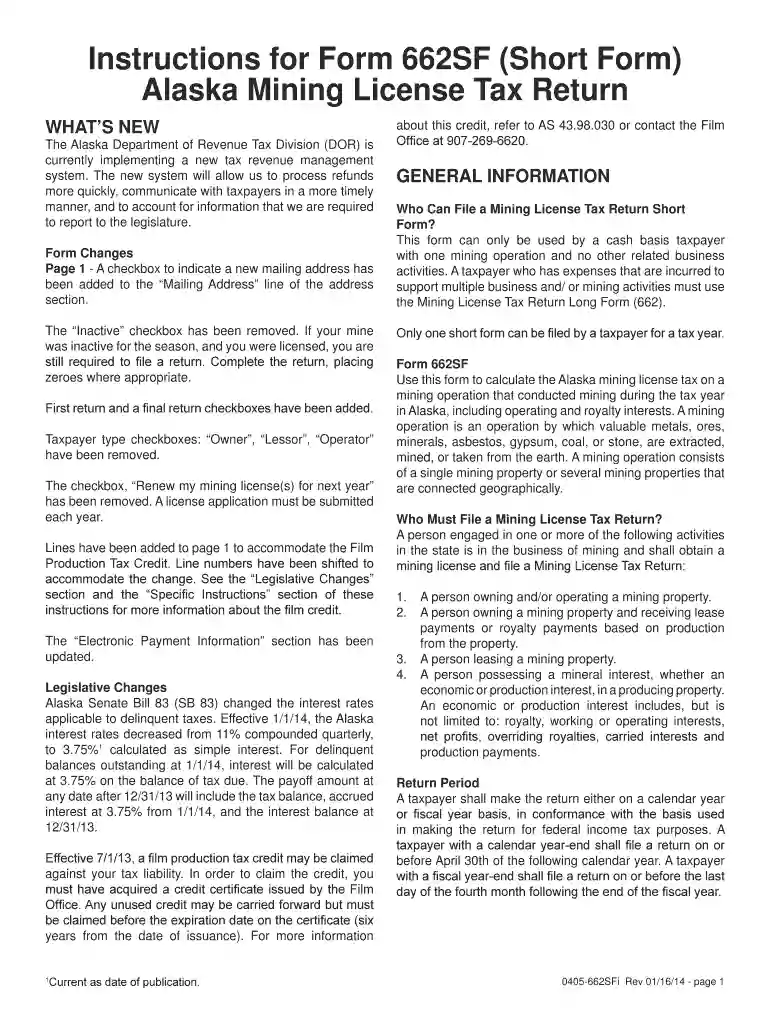
The Instructions for Form 662SF Alaska Mining License Tax Return play a crucial role in guiding taxpayers in the mining sector to accurately report their income. Key elements of these instructions include:
- Eligibility Criteria: The tax return is mandatory for individuals or entities engaged in mining activities within Alaska. This encompasses companies involved in extracting minerals such as gold, silver, and coal.
- Filing Deadlines: The form must be submitted by the 15th day of the fourth month following the close of the taxpayer's fiscal year.
- Income Reporting: Detailed guidelines assist in correctly calculating and reporting income derived from mining operations.
Important Terms Related to Instructions for Form 662SF Alaska Mining License Tax Return
Understanding specific terminology is vital to successfully navigating the tax return process:
- Gross Income: Total income received from mining operations before any deductions.
- Depletion Deduction: A tax deduction acknowledging the decrease in value of a mine as minerals are extracted. Annual depletion calculations are required and forms a key focus in the instructions.
- Film Production Tax Credits: Recent updates have introduced options for claiming these credits within the mining tax return mechanism.
Steps to Complete the Instructions for Form 662SF Alaska Mining License Tax Return
Filling out Form 662SF involves a series of structured steps to ensure accuracy:
- Gather Required Information: Compile all necessary financial documentation, including income statements and evidence of expenses.
- Calculate Depletion: Use the guidance provided to calculate allowable depletion deductions.
- Document Mining-Related Expenses: Ensure all justified expenses are recorded following the guidelines to minimize taxable income.
- Claim Applicable Credits: Identify and claim any film production or other relevant credits as per the current form instructions.
- Review and Submit: Verify all entries for accuracy, then submit the form by the designated deadline using the chosen method.
Legal Use of the Instructions for Form 662SF Alaska Mining License Tax Return
Taxpayers must adhere to legal guidelines when utilizing the instructions:
- Compliance with State Legislation: Ensuring all reported figures align with Alaskan law is crucial.
- Avoidance of Penalties: Late submissions or inaccuracies can result in fines. The instructions detail key areas to focus on to avoid such penalties.
Filing Deadlines / Important Dates
Timely compliance is critical:
- Submission Deadline: All submissions must be completed by the 15th day of the fourth month post-fiscal year.
- Extension Applications: These must be submitted before the standard deadline, detailing the reasons for delay.
Penalties for Non-Compliance
Failure to comply with guidelines can lead to negative repercussions:
- Late Filing: Penalties accrue from the day after the due date.
- Misreporting: Inaccurate submissions can incur additional fines and trigger audits.
Who Typically Uses the Instructions for Form 662SF Alaska Mining License Tax Return
Understanding the typical user base helps tailor compliance efforts:

- Mining Corporations: Large entities engaged in significant extraction activities.
- Small-Scale Miners: Individuals or small businesses involved in localized mining.
- Investment Firms: Organizations holding stakes in mining operations.
Compliance Standards and State-Specific Rules
Adhering to state-specific mandates is pivotal:
- State-Specific Tax Rates: The instructions clarify the rates applicable to various minerals.
- Local Compliance Obligations: Differences in local mining laws necessitate precise understanding of relevant obligations.
By following these structured sections and employing the comprehensive instructions provided, taxpayers can accurately fulfill their tax obligations related to mining operations in Alaska.