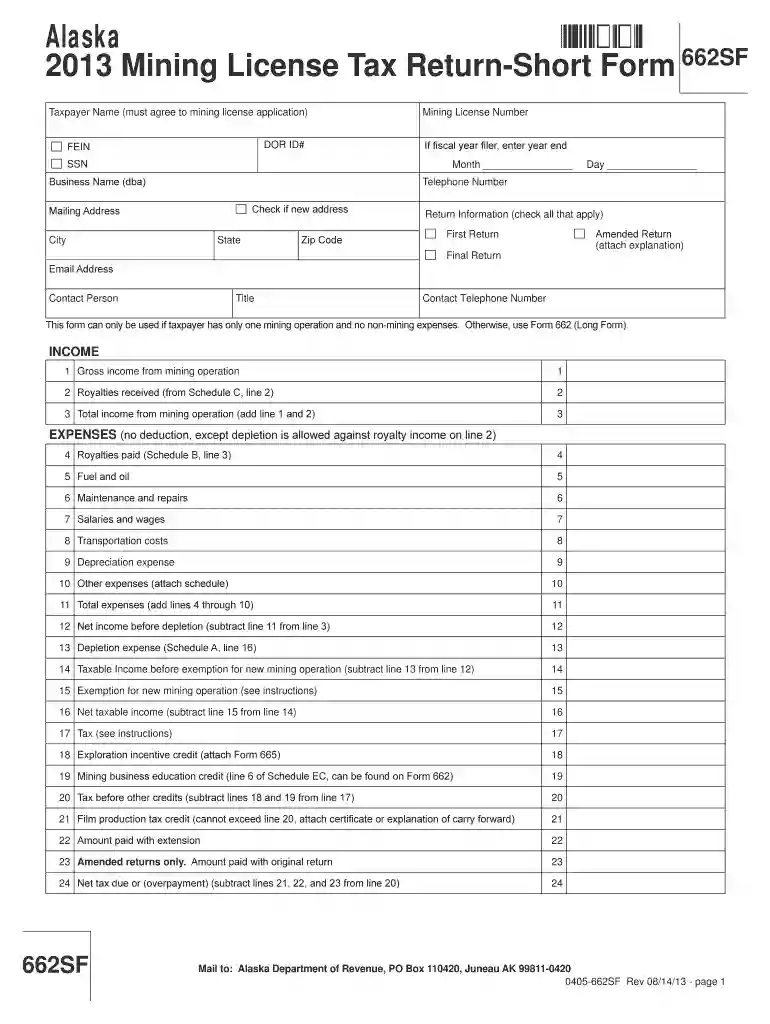
662sf Mining License Tax Return Short Form 2026

Get Form
662sf Mining License Tax Return Short Form Preview on Page 1

Here's how it works

01. Edit your form online
Type text, add images, blackout confidential details, add comments, highlights and more.

02. Sign it in a few clicks
Draw your signature, type it, upload its image, or use your mobile device as a signature pad.

03. Share your form with others
Send it via email, link, or fax. You can also download it, export it or print it out.

Definition & Meaning

The 662SF Mining License Tax Return Short Form is a specialized document used by miners in Alaska to report their income and calculate taxes attributable to their mining operations. This particular form is intended for those managing a single mining operation without any non-mining expenses. By completing this form, taxpayers detail their income from mining activities and any allowable deductions, ensuring they meet state tax obligations.

Key Elements of the 662SF

  • Mining Income: Report all revenues from mining activities.
  • Allowable Deductions: Include any deductions specific to mining operations, such as equipment depreciation.
  • Depletion Calculations: Document the reduction in the value of natural resources as they are mined.
  • Royalties: List any amounts paid or received as royalties which affect taxable income.

How to Use the 662SF Mining License Tax Return Short Form

Using the 662SF form involves compiling financial data relevant to a single mining operation. Users must:

  1. Gather financial statements detailing income and expenses specific to mining.
  2. Calculate deductible expenses and potential depletion to adjust taxable income.
  3. Accurately document all applicable royalties.

Step-by-Step Process

  1. Gather Documentation: Collect all financial records for the reporting period, including invoices, receipts, and contracts related to mining.
  2. Fill Out Income Section: Enter total income from mining operations.
  3. Calculate Deductions: Determine and enter eligible deductions such as labor, equipment costs, and operational expenses.
  4. Complete Depletion Section: Accurately calculate and document depletion costs, reflecting resource usage.
  5. Review & Submit: Double-check entries for accuracy, then submit the form per state guidelines.

Important Terms Related to 662SF Mining License Tax Return Short Form

Understanding specific terminology is crucial for accurately completing the 662SF form:

  • Depletion: Financial acknowledgment of resource exhaustion.
  • Royalties: Payments for the right to extract and sell minerals.
  • Deductions: Allowable expenses reducing taxable income.

Depletion Context

  • Explicit Costs: Directly attributable to extraction, such as equipment depreciation.
  • Implicit Costs: Indirect expenses, often related to investment returns over the extraction period.

Steps to Complete the 662SF Mining License Tax Return Short Form

For comprehensive form completion, follow these steps:

  1. Read the Instructions: Carefully review the form guidelines.
  2. Enter Personal Information: Fill in taxpayer identification details.
  3. Report Income: Detail all forms and sources of mining income.
  4. Document Expenses: Accurately list all deductions.
  5. Calculate Taxes: Use the provided tables to compute total tax liability.
  6. Verify Information: Ensure all fields are complete and correct.
  7. Submit the Form: Follow submission procedures, keeping a copy for records.

Who Typically Uses the 662SF Mining License Tax Return Short Form

The 662SF form is typically used by:

  • Small-Scale Miners: Operators of single mining ventures without supplementary income streams.
  • Individuals or Businesses: Sole operators or entities managing a singular, stand-alone mining site in Alaska.
decoration image ratings of Dochub

Examples of Usage

  • Independent Mining Contractors: Those solely working on contracted mining projects.
  • Small Family-Owned Mines: Operations with straightforward financials focused on a singular resource type.

Filing Deadlines / Important Dates

Compliance with submission deadlines is important:

  • Annual Deadline: Typically due by the 15th day of the fourth month following the taxable year's end.
  • Extension Application: Allowed in certain situations, requiring a formal request to avoid penalties.

Critical Timing Considerations

  • Fiscal Year Alignment: Some businesses may need to adjust reporting periods based on operational timelines.
  • State Extensions: Specific conditions permitting deadline extensions may vary, requiring careful review.

Required Documents

Essential documents for completing the 662SF include:

  • Income Statements: Detailed records of revenues specific to mining activities.
  • Expense Receipts: Proof of costs incurred, such as equipment purchase invoices.
  • Royalty Contracts: Agreements outlining payments for extracted resources.

Document Preparation Tips

  • Accuracy: Ensure all financial records are current and reflect true income and expenses.
  • Organization: Keep documents neatly filed for ease of access during form completion and review processes.

Penalties for Non-Compliance

Non-compliance with filing requirements can lead to various penalties, including:

  • Late Fees: Charges applied to overdue submissions.
  • Interest Accrual: Additional costs accruing on unpaid taxes.
  • Legal Action: Possible legal proceedings for continued non-compliance.

Avoidance Strategies

  • Timely Filing: Ensure all documentation is submitted by deadlines.
  • Professional Assistance: Consider tax professionals for verification and accurate filing assistance.

See more 662sf Mining License Tax Return Short Form versions

We've got more versions of the 662sf Mining License Tax Return Short Form form. Select the right 662sf Mining License Tax Return Short Form version from the list and start editing it straight away!
Versions Form popularity Fillable & printable
2022 4.9 Satisfied (26 Votes)
2017 4.8 Satisfied (143 Votes)
2015 4.3 Satisfied (166 Votes)
2013 4.4 Satisfied (236 Votes)
be ready to get more

Complete this form in 5 minutes or less

Get form

Got questions?

We have answers to the most popular questions from our customers. If you can't find an answer to your question, please contact us.
Contact us
The 1040EZ is a simplified form used by the IRS for income taxpayers that do not require the complexity of the full 1040 tax form. Simply select your tax filing status and enter a few other details to estimate your total taxes.
A Schedule K-1 is a federal tax form that pass through entities like partnerships and S corporations and sometimes trusts and estates send to their partners, shareholders, or beneficiaries. The form reports the income, losses, and gains passed to each party with an interest in the entity.
Normally, on a standard L tax code, youd simply have your tax-free Personal Allowance reduced to account for the extra tax you owe. However, if you owe enough this way to use up your entire Personal Allowance, youll be given a K tax code instead for the extra.
Schedule K-1 is a federal tax document used to report the income, losses, and dividends for a business or financial entitys partners or an S corporations shareholders. The K-1 form is also used to report income distributions from trusts and estates to beneficiaries.
K-1: Used to report income, losses, deductions, and credits for partners in a partnership, shareholders in an S corporation, and beneficiaries of trusts and estates. 1099: Used to report various types of non-employment income, such as interest, dividends, and payments to independent contractors.

Security and compliance

At DocHub, your data security is our priority. We follow HIPAA, SOC2, GDPR, and other standards, so you can work on your documents with confidence.

Learn more
ccpa2
pci-dss
gdpr-compliance
hipaa
soc-compliance

People also ask

The most common of these forms are: Form W-2. Its filled out by your employer to document your earnings for the calendar year. This tax form supplies you with some of the most important information youll need when you fill out your 1040 including the wages you earned and the taxes your employer withheld.

Related links