




01. Edit your form online
Type text, add images, blackout confidential details, add comments, highlights and more.

Type text, add images, blackout confidential details, add comments, highlights and more.

Draw your signature, type it, upload its image, or use your mobile device as a signature pad.

Send it via email, link, or fax. You can also download it, export it or print it out.
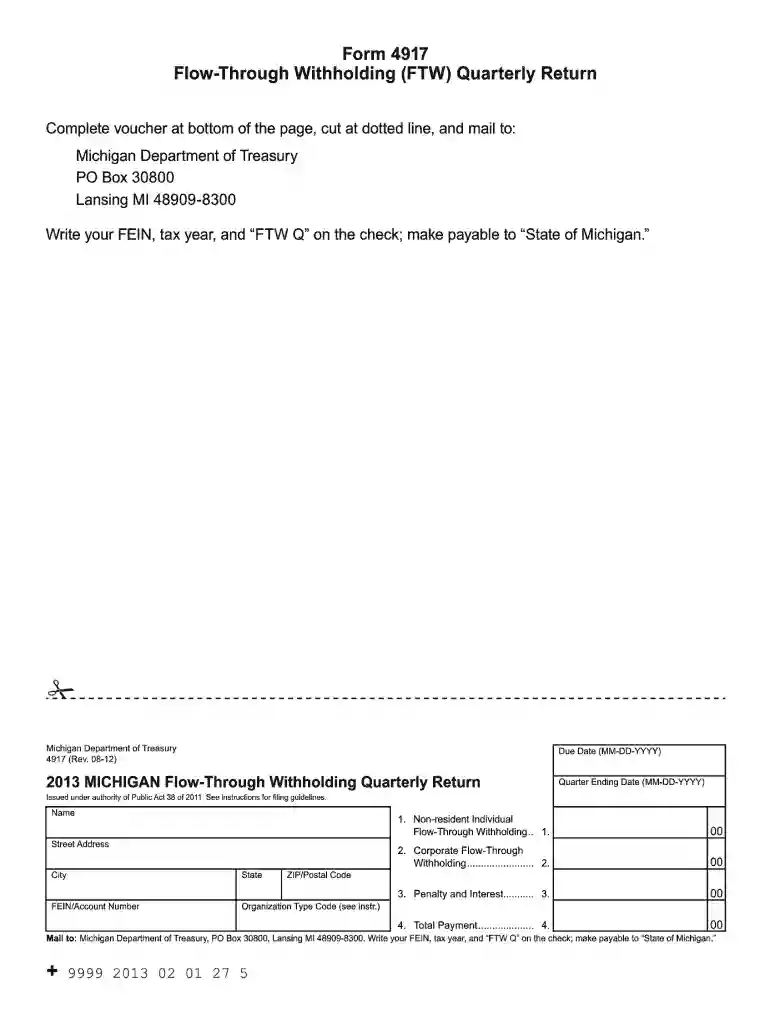
The 2013 Michigan form return refers to the necessary state tax documents required by Michigan for filing tax returns in the tax year 2013. This form addresses income reporting, deductions, and tax credits specific to Michigan residents, as well as non-residents who earned income within the state. Utilizing this form ensures compliance with Michigan tax laws for that particular year. Understanding how this form fits into your tax filings is crucial, especially if there were changes to your taxable income or deductions during 2013. It serves as a detailed record of financial activities pertinent to Michigan's tax obligations for the specified year.
To access the 2013 Michigan form return, visit the official Michigan Department of Treasury website where historical forms are archived. Alternatively, request a copy by contacting the department via phone or mail to receive physical copies. Many tax software packages, like TurboTax, also provide downloads for past year forms, including the 2013 iteration. This flexibility allows you to choose the most convenient method for procuring the necessary documentation.
For the 2013 Michigan form return, the original filing deadline was April 15, 2014. It's pertinent for taxpayers who missed the initial due date to file as soon as possible to avoid penalties. Extensions were available but required submission before the original deadline. For outstanding payments, interest accrues if payment was not made by this date, highlighting the importance of timely compliance.
Michigan tax laws in 2013 included a flat state income tax rate with specific allowances for personal exemptions and unique deductions. It was essential to account for Michigan-specific tax credits, such as the Homestead Property Tax Credit or the City Income Tax Credit. Compliance requires familiarity with these rules to maximize potential refunds and minimize tax liabilities.
Failure to file the 2013 Michigan form return results in significant penalties. These include late filing and payment penalties, which are assessed monthly. The Michigan Department of Treasury calculates penalties based on the unpaid tax amount, compounding these costs over time. Thus, any delay in submission or payment should be addressed promptly to minimize financial repercussions.
Filing the 2013 Michigan form return necessitates documentation that includes:
Software like QuickBooks and TurboTax are compatible with the 2013 Michigan form return, simplifying the filing process with guided inputs and calculations. Using such software not only ensures accuracy but also speeds up data entry and submission. These platforms often have dedicated support for historical tax year forms, making them a practical choice for managing past tax obligations.
Example scenarios include individuals relocating to Michigan and non-residents with income from Michigan sources. For these groups, correct use of the form ensures the appropriate taxation based on residency status, income type, and allowable deductions. Businesses, too, can refer to their quarterly filings and profit data to complete their state return, aligning records with overall financial activities for the fiscal year 2013.
We've got more versions of the 2013 michigan form return form. Select the right 2013 michigan form return version from the list and start editing it straight away!
At DocHub, your data security is our priority. We follow HIPAA, SOC2, GDPR, and other standards, so you can work on your documents with confidence.
To get a copy of the Form W-2 or Form 1099 filed with your return, you must use Form 4506 and request a copy of your return, which includes all attachments.
Sep 16, 2013 Tax Return, with an attached Form. 8941, is the first year of the two be available by September 30, 2013. The website for information returns


