




01. Edit your form online
Type text, add images, blackout confidential details, add comments, highlights and more.

Type text, add images, blackout confidential details, add comments, highlights and more.

Draw your signature, type it, upload its image, or use your mobile device as a signature pad.

Send it via email, link, or fax. You can also download it, export it or print it out.
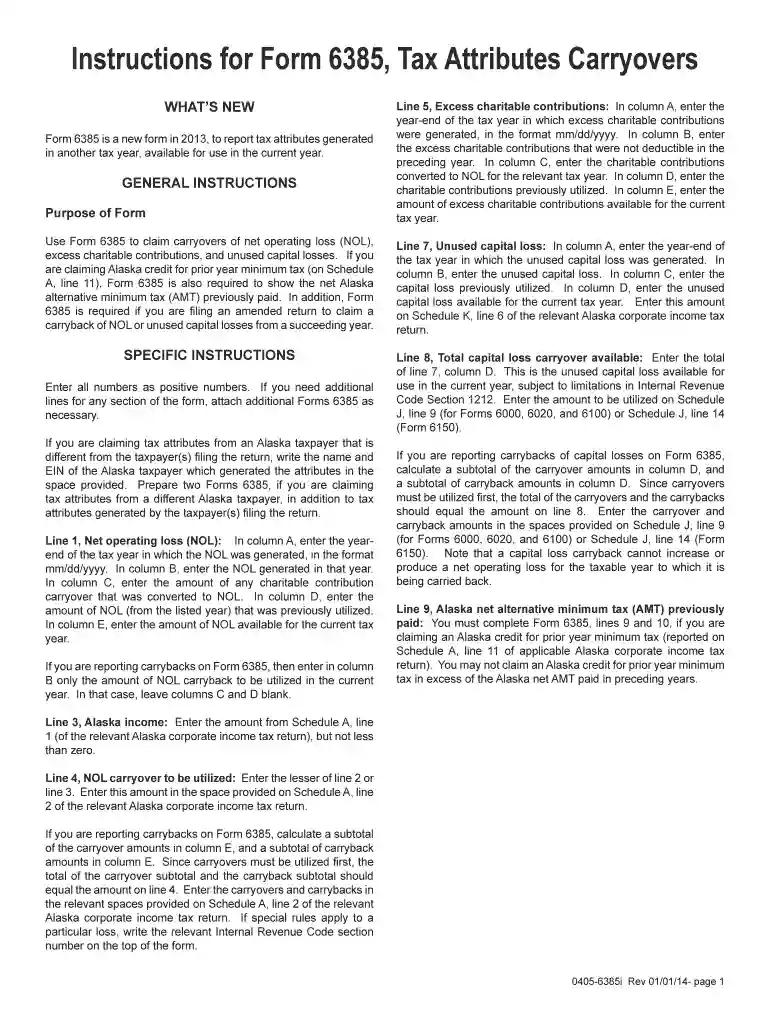
Form 6385, Tax Attributes Carryovers - Alaska, is a critical document for reporting and claiming various carryovers such as net operating losses (NOL), excess charitable contributions, and unused capital losses for Alaska corporate income tax purposes. This form is essential for businesses and corporations in Alaska, allowing them to manage and optimize their tax obligations. By accurately completing this form, businesses ensure compliance with Alaska's tax laws and optimize potential credits for prior-year minimum taxes.
The instructions for Form 6385 provide a step-by-step guide to properly completing the form, ensuring compliance with Alaska's tax laws.
Consider a business with excess charitable contributions from the last fiscal year. By using Form 6385, the business can report these on the current tax return, reducing the current taxable income and potentially decreasing tax liabilities.
Completing Form 6385 involves multiple detailed steps to ensure accuracy and compliance.
A software development company experienced a significant loss due to a failed product launch. Utilizing Form 6385, the company can report the NOL from that event, applying it to future profitable years to reduce tax obligations.
Understanding the key elements of the instructions can streamline the completion process and enhance accuracy.
Alaska has distinct tax rules that must be followed for proper completion of Form 6385.
A marketing agency, initially operating at a loss, can apply these losses to successive years where profits were realized, thus minimizing taxable income and reinvesting savings into business growth.
Adhering to the due dates for Form 6385 is crucial for avoiding penalties and ensuring credits are applied efficiently.
Collecting the necessary documents ensures accurate reporting on Form 6385.
Ensure all documents are organized and labeled efficiently before submission, whether through electronic or traditional methods, to avoid processing delays.
Submitting an inaccurate Form 6385 can lead to significant penalties.
We've got more versions of the Instructions for Form 6385, Tax Attributes Carryovers - Alaska form. Select the right Instructions for Form 6385, Tax Attributes Carryovers - Alaska version from the list and start editing it straight away!
At DocHub, your data security is our priority. We follow HIPAA, SOC2, GDPR, and other standards, so you can work on your documents with confidence.
10a b Charitable contributions if you take the standard deduction. See instructions 10b c Add lines 10a and 10b. These are your total adjustments to income . .
Dec 21, 2021 Have additional income, such as business or farm income or loss, unemployment compensation, prize or award money, or gambling winnings. Have any


