- tax alaska 2026

Get Form
- tax alaska Preview on Page 1

Here's how it works

01. Edit your form online
Type text, add images, blackout confidential details, add comments, highlights and more.

02. Sign it in a few clicks
Draw your signature, type it, upload its image, or use your mobile device as a signature pad.

03. Share your form with others
Send it via email, link, or fax. You can also download it, export it or print it out.

How to use or fill out - tax alaska with our platform

Form edit decoration
9.5
Ease of Setup
DocHub User Ratings on G2
9.0
Ease of Use
DocHub User Ratings on G2
  1. Click ‘Get Form’ to open it in the editor.
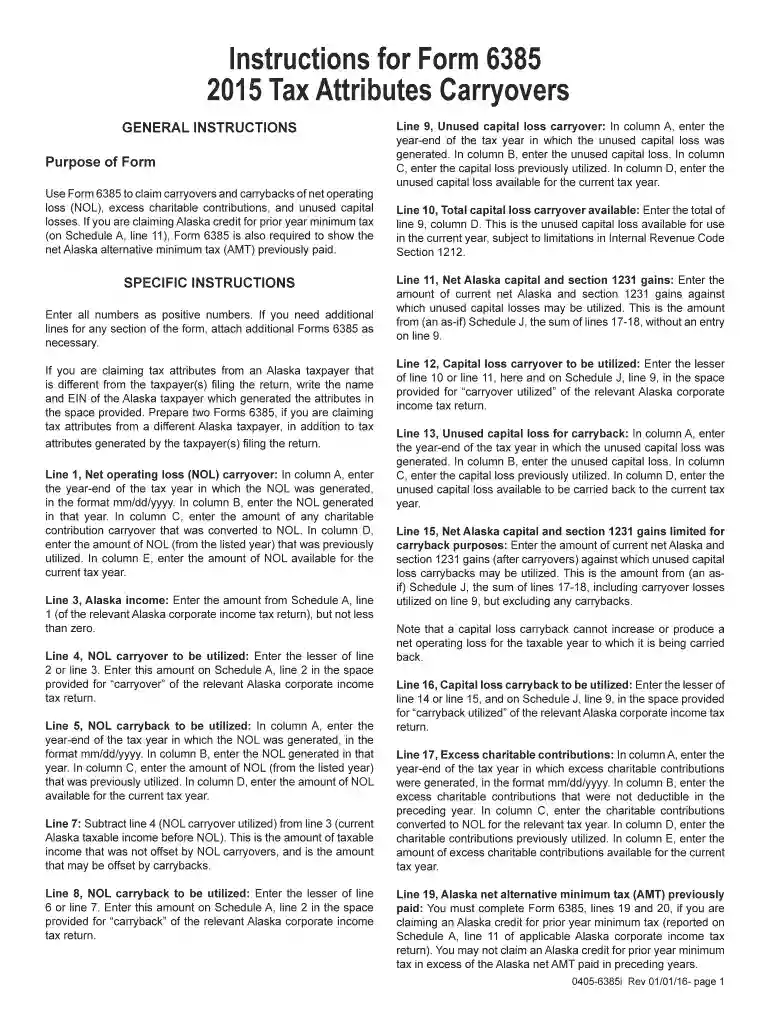
  2. Begin with Line 1, where you will enter the year-end of the tax year for your Net Operating Loss (NOL) in column A. Ensure the date is formatted as mm/dd/yyyy.
  3. In column B, input the NOL generated for that year. Column C is for any charitable contribution carryover converted to NOL, while column D should reflect any previously utilized NOL.
  4. For Line 3, enter your Alaska income from Schedule A, ensuring it is not less than zero.
  5. Proceed to Line 4 and enter the lesser amount between line 2 and line 3. This figure will be used on Schedule A under 'carryover'.
  6. Continue filling out subsequent lines by following similar instructions for each section, ensuring all entries are positive numbers and accurately reflect your tax attributes.

Start using our platform today to simplify your tax form completion process!

See more - tax alaska versions

We've got more versions of the - tax alaska form. Select the right - tax alaska version from the list and start editing it straight away!
Versions Form popularity Fillable & printable
2022 4.7 Satisfied (46 Votes)
2019 4.8 Satisfied (125 Votes)
2017 4.1 Satisfied (43 Votes)
2015 4.4 Satisfied (163 Votes)
2014 4 Satisfied (47 Votes)
be ready to get more

Complete this form in 5 minutes or less

Get form

Got questions?

We have answers to the most popular questions from our customers. If you can't find an answer to your question, please contact us.
Contact us
Alaska does not have a state sales tax but has an average combined state and local sales tax rate of 1.82 percent. Alaska has a 1.07 percent effective property tax rate on owner-occupied housing value.
While Alaska doesnt impose a state income tax, most residents still need to file federal income taxes. Its also important to consider property and sales taxes, which can impact your financial planning.
Alaska does not have a state sales tax but has an average combined state and local sales tax rate of 1.82 percent. Alaska has a 1.07 percent effective property tax rate on owner-occupied housing value. Alaska does not have an estate tax or inheritance tax.
With the pipeline, the petroleum industry boomed, increasing economic activity in the state. In subsequent years, Alaska was able to compensate for individual income tax revenue losses through growth in its severance tax and royalties from petroleum. These taxes amounted to 47 percent of state revenue in 2022.
Alaska has the lowest taxes in the country. There are no statewide income or sales taxes, but residents do still pay some local sales taxes. There are also property taxes that are above the national median.
be ready to get more

Complete this form in 5 minutes or less

Get form

People also ask

What is the average salary in United States of America? If you make $100,000 a year living in the region of Alaska, United States of America, you will be taxed $22,671. That means that your net pay will be $77,329 per year, or $6,444 per month. Your average tax rate is 22.7% and your marginal tax rate is 31.2%.
If you make $100,000 a year living in the region of Alaska, United States of America, you will be taxed $22,671. That means that your net pay will be $77,329 per year, or $6,444 per month.
There is no state sales tax in Alaska; however, local governments which include boroughs, the Alaska equivalent of counties, and municipalities may levy up a sales tax. Municipal sales taxes are collected in addition to borough sales taxes, if any. Regulations and exemptions vary widely across the state.

Related links