






Definition and Meaning
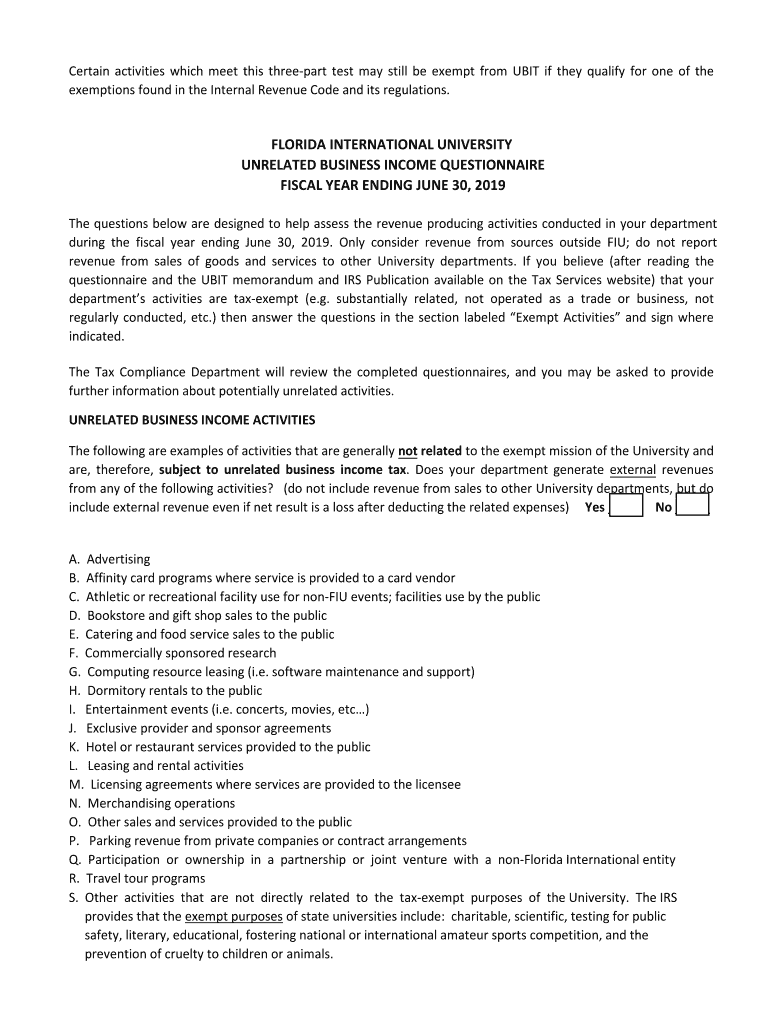
The overview of the unrelated business income tax (UBIT) at FIU, managed by the Office of Tax Compliance, refers to a process designed to identify and assess income-generating activities unrelated to the core mission of Florida International University. The purpose is to comply with IRS regulations, determining whether specific operations require tax reporting due to their commercial nature. FIU uses this assessment to ensure that any income from such activities is accurately reported and taxed accordingly, maintaining alignment with federal tax laws.
IRS Guidelines
IRS guidelines on unrelated business income tax stipulate that income from activities not substantially related to an organization’s exempt purpose must be reported and taxed. An institution like FIU must conduct regular reviews of all income-generating activities to distinguish between related and unrelated income. According to IRS criteria, an activity is considered unrelated if it is a trade or business, regularly carried on, and not substantially related to the organization's exempt purpose of education, research, and public service.
Examples of Unrelated Income
- Running a retail store on campus targeting the general public.
- Operating a restaurant or cafe that serves more than just the student body or staff.
- Providing consultancy services outside of the university's educational framework.
How to Use the Overview of the Unrelated Business Income Tax at FIU
The overview is utilized by university department heads and budget managers to evaluate potential unrelated business activities. They are required to complete and submit a questionnaire each fiscal year to indicate ongoing activities and newly initiated projects. This form aims to preempt any potential tax liabilities by identifying income streams early and ensuring compliance with IRS obligations.
Step-by-Step Process
-
Review IRS Criteria: Understand what qualifies as unrelated income according to federal guidelines.
-
Complete Questionnaire: Fill out the form provided by FIU, detailing all potentially unrelated activities.
-
Submit to Office: Send the completed form to the FIU Office of Tax Compliance for review and further assessment.
Key Elements of the Overview
Identification of Income Sources
- Clearly list all income sources not central to the university’s educational mission.
- Differentiate between routine and occasional activities to avoid misclassification.
Purpose and Scope
- Define the business objectives and scope of each activity.
- Explain how these activities align or do not align with FIU’s central mission.
Steps to Complete the Overview of the Unrelated Business Income Tax at FIU
-
Gather Necessary Information: Collect financial data and activity descriptions for all departments.
-
Identify Potentially Unrelated Activities: Screen all income-producing ventures to distinguish unrelated undertakings.
-
Complete the FIU Questionnaire: Provide detailed responses to every section of the form, ensuring transparency in reporting.
-
Submit for Compliance Review: Once completed, forward the questionnaire to the Office of Tax Compliance for a compliance assessment.
Who Typically Uses the Overview of the Unrelated Business Income Tax at FIU
The form is primarily completed by department heads, budget managers, and other administrative staff involved in financial planning and management within the university. These individuals are responsible for ensuring all department activities adhere to both educational goals and tax regulations.


Role of the Office of Tax Compliance
- Analyze submitted forms to classify income accurately.
- Provide guidance on potential tax liabilities arising from unrelated incomes.
- Ensure all reported activities are in line with IRS requirements.
Penalties for Non-Compliance
Failing to identify and report unrelated business income can result in significant penalties, including fines and increased scrutiny from the IRS. This can also lead to complications in future financial audits or reviews by federal entities, potentially affecting FIU’s exempt status.
Common Triggers for Penalties
- Incomplete or inaccurate reporting of income-generating activities.
- Delayed submission of the assessment questionnaire.
- Deviation from IRS guidelines in categorizing activities.
Business Entity Types Affected
While the primary focus is on the university's compliance, the principles of unrelated business income tax also apply to various business entity types associated with or operating in partnership with the university. These can include:
- LLCs engaged through the university for auxiliary services.
- Corporations that engage in joint ventures with FIU.
- Partnerships with external entities to run specific business models.
Each entity type must ensure independent compliance monitoring to avoid overlapping issues with tax assessments specific to nonprofit organizations.