







Definition & Meaning
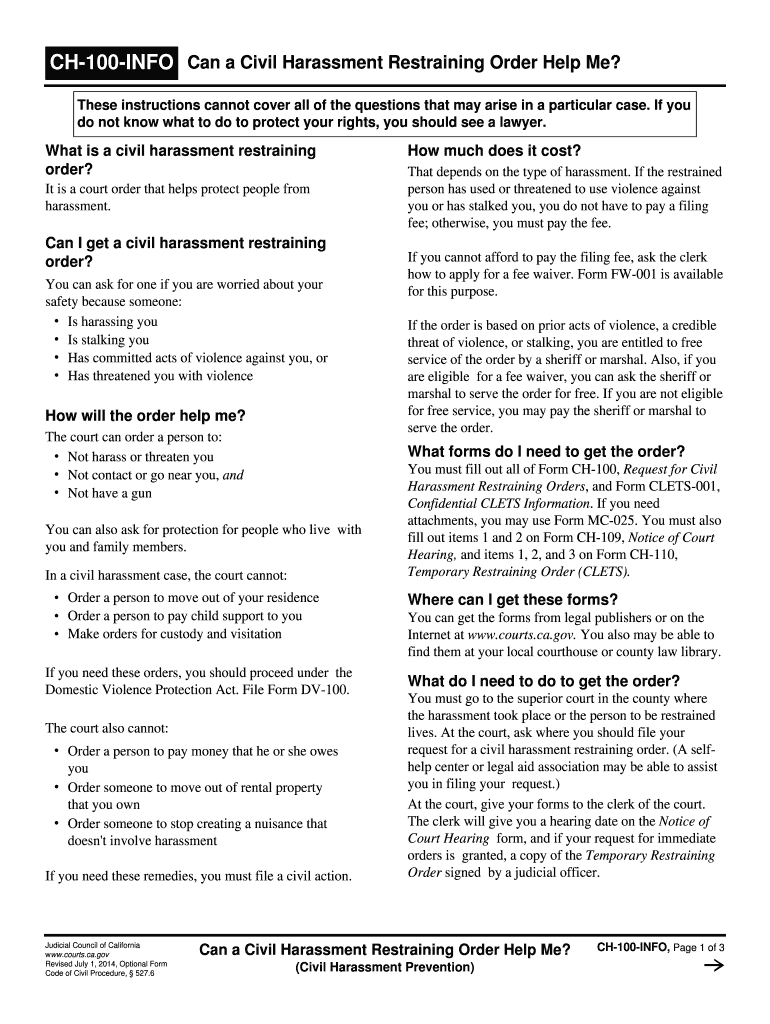
A Civil Harassment Restraining Order is a legal order issued by a court to protect individuals from harassment, stalking, or violent behaviors. It serves as a preventive measure, ensuring the safety of individuals who are threatened or feel at risk. This type of order is significant within the realm of civil harassment prevention and reflects the judiciary's role in maintaining personal safety.
Key Components
- Harassment: Includes actions like threats, stalking, or any behavior that causes fear or substantial emotional distress.
- Protection: Offers legal protection from physical harm or ongoing harassment by barring the harasser from contacting or approaching the victim.
- Enforcement: Failure to comply with the order can lead to legal consequences.
How to Use the CH-100-INFO Form
The CH-100-INFO form acts as guidance on whether a civil harassment restraining order applies to you. It details eligibility and the process of obtaining such an order, serving as a preliminary step in understanding what protections are available.
Strategic Use
- Identification of Threats: Helps in recognizing behaviors that qualify as harassment.
- Guidance: Provides clear steps for the next stages, including filing and court procedures.
- Preparation: Aids in preparing necessary documentation to strengthen your request.
Eligibility Criteria
To qualify for a civil harassment restraining order, specific conditions must be met. These criteria ensure that only appropriate cases proceed, maintaining judicial efficiency and fairness.


Common Requirements
- Relationship with the Harasser: Unlike domestic violence orders, civil harassment restraining orders do not require a specific relationship between the parties.
- Nature of Harassment: Includes a pattern of harassment or violence. Mere disagreements or personality conflicts typically do not suffice.
- Documented Evidence: Proof of harassment, such as witness statements or recordings, can significantly aid in the approval process.
Steps to Complete the CH-100-INFO Form
Completing the CH-100-INFO form involves a systematic approach to ensure accuracy and completeness. Here is a detailed step-by-step process:
- Gather Personal Information: Start with basic information, including your name, address, and contact information.
- Describe the Incidents: Clearly outline the incidents of harassment, providing dates, locations, and descriptions.
- Collect Supporting Documentation: Gather any evidence that supports your claims, such as photographs, messages, or witness statements.
- Follow Court Instructions: Adhere to any specific guidelines provided by the court, ensuring all required fields are completed.
- Review: Double-check for accuracy and completeness before submission.
Legal Use of the CH-100-INFO Form
The form is used within legal boundaries to support the filing for a restraining order. It aligns with state regulations and ensures all judicial protocols are respected during the process.
Legal Considerations
- Admissibility: Ensures the information presented is acceptable to the court.
- Confidentiality: Protects the privacy of individuals involved, often sealing sensitive information from public records.
- Relevance: Each section must provide relevant details that support the need for protective measures.
Important Terms Related to CH-100-INFO Form
Familiarizing yourself with the terminology involved in this process can enhance your understanding of the procedures and expectations.
Terms to Know
- Petitioner: The individual seeking the restraining order.
- Respondent: The individual against whom the order is sought.
- Temporary Restraining Order (TRO): A short-term measure offering immediate protection until a full hearing can be conducted.
State-Specific Rules
Civil harassment restraining orders can vary by state, affecting eligibility, process, and enforcement. Awareness of these differences ensures compliance and accurate application of the intended protections.
Variation Considerations
- Filing Procedures: Some states may require specific forms or additional documentation.
- Court Hearings: Rules about notifications and hearing schedules can differ.
- Enforcement: While the order is a legal directive, enforcement practices can vary by state or even by county.
Examples of Using a Civil Harassment Restraining Order
Understanding real-world applications can reinforce how such orders function in practical settings, shedding light on their value in specific contexts.
Scenarios
- Stalking Situations: An individual who has experienced consistent and unwanted following or communication may seek this order.
- Workplace Harassment: Cases where an employee feels threatened by a non-colleague can benefit from this protective measure.
- Neighborhood Disputes: Individuals experiencing harassment or threats from neighbors outside of regular civil interactions.
Application Process & Approval Time
Receiving a civil harassment restraining order involves a distinct process that varies in duration, depending on the complexity and jurisdiction.
Process Outline
- Initial Filing: Submit the form with required evidence at the appropriate courthouse.
- Temporary Orders: Receive immediate, temporary protection in emergencies.
- Hearing Schedule: A court hearing is set to review the details and determine the need for a long-term order.
- Final Decision: After the hearing, a judge either grants or denies the restraining order based on the evidence provided.




