




01. Edit your form online
Type text, add images, blackout confidential details, add comments, highlights and more.

Type text, add images, blackout confidential details, add comments, highlights and more.

Draw your signature, type it, upload its image, or use your mobile device as a signature pad.

Send it via email, link, or fax. You can also download it, export it or print it out.
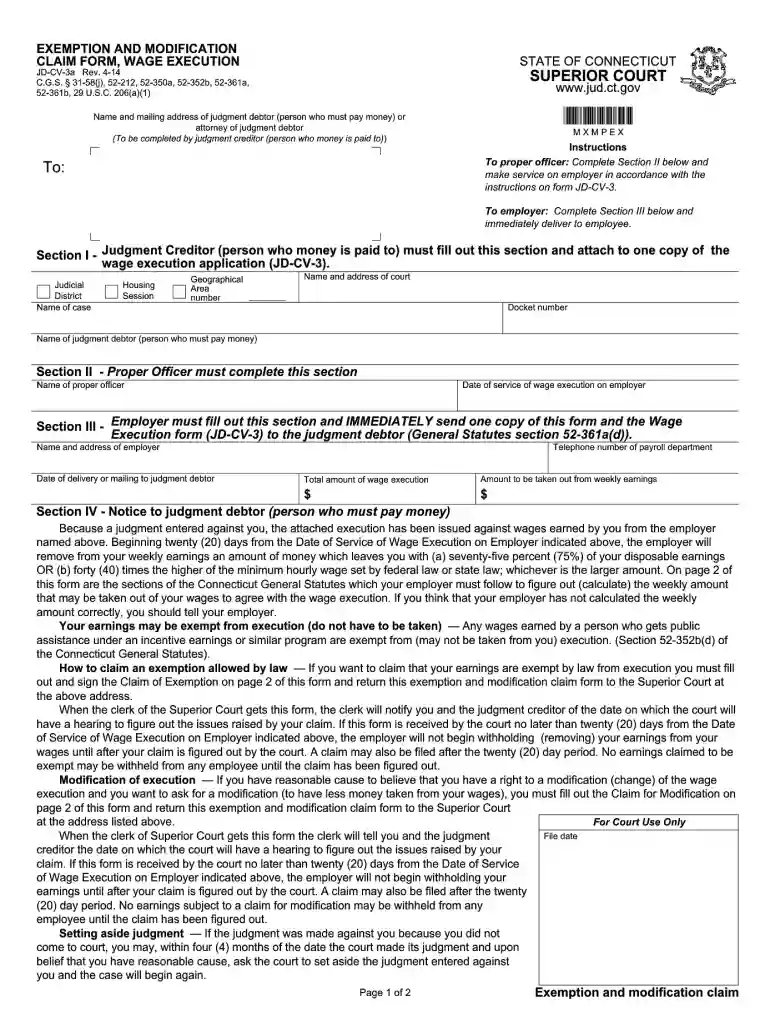
The "JD-CV-3a 2014 Form" serves as a claim form for exemption and modification related to wage execution, specifically used within the legal framework of the State of Connecticut. This form is designed for judgment debtors who need to assert their right to exemptions from wage garnishment or seek adjustments to the amount being withheld from their wages. Through this document, individuals can formally declare their financial circumstances and request relief from the court in accordance with Connecticut's legal statutes.
To effectively utilize the JD-CV-3a 2014 Form, individuals should first gather all pertinent financial documentation that demonstrates eligibility for exemption or modification of wage execution. Once the necessary financial details are assembled, the debtor must fill out the form by providing details such as:
After the form is completed, it should be submitted to the appropriate court or legal body for review. It is important to ensure that all information provided is accurate and supported by documentation to facilitate a favorable outcome.
The JD-CV-3a 2014 Form is accessible through several channels:
It may also be beneficial to consult legal professionals for guidance on obtaining and understanding the form's requirements.
Completing the JD-CV-3a 2014 Form involves several steps:
The primary users of the JD-CV-3a 2014 Form are judgment debtors residing in Connecticut who are facing wage garnishment. These individuals may seek legal relief either by claiming exemptions based on their financial circumstances or requesting that the stipulated amount subject to execution be adjusted. Additionally, legal representatives and financial consultants working on behalf of these debtors may use the form to assist their clients in legal proceedings.


Legally, the JD-CV-3a 2014 Form serves to protect debtors' rights under Connecticut law by providing them with a mechanism to present their financial situation to the court. By filling out this form, judgment debtors can invoke state allowances and exemptions that prevent undue financial hardship due to wage reductions. The legal use of this form ensures that debt collections are conducted fairly, balancing the creditor's rights with the debtor's economic well-being.
Key elements included in the JD-CV-3a 2014 Form consist of:
Understanding these elements is crucial for filling out the form correctly and effectively.
The JD-CV-3a 2014 Form is governed by the legal statutes of Connecticut, which outline specific rules for wage garnishment exemptions and modifications. These rules can include:
Being aware of these state-specific rules ensures that debtors are fully informed and compliant when making claims on the form.
We've got more versions of the jd cv 3a 2014 form form. Select the right jd cv 3a 2014 form version from the list and start editing it straight away!
At DocHub, your data security is our priority. We follow HIPAA, SOC2, GDPR, and other standards, so you can work on your documents with confidence.
Pursuant to this authority, the Department has promulgated regulations governing a schools. Case 3:21-cv-00384-JD Document 25 Filed 04/06/21 Page 8 of 22. Page
by JR Saveri 2020 2014). IV. REMEDIES. A. Joint and Several Liability. Each participant in an agreement, contract, understanding or a conspiracy that
JD-CV-3 - Wage Execution Proceedings Application, Order, Execution. JD-CV-3a - Exemption and Modification Claim Form, Wage Execution. Library of Connecticut


