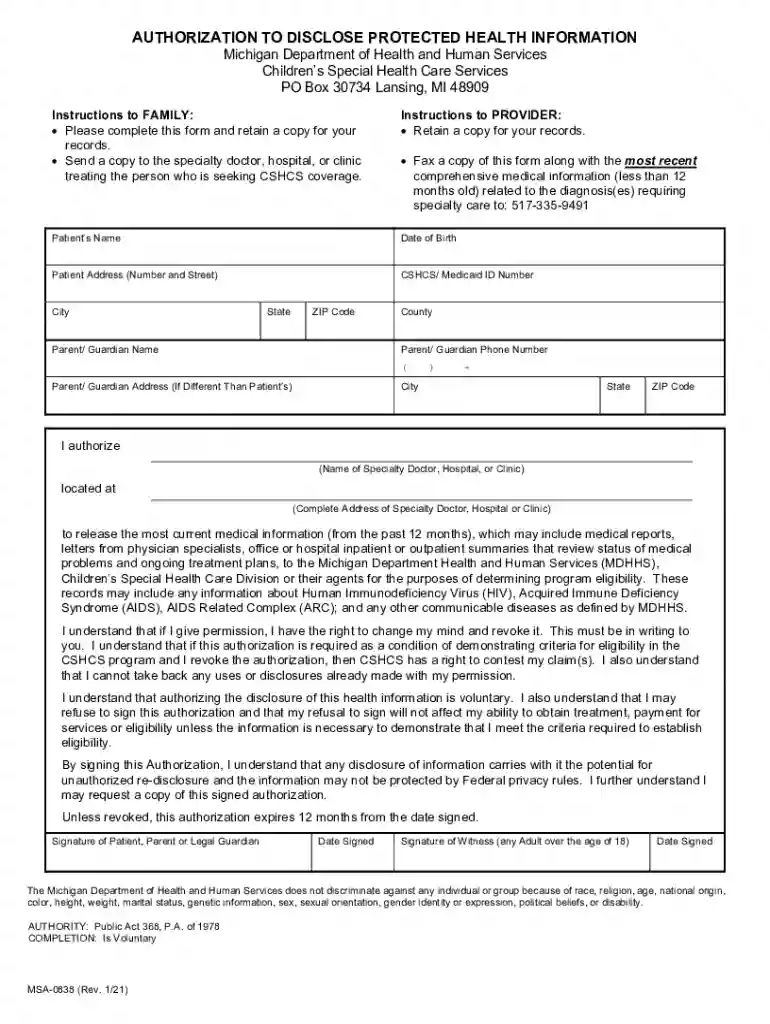
MidState Health Center: Authorization to Release 2026

Get Form
MidState Health Center: Authorization to Release Preview on Page 1

Here's how it works

01. Edit your form online
Type text, add images, blackout confidential details, add comments, highlights and more.

02. Sign it in a few clicks
Draw your signature, type it, upload its image, or use your mobile device as a signature pad.

03. Share your form with others
Send it via email, link, or fax. You can also download it, export it or print it out.

Definition and Meaning of the Authorization to Release

The "MidState Health Center: Authorization to Release" form is a critical document designed to allow the sharing of a patient's protected health information. This authorization is strictly voluntary and gives patients control over who can access their medical details. This form is often necessary for programs like Michigan's Children's Special Health Care Services (CSHCS), where healthcare and family collaboration is essential.

The document ensures that healthcare providers and other involved parties have consent to access and share specific medical information, helping in decision-making processes related to patient care. It also underscores the patient's right to confidentiality and the ability to revoke consent, which provides another layer of control over personal health information.

How to Use the Authorization to Release

Using the "Authorization to Release" form involves understanding its purpose and correctly completing each section. This process starts with identifying the specific information to be disclosed. Patients need to clearly specify which health records they want to share, such as diagnoses, laboratory results, or treatment plans.

  1. Identifying Relevant Parties: Clearly list all individuals or entities authorized to receive the information.
  2. Specifying the Scope: Detail whether the disclosure is a one-time release or recurring over a specified period.
  3. Authorization Period: Set the time frame for which the release is valid to ensure compliance with patient preferences and legal standards.

This careful documentation ensures that only the intended data is shared with the appropriate individuals or organizations.

Steps to Complete the Authorization Form

Completing the "MidState Health Center: Authorization to Release" form can be broken down into several detailed steps, ensuring all necessary information is captured:

  1. Patient Information: Enter the patient's full name, date of birth, and medical record number if applicable.
  2. Recipient Information: Fill in the names and contact details of those who will receive the information.
  3. Information to Be Disclosed: Check applicable boxes or describe the specific data to be released.
  4. Purpose of Disclosure: Explain the reason for sharing information, such as for medical treatment or insurance claims.
  5. Expiration Date: Specify when the authorization will expire, which helps limit the duration of data sharing.
  6. Signature and Date: The patient or legal guardian signs and dates the form, providing consent for the release.

This structured approach ensures accuracy and completeness, avoiding potential delays in healthcare delivery or administrative processing.

Key Elements of the Authorization to Release

The form contains several essential components that must be understood and executed properly:

  • Patient Consent: This is the foundational element where the patient authorizes the information disclosure.
  • Detailed Information Listing: A clear specification of the types of information that can be disclosed.
  • Recipient Details: Accurate details of who will receive the information help in safeguarding against unauthorized disclosures.
  • Purpose Specification: This clause clarifies why information is shared, aligning with legal and ethical guidelines.

Understanding these elements ensures users can fill out the form accurately and efficiently, adhering to legal and ethical standards.

Legal Use of the Authorization to Release

This form's legal foundation is established under health privacy regulations, such as the Health Insurance Portability and Accountability Act (HIPAA). The form must be completed in full compliance with these laws to prevent unauthorized sharing of health data.

The legal use involves ensuring informed consent, where the patient is fully aware of what data is shared, with whom, and for what purpose. Understanding these aspects ensures that the patient’s privacy is respected and protected throughout the process.

Examples and Scenarios of Using the Authorization

The "Authorization to Release" form is often used in diverse real-world scenarios:

  • Insurance Claims: Patients authorize insurers to access their medical records for claims processing.
  • Medical Referrals: A primary care doctor might share specific health information with a specialist for further treatment.
  • Family Consultations: Legal guardians might permit schools to access health data for children needing special care services, such as Michigan's CSHCS program.

By illustrating these examples, it becomes evident how crucial proper authorization and data sharing are in facilitating seamless healthcare delivery.

Important Terms Related to the Authorization

When handling the "Authorization to Release" form, several terms are pertinent for thorough understanding:

  • Protected Health Information (PHI): Refers to any data about health status, provision of healthcare, or payment for healthcare that can be linked to a specific individual.
  • Consent: The patient's authorization for data sharing, which must be informed, specific, and documented.
  • Revocation: The patient’s right to withdraw the authorization at any time, reinforcing control over personal health information.

A strong grasp of these terms ensures clear communication and adherence to the standards outlined in healthcare information management.

State-Specific Rules for the Authorization Form

While this form follows federal guidelines, specific state regulations might alter some procedures or requirements:

  • State Privacy Laws: Some states mandate additional patient rights or levels of information protection beyond federal regulations.
  • Child Health Programs: States like Michigan may have unique stipulations for forms used in programs like CSHCS.

Understanding state-specific rules helps ensure compliance with all legal requirements, reducing the risk of information breaches and ensuring data is handled lawfully.

See more MidState Health Center: Authorization to Release versions

We've got more versions of the MidState Health Center: Authorization to Release form. Select the right MidState Health Center: Authorization to Release version from the list and start editing it straight away!
Versions Form popularity Fillable & printable
2021 4.8 Satisfied (78 Votes)
2008 4 Satisfied (47 Votes)
be ready to get more

Complete this form in 5 minutes or less

Get form

Got questions?

We have answers to the most popular questions from our customers. If you can't find an answer to your question, please contact us.
Contact us
Begin by specifying your name, the entity authorized to disclose information, and the individuals or entities you authorize to receive it. Indicate the specific information and purpose for which it will be disclosed, add an expiration date or event, and sign and date the form to confirm your consent.
A consent to release medical information form will typically be requested when someone wants a copy of their own medical records or would like to have them sent to a third party. The request is made to the healthcare provider, therapist, or organization that has the patients records.
It is permissible to release a patients medical record when a court issues a subpoena, to EMTs in emergencies as per EMTALA, between healthcare providers for continuity of care, and for workers compensation claims with proper legal requirements and patient consent, all while adhering to HIPAA regulations.
If a HIPAA Authorization Form lacks the core elements or required statements, if it is difficult for the individual to understand, or if it is completed incorrectly, the authorization will be invalid and any subsequent use or disclosure of PHI made on the reliance of the authorization will be impermissible.
Under the CMIA, medical information must be released when compelled: by court order. by a board, commission or administrative agency for purposes of adjudication.

Security and compliance

At DocHub, your data security is our priority. We follow HIPAA, SOC2, GDPR, and other standards, so you can work on your documents with confidence.

Learn more
ccpa2
pci-dss
gdpr-compliance
hipaa
soc-compliance