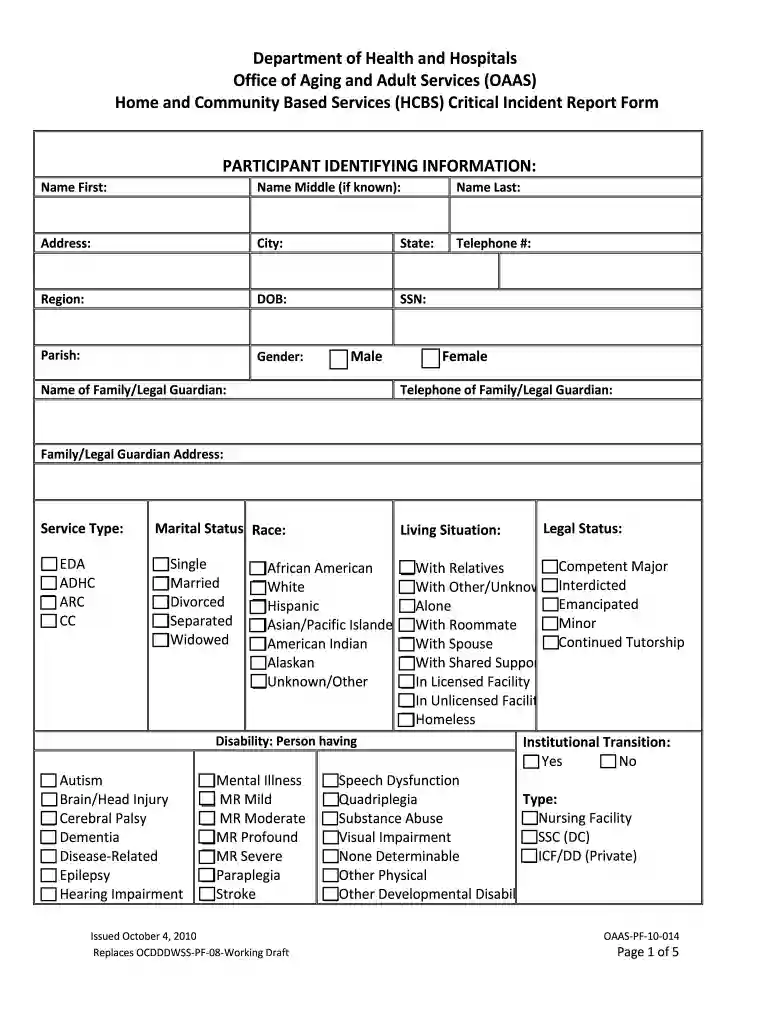
Critical Incident Report Form - Louisiana Department of Health and - dhh state la 2026

Get Form
Critical Incident Report Form - Louisiana Department of Health and - dhh state la Preview on Page 1

Here's how it works

01. Edit your form online
Type text, add images, blackout confidential details, add comments, highlights and more.

02. Sign it in a few clicks
Draw your signature, type it, upload its image, or use your mobile device as a signature pad.

03. Share your form with others
Send it via email, link, or fax. You can also download it, export it or print it out.

Definition and Purpose of the Critical Incident Report Form

The Critical Incident Report Form is a vital document used by the Office of Aging and Adult Services (OAAS) under the Louisiana Department of Health. It is specifically designed to document and report incidents involving participants in Home and Community-Based Services (HCBS). This form plays a crucial role in ensuring the safety and well-being of these participants by categorizing incidents like abuse, neglect, and exploitation, as well as detailing event information and necessary follow-up actions.

Key Functions of the Form

  • Incident Documentation: Captures detailed accounts of what transpired during critical incidents, providing a clear narrative of the events.
  • Notification Tool: Alerts relevant authorities and stakeholders about incidents that require attention and follow-up.
  • Data Collection for Improvement: Facilitates data gathering that can contribute to improving safety protocols and participant care within HCBS.

Steps to Complete the Critical Incident Report Form

Filling out the Critical Incident Report Form correctly is essential for efficient and effective reporting. Below are the steps to correctly complete the form, ensuring that all necessary information is accurately captured.

Step-by-Step Process

  1. Participant Information: Start by entering the participant’s full name, age, and contact details. This section ensures that the incident is correctly attributed to the affected individual.
  2. Incident Details: Provide a thorough description of the incident, including the date, time, location, and parties involved. Be as specific as possible to provide a clear context.
  3. Incident Categories: Select relevant categories that best describe the nature of the incident, such as abuse, neglect, or exploitation.
  4. Event Information: Discuss the sequence of events leading up to and during the incident. Detailed accounts help clarify the facts and circumstances.
  5. Follow-Up Actions: Record any immediate actions taken in response to the incident and propose further measures to prevent recurrence.
  6. Reporting Authority Information: Include the names and contact details of the personnel completing the form as well as the supervisor responsible for its oversight.

Key Elements of the Critical Incident Report Form

Understanding the critical components of the report form is essential for accurate and comprehensive reporting. Each section of the form has specific elements that must be addressed.

Essential Components

  • Participant and Reporter Information: Clearly identifies those involved in the incident and those responsible for reporting.
  • Incident Description: Provides a factual, unbiased account of the incident.
  • Intervention and Response: Documents the actions taken immediately following the incident and any planned actions for prevention.

Legal Use of the Critical Incident Report Form

The Critical Incident Report Form is a legally binding document within the state of Louisiana that mandates accurate reporting of incidents to ensure compliance with legal and departmental standards.

Importance of Legal Compliance

  • Mandatory Reporting: Certain types of incidents, especially those involving abuse or exploitation, must be reported by law.
  • Protective Measure: The form serves as a lawful record that can be used to protect participants' rights and initiate formal investigations if necessary.

State-Specific Rules for the Critical Incident Report Form

Louisiana has particular regulations concerning the handling of critical incident reports which are tailored to ensure the form's effectiveness within the state’s healthcare context.

Louisiana-Specific Protocols

  • Reporting Timeline: Incidents must be reported within a specific timeframe after they occur to ensure prompt action.
  • Authorized Reporters: Only designated personnel, typically those within healthcare services, are permitted to fill out and submit these forms.
  • Retention Requirements: Forms must be maintained for a defined period for audit and review purposes.

Who Typically Uses the Critical Incident Report Form

The form is primarily used by professionals involved in the care and oversight of elderly or vulnerable adults participating in Louisiana's HCBS.


decoration image ratings of Dochub

Primary Users

  • Healthcare Professionals: Nurses, social workers, and home health aides who directly oversee the care of participants.
  • Administrative Staff: Personnel managing compliance and quality assurance within healthcare facilities.
  • Government Authorities: Agencies that monitor and regulate home and community-based services.

Examples of Using the Critical Incident Report Form

Practical examples provide insight into how this form is used in real-world scenarios to report and manage critical incidents.

Real-World Scenarios

  • Case Study A: Reporting an incident of suspected elder abuse in a home care setting.
  • Case Study B: Recording a fall incident in an adult day care center, documenting injury severity and medical response.
  • Case Study C: Notifying authorities of a medication error in a home health service and outlining corrective measures.

How to Obtain the Critical Incident Report Form

Securing the form is a straightforward process, ensuring that all healthcare providers have easy access for timely reporting.

Methods to Acquire the Form

  • Online: Downloadable from the Louisiana Department of Health’s official website.
  • Physical Copies: Available through the Office of Aging and Adult Services upon request.
  • Through Employers: Most healthcare facilities provide these forms to their employees as part of administrative protocol.

Important Terms Related to the Form

Familiarity with key terminology enhances understanding and accurate completion of the form.

Definitions and Clarifications

  • Critical Incident: Any event that poses a serious risk to the health or safety of service participants.
  • Follow-Up Actions: Measures taken to address the incident and prevent future occurrences.
  • HCBS Participant: An individual receiving Home and Community-Based Services, often elderly or with disabilities.

Digital vs. Paper Version of the Form

Both digital and paper versions of the form are utilized, each offering distinct advantages based on user preferences and technological capability.

Comparing Formats

  • Digital Form: Allows for easy sharing and storage, quicker submission, and enhanced accuracy through digital aids.
  • Paper Form: Useful for situations lacking digital access or where a physical record is preferred.

Software Compatibility for the Form

Ensuring seamless interfacing with document management software enhances the efficiency of form processing and storage.

Compatible Software Platforms

  • DocHub: Facilitates editing and signing of digital forms.
  • Google Workspace Integration: Makes document storage and sharing straightforward for teams using Google infrastructure.
  • Cloud Storage Solutions: Enables easy backup and retrieval from services like Google Drive or Dropbox.

By comprehensively understanding each section and aspect of the Critical Incident Report Form, stakeholders can ensure that reporting is completed accurately and expediently, thereby upholding participant safety and compliance with state regulations.

See more Critical Incident Report Form - Louisiana Department of Health and - dhh state la versions

We've got more versions of the Critical Incident Report Form - Louisiana Department of Health and - dhh state la form. Select the right Critical Incident Report Form - Louisiana Department of Health and - dhh state la version from the list and start editing it straight away!
Versions Form popularity Fillable & printable
2014 4.8 Satisfied (101 Votes)
2010 4.3 Satisfied (58 Votes)
be ready to get more

Complete this form in 5 minutes or less

Get form

Got questions?

We have answers to the most popular questions from our customers. If you can't find an answer to your question, please contact us.
Contact us
Critical incident reporting metrics are designed to measure the events that have the most potential to be psychologically traumatizing for first responders and are closest linked to PTSD and suicide.
Examples of a critical incidents in the workplace include a death or severe injury of a member, a fire, a bomb threat, or an armed hold-up. People who witness a critical incident may suffer from distress and poor emotional well-being moving forward. This may last a few hours or many months.
How to Write an Incident Report: A Step-by-Step Guide (with Examples) Step 1: Provide Fundamental Information. Step 2: Take Note of Any Damages and Injuries. Step 3: Identify Affected Individual(s) Step 4: Identify Witnesses and Take Their Statements. Step 5: Take Action. Step 6: Close Your Report.
The Health and Safety Executive specifies that the following must be reported: Deaths and injuries caused by workplace accidents. Occupational diseases. Carcinogens mutagens and biological agents.
How to write a workplace incident report Gather essential information. Describe the incident. Include injuries and damages. Interview witnesses. Identify contributing factors. Review company policies and procedures. Attach supporting documents. Maintain objectivity.

Security and compliance

At DocHub, your data security is our priority. We follow HIPAA, SOC2, GDPR, and other standards, so you can work on your documents with confidence.

Learn more
ccpa2
pci-dss
gdpr-compliance
hipaa
soc-compliance