




01. Edit your form online
Type text, add images, blackout confidential details, add comments, highlights and more.

Type text, add images, blackout confidential details, add comments, highlights and more.

Draw your signature, type it, upload its image, or use your mobile device as a signature pad.

Send it via email, link, or fax. You can also download it, export it or print it out.
The CT-399-I form is a crucial document from the New York State Department of Taxation and Finance. It primarily assists corporations in calculating their entire net income by outlining the procedures for computing depreciation adjustments. This form is instrumental for companies seeking to align their federal and New York State depreciation deductions accurately. By understanding the CT-399-I, corporations can manage their depreciation modifications effectively, ensuring compliance with tax reporting requirements.
When using the CT-399-I form, corporations need to detail depreciable property and indicate both federal and New York State depreciation deductions. Key steps involve:
This detailed approach allows corporations to accurately present depreciation data in their tax filings.
This process ensures the most accurate and compliant submission of the CT-399-I form.
Understanding these terms is critical for completing the CT-399-I accurately.
The CT-399-I form is a legal document mandating accurate reporting of depreciation for tax purposes. Corporations must adhere to both federal and New York State guidelines when completing this form to ensure compliance and avoid potential legal issues. Proper use of the CT-399-I helps in maintaining accurate financial records and minimizing the risk of audits or penalties.
Corporations operating in New York State primarily use the CT-399-I form. This document is essential for businesses that own significant amounts of depreciable property and need to reconcile depreciation differences between federal and state tax guidelines. Both large enterprises and smaller corporations can benefit from accurately completing this form to optimize their tax liability.


The CT-399-I form must be filed in conjunction with a corporation's annual tax return. It is imperative for businesses to be aware of the following:
Missing these deadlines can result in penalties, so timely submission is crucial.
These elements ensure the form's comprehensive coverage of all necessary depreciation details.
Failure to properly complete and submit the CT-399-I form can lead to several penalties:
Understanding these penalties emphasizes the importance of accuracy and adherence to deadlines when utilizing the CT-399-I.
We've got more versions of the CT-399-I - Department of Taxation and Finance form. Select the right CT-399-I - Department of Taxation and Finance version from the list and start editing it straight away!
| Versions | Form popularity | Fillable & printable |
|---|---|---|
| 2025 | 4.6 Satisfied (42 Votes) | |
| 2024 | 4.8 Satisfied (60 Votes) | |
| 2023 | 4.4 Satisfied (55 Votes) | |
| 2022 | 4.8 Satisfied (53 Votes) | |
| 2021 | 4.8 Satisfied (30 Votes) | |
| 2020 | 4.3 Satisfied (174 Votes) | |
| 2019 | 4.3 Satisfied (24 Votes) | |
| 2018 | 4.3 Satisfied (54 Votes) | |
| 2016 | 4.1 Satisfied (29 Votes) | |
| 2015 | 4.3 Satisfied (164 Votes) | |
| 2014 | 4 Satisfied (37 Votes) | |
| 2013 | 4.4 Satisfied (71 Votes) | |
| 2012 | 4 Satisfied (29 Votes) |
At DocHub, your data security is our priority. We follow HIPAA, SOC2, GDPR, and other standards, so you can work on your documents with confidence.
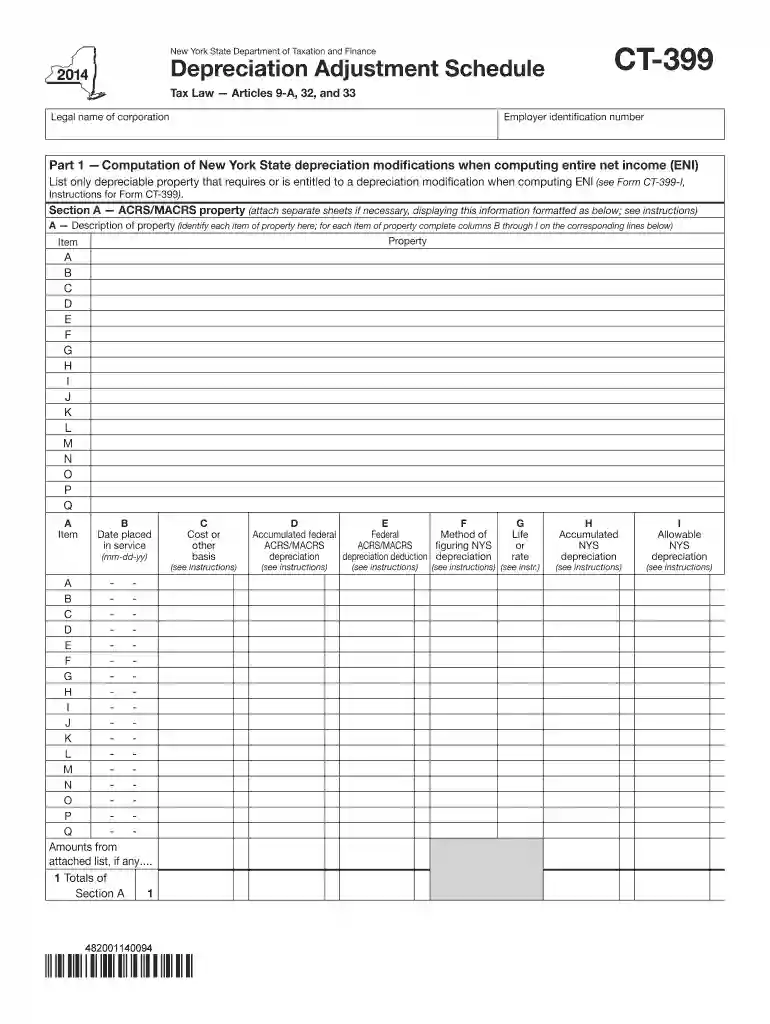
List only depreciable property that requires or is entitled to a depreciation modification when computing ENI (see Form CT-399-I,. Instructions for Form CT-399)
Department of Taxation and Finance. Depreciation Adjustment Schedule. Tax Law Articles 9-A and 33. Legal name of corporation. Employer identification number.
Jan 15, 2021 For the taxable year beginning on January 1, 2020, Form. CT‑1040 has been updated to provide a check box for filers of federal Form 1310,


