




01. Edit your form online
Type text, add images, blackout confidential details, add comments, highlights and more.

Type text, add images, blackout confidential details, add comments, highlights and more.

Draw your signature, type it, upload its image, or use your mobile device as a signature pad.

Send it via email, link, or fax. You can also download it, export it or print it out.
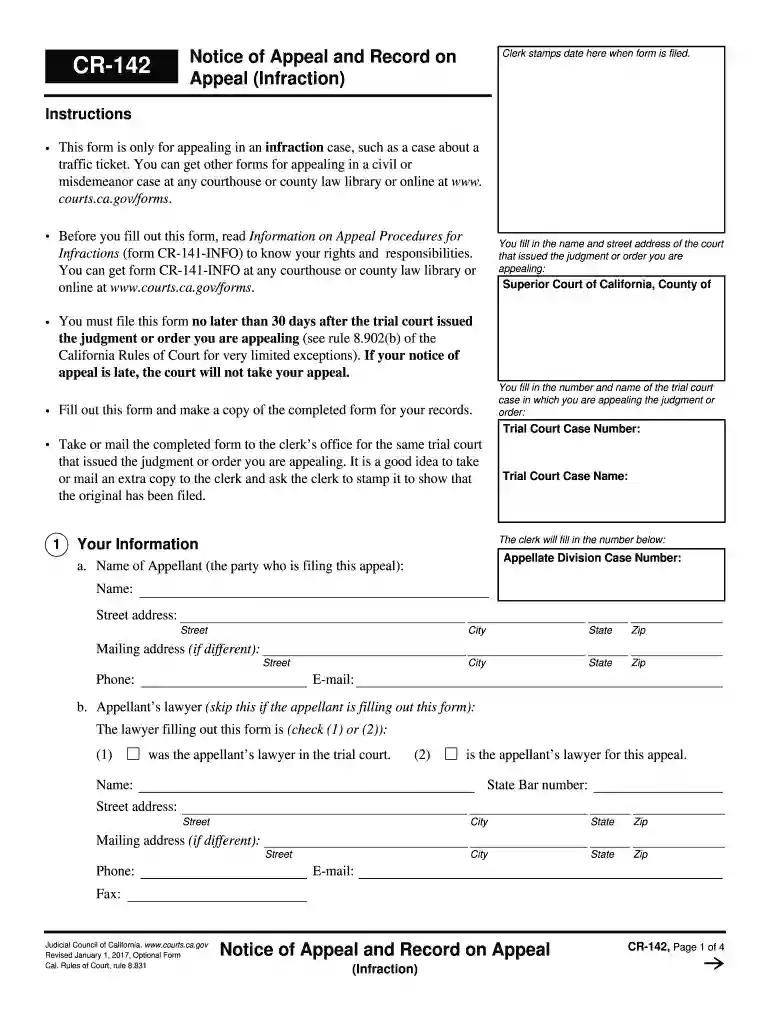
The CR-142 form, also known as the Notice of Appeal and Record of Oral Proceedings (Infraction) form, is utilized to appeal judgments in infraction cases, such as traffic violations, within the legal system. Enacted to facilitate a standardized method for appellants, this form delineates the procedural steps necessary for pursuing an appeal. The form allows users to request a review of a trial court's decision by a higher court, predominantly in cases where a party disputes the initial judgment.
To correctly use the CR-142 form, begin by filling in your personal information, including your full name, address, and contact details. Ensure you have accurate information about the original court case, such as the case number and the judgment date, as these details are crucial for an effective appeal process. The form must be submitted within 30 days following the original judgment to be considered timely. You have to indicate whether you wish to appeal with or without a record of the oral proceedings from the trial court, which can impact the review process.
Obtaining the CR-142 form can be easily managed through various channels. Most commonly, the form is available for download from the relevant court's website. It can also be acquired in person at the courthouse where your case was initially judged. In some jurisdictions, a call to the court's clerk may result in the form being mailed to you. Always ensure to verify that you are using the 2009 version specifically, as later amendments or modifications to the form may not apply to older cases.
Personal Information: Start by filling in your name, address, phone number, and email.
Case Details: Enter the case number, date of judgment, and court where it was held.
Grounds for Appeal: Clearly state the reasons for your appeal, referencing any legal grounds or procedural errors that you believe occurred.
Oral Proceedings: Decide if you require a record of the oral proceedings. If affirmative, make sure to indicate this on the form.
Filing Details: Specify the method of appeal and any additional documents you're attaching, especially if they're pertinent to your case.
Sign and Date: Finally, sign and date the form, confirming your agreement to the appeal process.
The form includes several key sections designed to capture comprehensive appeal information:
Appellant Information: Contact details essential for court communication.
Case Circumstances: Identifiers for the specific legal case, including the trial court’s decision.
Decision Impact: A narrative section explaining the basis of the appeal.
Proceeding Record: Options to include a transcript of the original court proceedings, crucial for cases where procedural issues are contested.
Legally, the CR-142 form serves as a formal declaration of intent to appeal an infraction ruling within the judicial system. It must be duly completed and submitted to either the trial court or appellate court, depending on jurisdictional rules. It enables the appellant to formally request a judicial review of the initial court's decision, ideally leading to a new trial or modification of the judgment should the appeal be successful. Noncompliance with proper procedures or failing to meet filing deadlines could result in dismissal.
Every appeal using the CR-142 form must adhere to strict timelines:
30-day Rule: Appeals must be filed within 30 days from the date of the judgment. This is non-negotiable.
Submission Confirmation: Ensure receipt is acknowledged by the court, maintaining proof of timely filing.
Failure to comply with these deadlines typically results in the forfeit of the right to appeal, underscoring the importance of prompt action.
The CR-142 form can be submitted in different ways, accommodating a variety of preferences and circumstances:
Online Submission: Some jurisdictions offer electronic submission via court websites, enhancing immediacy and efficiency.
Mail Submission: Mailing the completed form to the court clerk’s office remains a valid and frequently used option.
In-Person Submission: Hand-delivering the form to the court allows for immediate feedback and ensures personal responsibility for its receipt.
Always confirm with the court for acceptable methods specific to your jurisdiction, especially if submitting close to filing deadlines to avoid delays or rejections.
We've got more versions of the cr142 form 2009 form. Select the right cr142 form 2009 version from the list and start editing it straight away!
At DocHub, your data security is our priority. We follow HIPAA, SOC2, GDPR, and other standards, so you can work on your documents with confidence.
CR-142. Notice of Appeal and Record on Appeal (Infraction). Effective: January 1 Effective: January 1, 2009 See form info Download CR-186. Order for
by JED Larkin 2012 Cited by 18 Using the encryption key, the government can decrypt the protected information without the defendants assistance. Id. 125. Id. at 204-05 ([Blecause the key is


