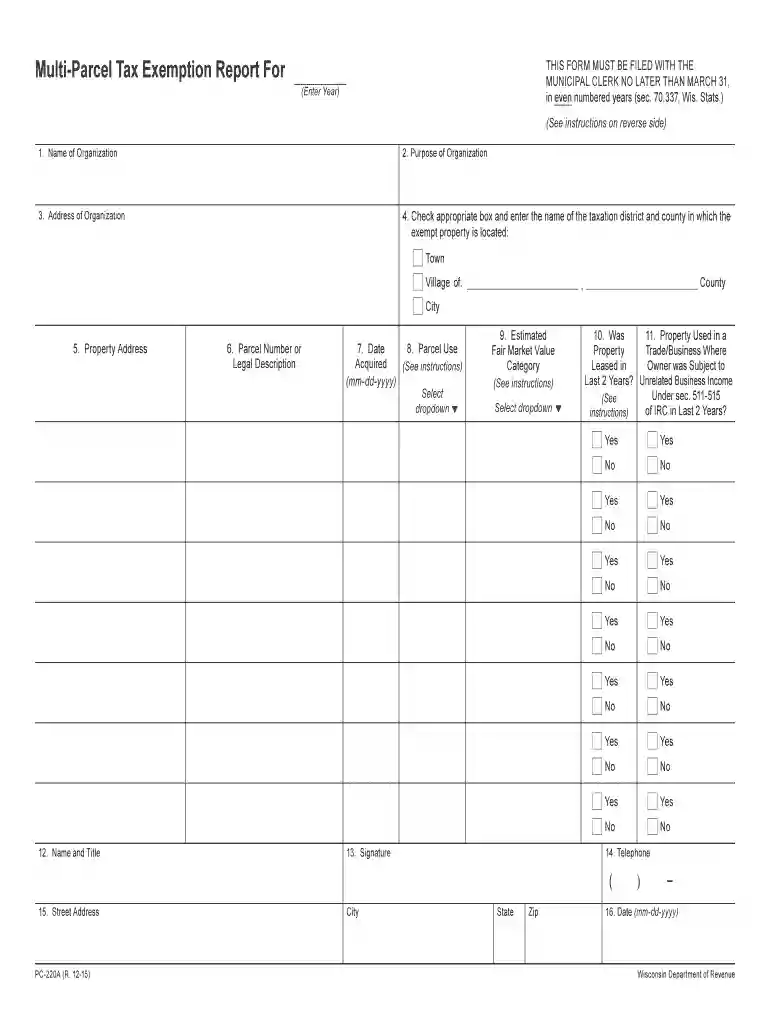
Wisconsin pc 220a 2015 form-2026

Get Form
wisconsin pc 220a 2015 form Preview on Page 1

Here's how it works

01. Edit your form online
Type text, add images, blackout confidential details, add comments, highlights and more.

02. Sign it in a few clicks
Draw your signature, type it, upload its image, or use your mobile device as a signature pad.

03. Share your form with others
Send it via email, link, or fax. You can also download it, export it or print it out.

Definition and Purpose of the Wisconsin PC-220A 2015 Form

The Wisconsin PC-220A 2015 form, known as the Multi-Parcel Tax Exemption Report, is a critical document for organizations seeking property tax exemptions within Wisconsin. It is required to be filed with the municipal clerk by March 31 in even-numbered years. The primary function of this form is to provide detailed information about the taxpayer's exempt properties, ensuring transparency and compliance with state tax regulations.

Organizations fill this form to list properties that qualify for tax-exempt status, specifying the organization's name, purpose, property address, parcel number, estimated fair market value, and usage of the property.

Steps to Complete the Wisconsin PC-220A 2015 Form

  1. Gather Necessary Information:

    • Organization's full legal name and contact information.
    • Property details: address, parcel number, fair market value, and current use.
  2. Fill Out Section A:

    • Detail each property individually, ensuring accurate information to avoid delays or rejections in processing.
  3. Complete Section B:

    • Provide explanations for the property's exempt status. Documentation supporting exemption claims, such as proof of non-profit status, might be required.
  4. Review and Sign:

    • Verify the information for accuracy. The authorized representative must sign the form to attest to its correctness.
  5. Submit to the Municipal Clerk:

    • Ensure submission by the March 31 deadline in even-numbered years. Double-check that all properties needing exemption are listed to avoid future complications.

How to Obtain the Wisconsin PC-220A 2015 Form

  • Download Online:

    • The form is available on official Wisconsin government websites. Ensure you access the latest version to meet all current requirements.
  • Visit Local Government Offices:

    • Acquire physical copies from the local municipality or county clerk's office.
  • Contact the Wisconsin Department of Revenue:

    • For assistance or to request the form by mail, their contact details can typically be found on the department's official site.

Key Elements of the Form

  • Organization Information:

    • Consists of the name and legal standing of the entity claiming exemption.
  • Property Details:

    • Each property must be clearly listed with the appropriate identifiers.
  • Exemption Clauses:

    • Specific state clauses under which properties claim exemption must be included.
  • Certification:

    • A signed declaration by an authorized individual certifying the form’s authenticity and completeness.

Legal Use and Compliance

The Wisconsin PC-220A 2015 form is legally binding and instrumental in maintaining tax exemption status for eligible properties. Filing this form accurately and on time is necessary to comply with state tax regulations. Failure to submit or incorrect submissions could result in penalties or loss of exemption status.

Important Terms Related to the Form

  • Exempt Property: Properties that legally qualify for exemption from property taxes under Wisconsin law.
  • Parcel Number: A unique identifier assigned to each piece of land, necessary for tax and legal purposes.
  • March 31 Deadline: The strict submission deadline for filing in even-numbered years.

Filing Deadlines and Important Dates

The form must be filed with the municipal clerk by March 31 during even-numbered years. Filing after this date may result in penalties or the loss of tax-exempt status. It's essential to mark this date in advance and ensure all necessary documents are prepared.

Penalties for Non-Compliance

Non-compliance with the filing requirement can result in significant consequences for organizations. These may include:

  • Loss of property tax exemption status.
  • Possible financial penalties imposed by local tax authorities.
  • Increased scrutiny in future exemption requests.

Software Compatibility

While the form is typically filled manually or via a PDF editor, certain tax preparation softwares, such as TurboTax or QuickBooks, might assist in organizing the information needed for the form. However, the final submission often requires manual interaction, especially in regards to signature and certification sections.

Form Submission Methods

  • Online:

    • Not commonly available for this form, but check for any updates on submission options through government websites.
  • Mail or In-Person:

    • Standard submission methods remain via mail or direct submission at the municipal clerk’s office to ensure proper receipt.

To ensure seamless processing and compliance, organizations should closely follow the instructions and deadlines related to the Wisconsin PC-220A 2015 form.

See more wisconsin pc 220a 2015 form versions

We've got more versions of the wisconsin pc 220a 2015 form form. Select the right wisconsin pc 220a 2015 form version from the list and start editing it straight away!
Versions Form popularity Fillable & printable
2016 4.8 Satisfied (81 Votes)
2015 4.2 Satisfied (38 Votes)
2009 4 Satisfied (25 Votes)
be ready to get more

Complete this form in 5 minutes or less

Get form

Got questions?

We have answers to the most popular questions from our customers. If you can't find an answer to your question, please contact us.
Contact us
Cemeteries, exempt under sec. 70.11(13), Wis. Stats. Archeological sites, exempt under sec.
In even years, the property owner (or representative) must file the Tax Exemption Report (Form PC‑220) for single parcels or Form PC‑220A for multiple parcels, with the Municipal Clerk no later than March 31. (sec. 70.337, Wis. Stats.)
Exempt property, under the law of property in many jurisdictions, is property that can neither be passed by will nor claimed by creditors of the deceased in the event that a decedent leaves a surviving spouse or surviving descendants.
To apply for an exemption, you must complete a Wisconsin Department of Revenue application form, which may be obtained from the local assessor. The form must be filed for any property that was taxed in the previous year but, because of a change in the use, occupancy, or ownership, may now qualify for exemption.
You are a legal resident of Wisconsin for all of 2024, from January 1 through December 31. You are 18 years of age or older on December 31, 2024. You have less than $24,680 in household income for 2024. See the definition of household income.)

Security and compliance

At DocHub, your data security is our priority. We follow HIPAA, SOC2, GDPR, and other standards, so you can work on your documents with confidence.

Learn more
ccpa2
pci-dss
gdpr-compliance
hipaa
soc-compliance

People also ask

The homeowner must be at least 65 or a qualifying veteran. If qualifying by age, any co-owner must be at least 60 years of age.

Related links