




01. Edit your form 8814 instructions online
Type text, add images, blackout confidential details, add comments, highlights and more.

Type text, add images, blackout confidential details, add comments, highlights and more.

Draw your signature, type it, upload its image, or use your mobile device as a signature pad.

Send 8814 instructions via email, link, or fax. You can also download it, export it or print it out.
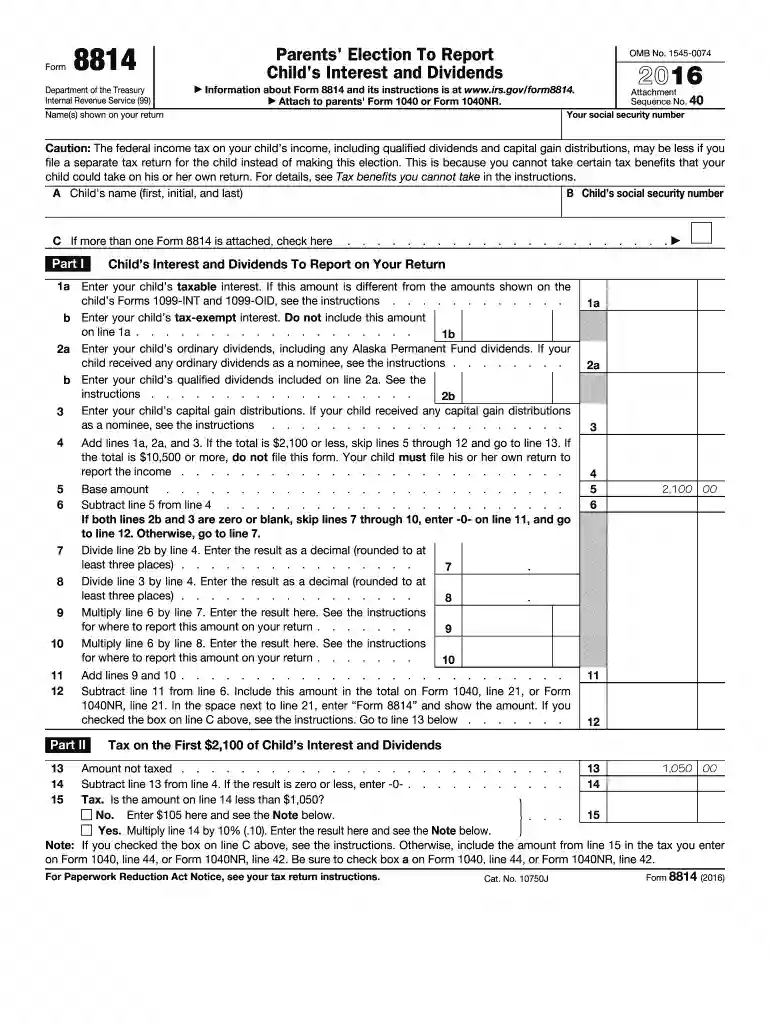
IRS Form 8814, referred to as "Parents' Election to Report Child's Interest and Dividends," allows parents to include their child's unearned income, such as interest and dividends, on their tax return. This option is utilized to simplify tax filing for dependent children under 19 (or under 24 if a full-time student), provided the child’s income is below $10,000. Filing this form can help parents manage their dependents' taxes more efficiently by consolidating the filing process into their own tax return. Including a child’s income in this manner can offer convenience, though it may impact eligibility for certain tax benefits.
Begin by Entering Basic Information:
Calculate Child’s Income:
Determine Tax Liability:
Complete Parent’s Information:
Review and Attach to Parent’s Return:
Parents can elect to use this form when specific conditions are met, such as the child's:
It's crucial for parents to evaluate these criteria annually, as eligibility can change based on the child's age, income levels, or the types of unearned income received during the year.


Personal Information Section:
Unearned Income Reporting:
Tax Calculation Section:
To access Form 8814, taxpayers can:
The IRS provides comprehensive instructions for completing Form 8814, highlighting:
Failure to correctly report or file IRS Form 8814 can lead to IRS penalties, including:
Common scenarios where Form 8814 is advantageous include:
Parents with Minor Children:
Full-Time Students with Low Earnings:
By leveraging IRS Form 8814, families can streamline tax responsibilities, ensuring both compliance and convenience in managing family-related tax matters efficiently.

We've got more versions of the form 8814 instructions form. Select the right form 8814 instructions version from the list and start editing it straight away!
| Versions | Form popularity | Fillable & printable |
|---|---|---|
| 2025 | 4.2 Satisfied (41 Votes) | |
| 2024 | 4.2 Satisfied (32 Votes) | |
| 2023 | 4.7 Satisfied (25 Votes) | |
| 2022 | 4.7 Satisfied (24 Votes) | |
| 2021 | 4.8 Satisfied (83 Votes) | |
| 2020 | 4.4 Satisfied (258 Votes) | |
| 2019 | 4.4 Satisfied (169 Votes) | |
| 2018 | 4.3 Satisfied (286 Votes) | |
| 2016 | 4.3 Satisfied (151 Votes) | |
| 2013 | 4 Satisfied (35 Votes) |
At DocHub, your data security is our priority. We follow HIPAA, SOC2, GDPR, and other standards, so you can work on your documents with confidence.
Mar 10, 2025 Parents use this form to report their childs income on their return, so their child will not have to file a return. Current revision. Form 8814
A separate Form 8814 must be filed for each child whose income you choose to report. ○ Had no estimated tax payments for 1999. (including any overpayment of tax
A separate Form 8814 must be filed for each child whose income you choose to report. Parents who qualify to make the election. You qualify to make this election


