




01. Edit your form online
Type text, add images, blackout confidential details, add comments, highlights and more.

Type text, add images, blackout confidential details, add comments, highlights and more.

Draw your signature, type it, upload its image, or use your mobile device as a signature pad.

Send it via email, link, or fax. You can also download it, export it or print it out.
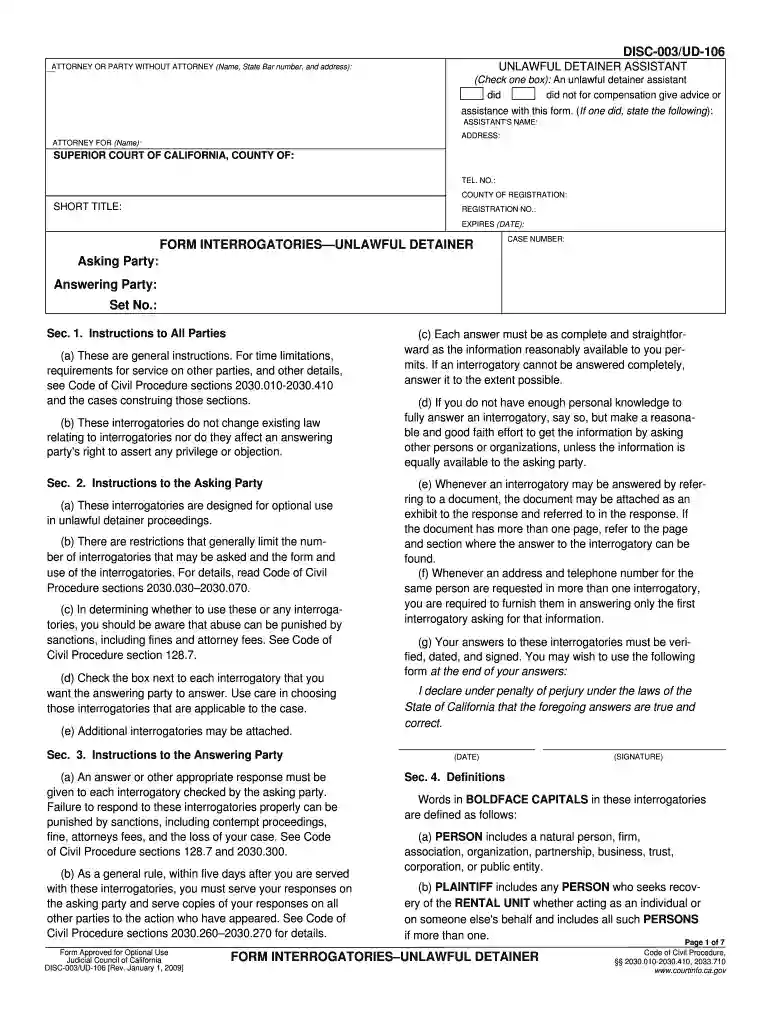
The UD 106 DISC 003 Form, commonly used in California, is an essential document for unlawful detainer proceedings. This form is specifically designed for parties involved in eviction cases to articulate their arguments and evidence clearly. Unlawful detainer is a legal term used to describe the process by which a landlord seeks to regain possession of a property from a tenant who refuses to vacate after the lease has expired or been terminated lawfully. The UD 106 DISC 003 Form aids in detailing the case's specifics, ensuring that all necessary information is conveyed in a structured and legally compliant manner.
Using the UD 106 DISC 003 Form effectively requires an understanding of its structure and purpose. It typically involves the following steps:
Identify the Parties: Clearly state the names and roles of the involved parties, such as the plaintiff (landlord) and defendant (tenant).
Outline the Case Details: Provide a concise overview of the case, including pertinent facts about the rental agreement, any notices to quit served, and alleged breaches by the tenant.
Specify Requested Relief: Indicate what relief the plaintiff is seeking, which typically involves possession of the property and potentially monetary damages.
Signatures: Ensure that the form is duly signed by the filing party or their attorney to verify the information provided.
Each section of the form should be completed with precision to avoid any misrepresentation or omission that could affect the case outcome.
Completing the UD 106 DISC 003 Form involves a detailed approach to ensure accuracy and legal compliance:
Review and Understand the Form: Familiarize yourself with each section of the form to understand what information is being requested.
Gather Necessary Information: Collect all relevant documents, such as the lease agreement, eviction notices, and any prior correspondences related to the case.
Fill Out the Form: Begin with the basics such as case number, court location, and involved parties. Proceed to detail the circumstances of the dispute.
Confirm Accuracy: Double-check all entered information for accuracy and completeness. Any errors can lead to delays or unfavorable judgments.
Submit the Form: Submit the completed form to the appropriate court as per the guidelines for eviction proceedings in California.
Ensuring that each of these steps is followed diligently can significantly impact the efficiency and effectiveness of the legal proceedings.
When dealing with the UD 106 DISC 003 Form, several key elements must be carefully completed:
These elements are critical in ensuring that the form effectively communicates the necessary details and complies with legal standards.
The legal use of the UD 106 DISC 003 Form is exclusive to eviction cases in California’s unlawful detainer proceedings. Its role is to:
This form is a tool to ensure justice and fairness in eviction-related disputes.
California has specific rules regarding the UD 106 DISC 003 Form:
By adhering to these state-specific guidelines, involved parties can ensure compliance and avoid the negative implications of delays or procedural mistakes.
Example scenarios where the UD 106 DISC 003 Form is utilized include:
These examples illustrate the form’s critical role in managing typical landlord-tenant conflicts.
Understanding key terms is essential:
Familiarity with these terms assists in correctly completing and understanding the form's implications in legal proceedings.
We've got more versions of the ud 106 disc 003 form form. Select the right ud 106 disc 003 form version from the list and start editing it straight away!
At DocHub, your data security is our priority. We follow HIPAA, SOC2, GDPR, and other standards, so you can work on your documents with confidence.
Jan 1, 2014 Sec. 1. Instructions to All Parties. (a) These are general instructions. For time limitations, requirements for service on other parties,
Chapter 8: Sample DISC-003/UD-106, Form InterrogatoriesUnlawful Detainer. California Eviction Defense 2.0: Beyond the Basics of Protecting Low-Income
DEVICE DESCRIPTION. The Mobi-C Cervical Disc Prosthesis (Mobi-C) is a single use device for cervical intervertebral disc replacement at one level from C3


