




01. Edit your k1 form amended online
Type text, add images, blackout confidential details, add comments, highlights and more.

Type text, add images, blackout confidential details, add comments, highlights and more.

Draw your signature, type it, upload its image, or use your mobile device as a signature pad.

Send k1 1041 form via email, link, or fax. You can also download it, export it or print it out.
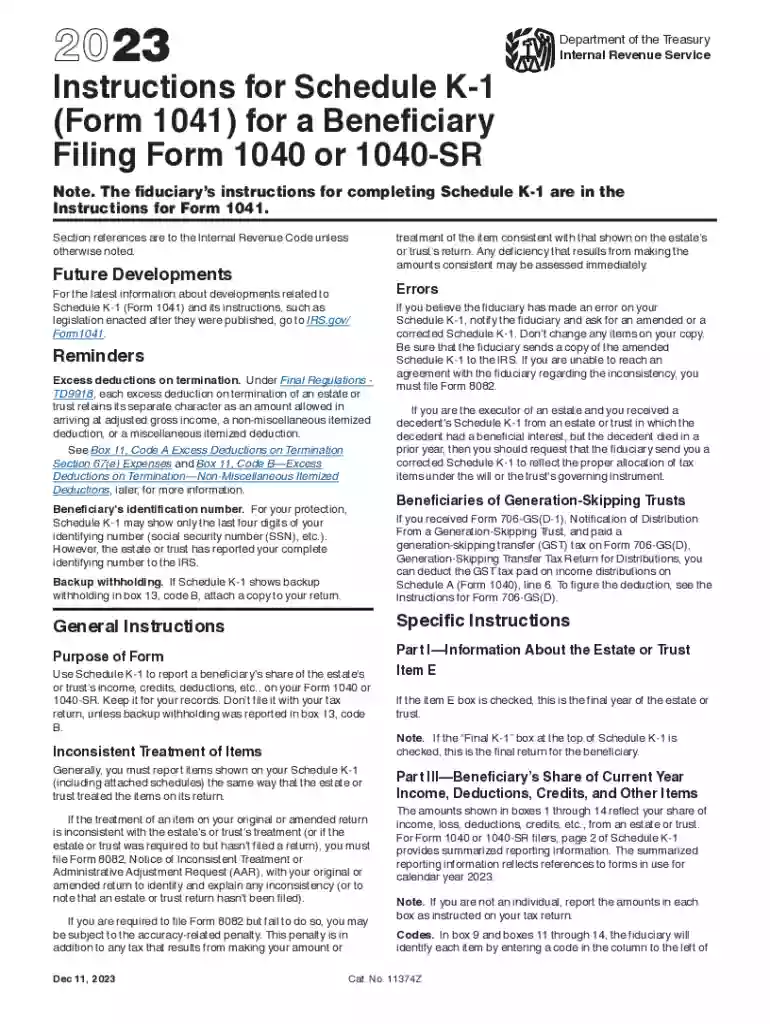
Schedule K-1 (Form 1041) is a tax document used to report income, deductions, and credits from an estate or trust to its beneficiaries. It is critical for the beneficiaries to report these details accurately on their individual tax returns, typically Form 1040 or 1040-SR. The form serves to ensure that all taxable items are properly transferred to and accounted for by the beneficiaries. Legal compliance with IRS regulations is crucial to avoid penalties or discrepancies.
Schedule K-1 typically includes detailed sections for:
Each section is crucial for helping the beneficiary accurately complete their tax filings and reflect all tax responsibilities.
The IRS provides explicit instructions and codes for completing Schedule K-1. It is critical to understand these guidelines to avoid errors. Key instructions include:
Filing on time is crucial for both the estate or trust and its beneficiaries to avoid penalties.
Schedule K-1 is typically issued by the executor of an estate or the trustee of a trust. Beneficiaries should receive the form directly from these entities. It is also crucial to understand your eligibility for the form, which is generally determined by being a beneficiary of a trust or estate.
Failing to accurately report the information on Schedule K-1 can lead to significant penalties. Errors can lead to:
Timely and accurate filing is essential to avoid such outcomes.
Popular tax preparation software such as TurboTax and QuickBooks are capable of handling Schedule K-1 (Form 1041). These tools provide:
Utilizing tax software can streamline the process and help ensure compliance with IRS requirements.
We've got more versions of the k1 form amended form. Select the right k1 form amended version from the list and start editing it straight away!
| Versions | Form popularity | Fillable & printable |
|---|---|---|
| 2023 | 4.8 Satisfied (49 Votes) | |
| 2022 | 4.3 Satisfied (58 Votes) | |
| 2021 | 4.8 Satisfied (71 Votes) | |
| 2020 | 4.3 Satisfied (156 Votes) | |
| 2019 | 4.3 Satisfied (170 Votes) | |
| 2018 | 4.3 Satisfied (126 Votes) | |
| 2017 | 4.3 Satisfied (238 Votes) | |
| 2016 | 3.9 Satisfied (44 Votes) | |
| 2015 | 4.4 Satisfied (571 Votes) | |
| 2011 | 4.4 Satisfied (550 Votes) |
At DocHub, your data security is our priority. We follow HIPAA, SOC2, GDPR, and other standards, so you can work on your documents with confidence.
Jan 31, 2012 Schedule K-1 (Form 1041), or other and geothermal property. Examples Schedule K-1 that shows other items property held for
The fiduciary of a trust or decedents estate uses Schedule K-1 to report your share of the trusts or estates income, credits, deductions, etc. Keep it for
Jan 14, 2025 Use Schedule K-1 to report a beneficiarys share of the estates or trusts income, credits, deductions, etc., on your Form 1040 or 1040-SR.


