




Here's how it works

01. Edit your form online
Type text, add images, blackout confidential details, add comments, highlights and more.

02. Sign it in a few clicks
Draw your signature, type it, upload its image, or use your mobile device as a signature pad.

03. Share your form with others
Send it via email, link, or fax. You can also download it, export it or print it out.
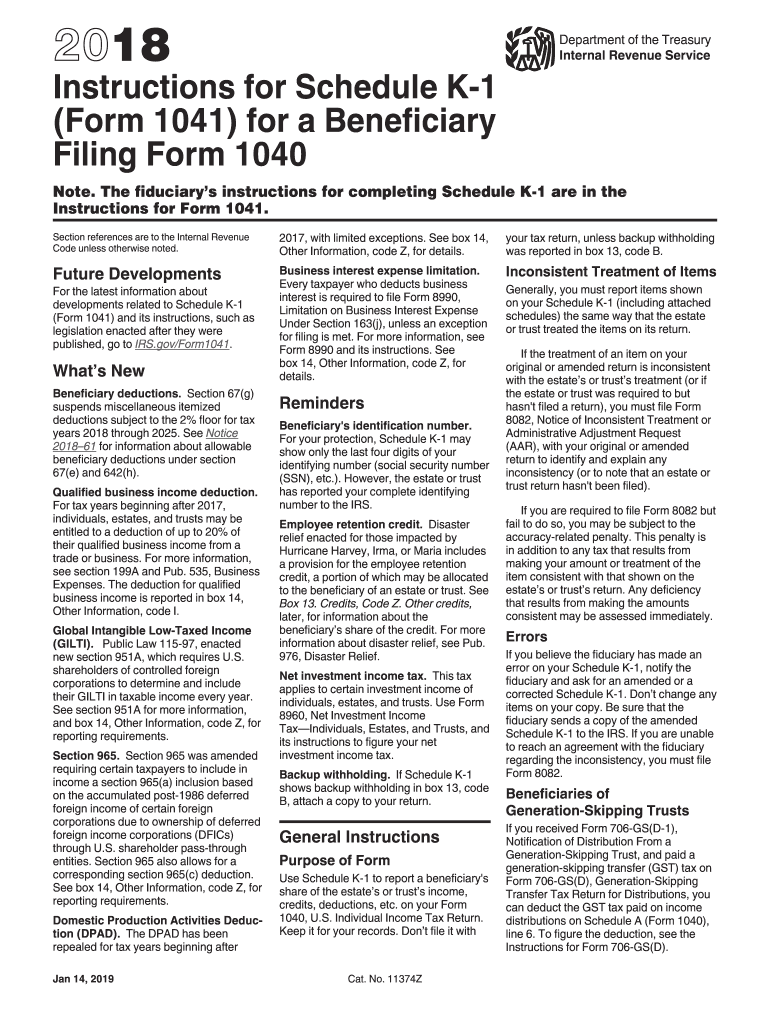
How to use or fill out 2017 K-1 instructions with our platform

- Click ‘Get Form’ to open the 2017 K-1 instructions in the editor.
- Begin by reviewing Part I, which provides information about the estate or trust. Ensure that all details are accurate, especially if the 'Final K-1' box is checked.
- Move to Part III, where you will find your share of current year income, deductions, credits, and other items. Pay close attention to boxes 1 through 14 for specific amounts that need to be reported on your Form 1040.
- For each box, refer to the corresponding instructions provided in the document. For example, box 1 reports taxable interest income; ensure you enter this amount correctly on your tax return.
- If there are any attached statements indicated by an asterisk (*), review them carefully as they provide additional information necessary for accurate reporting.
Start using our platform today for free to simplify your document editing and form completion!
Fill out 2017 k 1 instructions online
It's free
It's free
See more 2017 k 1 instructions versions
We've got more versions of the 2017 k 1 instructions form. Select the right 2017 k 1 instructions version from the list and start editing it straight away!
| Versions | Form popularity | Fillable & printable |
|---|---|---|
| 2024 | 4.6 Satisfied (33 Votes) | |
| 2023 | 4.8 Satisfied (49 Votes) | |
| 2022 | 4.3 Satisfied (58 Votes) | |
| 2021 | 4.8 Satisfied (71 Votes) | |
| 2020 | 4.3 Satisfied (156 Votes) | |
| 2019 | 4.3 Satisfied (170 Votes) | |
| 2018 | 4.3 Satisfied (126 Votes) | |
| 2017 | 4.3 Satisfied (238 Votes) | |
| 2016 | 3.9 Satisfied (44 Votes) | |
| 2015 | 4.4 Satisfied (571 Votes) | |
| 2011 | 4.4 Satisfied (550 Votes) |
Got questions?
We have answers to the most popular questions from our customers. If you can't find an answer to your question, please contact us.
Contact us
Where do I report Schedule K-1 on my personal tax return?
The K-1 isnt filed with your tax return, unless backup withholding was reported in box 13, code B.10 Keep it with your records. The trust or estate files a copy of Schedule K-1/Form 1041 with the IRS.
How much tax do you pay on K1 income?
The partnership only provides information to the IRS and does not pay taxes on the income reported on K-1 forms. The partnership provides each partner their Schedule K-1 form and each partner uses the information regarding their share of income, losses, deductions, and credits to file their individual tax returns.
What is a Schedule K-1 instructions?
General Instructions Purpose of Form. Use Schedule K-1 to report a beneficiarys share of the estates or trusts income, credits, deductions, etc., on your Form 1040 or 1040-SR. Keep it for your records. Dont file it with your tax return, unless backup withholding was reported in box 13, code B.
How does a K1 affect my personal taxes?
In general, a K-1 can affect personal taxes in two ways: either by increasing a partners tax liability or by providing them with a tax deduction. It will likely increase their total tax liability for the year if the K-1 is associated with an income.
Does a loss on a K1 reduce taxable income?
Your tax liability may decrease because the K-1 loss lowers your overall taxable income. Keep in mind that not all K-1 losses can be used this way. The ability to offset W-2 income depends on whether the losses come from passive or nonpassive activities.
Security and compliance
At DocHub, your data security is our priority. We follow HIPAA, SOC2, GDPR, and other standards, so you can work on your documents with confidence.
Learn more


People also ask
What happens if you dont file a K1?
Consequences of Not Filing K-1 Tax Forms The IRS doesnt expect individuals to file a K-1. However, they will compare your tax return to the information filed by your partnership. Partnerships that dont meet their Schedule K-1 responsibilities can also face expensive filing penalties.
What is a K-1 schedule?
Schedule K-1 is an IRS form used by partnerships, S corporations, and estates and trusts to declare the income, deductions, and credits that partners, shareholders, and beneficiaries have received in the tax year. Individual taxpayers transfer the financial information on their K-1s to their tax returns.
What is the difference between a 1099 and a Schedule k1?
In other words, 1099 forms are relevant for reporting the income of the partnership as a whole. Schedule K-1 is relevant to the individuals of the partnership when reporting their share of the profit or loss on their income tax return. A partner will almost never receive a 1099 from the partnership that they own.