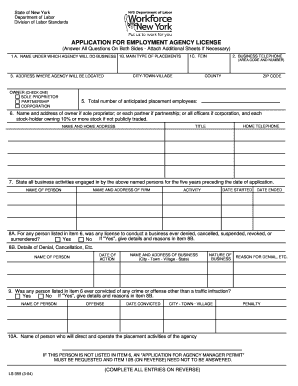
Defining the Broker Application
The broker application is a formal document necessary for individuals aiming to become licensed real estate brokers or associate brokers. It functions as a critical step in the licensing process by capturing essential information about the applicant's professional background, educational achievements, and experience in real estate. Potential applicants must understand the specific requirements and questions laid out in the form, as accuracy is paramount to avoid processing delays.
Key Components
- Personal Information: Details such as name, contact information, and Social Security number.
- Experience Verification: Proof of prior experience in the real estate sector.
- Educational Credentials: Certificates or diplomas confirming the completion of necessary coursework.
- Examination Results: Evidence of passing the required state examination.
- Business Information: If applicable, details of the business entity under which the applicant will operate.
How to Obtain the Broker Application
Acquiring a broker application is a straightforward process. Forms are typically available from the state Department of State's division responsible for licensing. They may also be accessible online via the department’s official website for download or submission.
Access Points
- State Licensing Websites: Direct download options for digital applications.
- In-Person Pickup: Visiting local department offices for physical copies.
- Request by Mail: Some states offer the application by mail upon request, though this method may take longer.
Steps to Complete the Broker Application
Completing the broker application involves several steps, each demanding attention to detail to ensure accuracy and completeness.
Detailed Procedure
- Gather Required Information: Prior experience, educational history, and examination scores.
- Fill Out the Application: Enter personal and professional details carefully.
- Attach Supporting Documents: Include all necessary proof, such as experience verification and educational certificates.
- Review for Accuracy: Double-check all entries for consistency and correctness.
- Submit the Application: Follow the state's designated submission method, which could be online or via mail.
- Pay Applicable Fees: Include any necessary fees as specified by state requirements.
Eligibility Criteria for Broker Application
To qualify for a broker license, applicants must meet specific eligibility criteria as outlined by state regulations.


Common Requirements
- Minimum Age: Generally, applicants must be at least 18 or 21 years old, depending on state provisions.
- Experience Required: A minimum number of years working as a licensed real estate salesperson.
- Educational Standards: Completion of approved real estate courses.
- Examination: Successful passing of a state-administered real estate broker exam.
Important Terms Related to Broker Application
Understanding key terms within the broker application can aid in accurately completing the form and avoiding misunderstandings.
Glossary
- Principal Broker: The broker who is responsible for supervising real estate activities.
- Associate Broker: An individual licensed as a broker but chooses to work under another broker.
- Fiduciary Duty: The legal obligation of the broker to act in the best interest of clients.
- Escrow: Holding funds or assets temporarily until specified conditions are met.
Legal Use of the Broker Application
The broker application carries legal implications, especially regarding its completion and submission.
Legal Considerations
- Truthfulness: False or misleading information can result in application denial or legal action.
- Signatures: All representations and information must be corroborated by the applicant's signature.
- Data Integrity: Ensuring all the details are accurate is critical as discrepancies can lead to severe consequences.
Required Documents for the Broker Application
Submitting a broker application involves providing various supporting documents that validate the applicant's claims.
Document Checklist
- Proof of Identity: A valid government-issued ID.
- Experience Verification: Letters from previous employers verifying real estate work history.
- Educational Proof: Diplomas or certificates for required courses.
- Exam Score Report: Official documentation of passing the broker exam.
State-Specific Rules for the Broker Application
Broker applications are state-specific, with each state having distinct rules and requirements for becoming licensed.
Notable Variations
- Processing Times: The time required for approval can vary significantly between states.
- Specific Course Requirements: Varying educational syllabi or additional state-specific modules.
- Unique Application Sections: Some states may ask for more detailed business plans or extra attestations.
- State-Specific Fees: Licensing costs can differ, requiring applicants to check precise amounts.