




01. Edit your form online
Type text, add images, blackout confidential details, add comments, highlights and more.

Type text, add images, blackout confidential details, add comments, highlights and more.

Draw your signature, type it, upload its image, or use your mobile device as a signature pad.

Send it via email, link, or fax. You can also download it, export it or print it out.
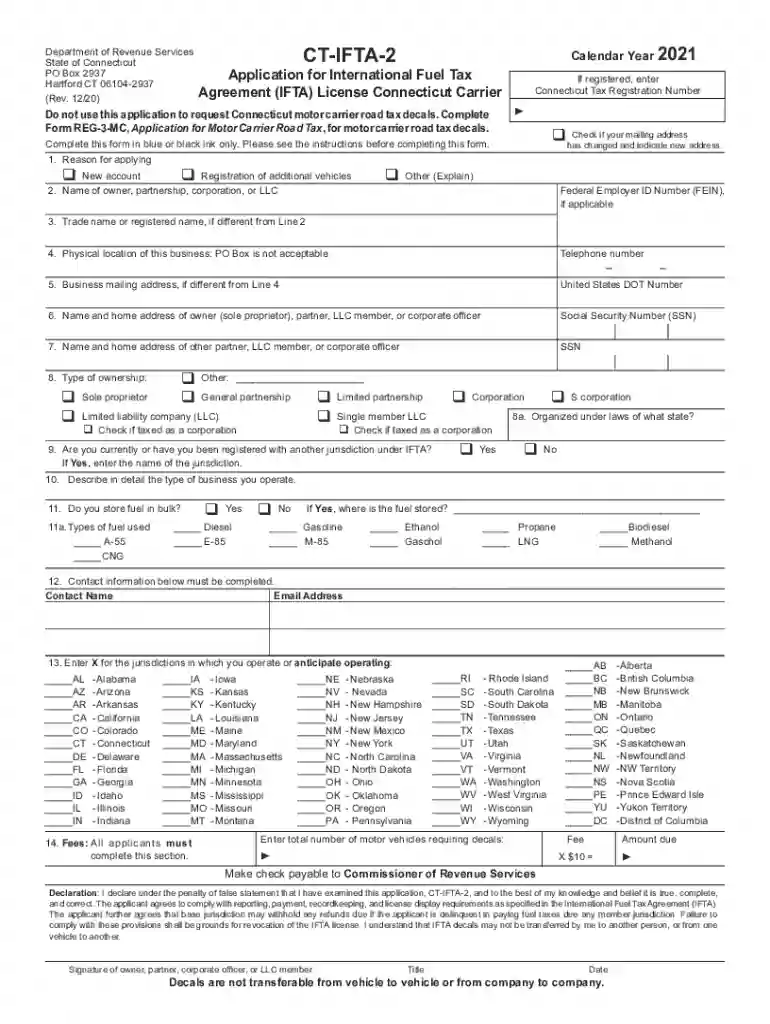
The International Fuel Tax Agreement (IFTA) License Connecticut Carrier is a crucial document that allows motor carriers operating interstate to streamline their fuel tax reporting. This license is part of a collaborative multijurisdictional agreement designed to facilitate the collection and distribution of fuel taxes. Primarily, the IFTA License is aimed at eliminating the need for carriers to procure separate fuel permits for each state or province they operate in, thereby reducing administrative burdens and enhancing efficiency.
The license applies specifically to motor carriers registered in Connecticut and is essential for those who operate commercial vehicles across state lines. IFTA simplifies tax collection by requiring carriers to file one quarterly tax return in their base jurisdiction, which in this case is Connecticut. The collected information enables the equitable distribution of taxes owed to each state in which the carrier operates.
To acquire the IFTA License, carriers must go through a structured application process, often starting with submitting the CT-IFTA-2 form. Here are the detailed steps involved in obtaining the license:
Initial Application Preparation: Before applying, gather necessary business information, including the Carrier's name, address, and federal identification number, as well as vehicle details.
Completing the CT-IFTA-2 Form: Fill out the application form accurately with information regarding business structure, jurisdictions operated in, and fuel type used. Ensure all sections are completed to avoid processing delays.
Submission Process: Submit the completed form through Connecticut’s Department of Revenue Services. Applicants can typically mail it or use an online submission portal when available.
Payment of Fees: Pay the required application fee. This fee may vary, so consult the latest Connecticut guidelines for accurate information.
Approval and Issuance: After submission, the application goes under review. Once processed and approved, the IFTA license and decals are issued, allowing legal operation across jurisdictions.
The IFTA License includes several key components that carriers must understand and comply with:
License Identification: Each carrier receives a unique IFTA License number, which must be prominently displayed on each qualified vehicle for easy identification during roadside inspections.
Decals: Along with the license, decals must be affixed to each vehicle. These decals serve as proof of compliance when operating in other IFTA jurisdictions.
Quarterly Reporting: Carriers are required to file quarterly fuel use tax reports. These reports must reflect all fuel consumed and distance traveled across participating jurisdictions to ensure accurate tax collection and allocation.
Record Keeping: Meticulous records of mileage and fuel purchases must be maintained for at least four years. These records are crucial for audits and ensuring compliance.
Completing the CT-IFTA-2 form is a critical part of securing the IFTA License. Here’s a step-by-step guide to assist applicants:
Business Information Section: Enter all relevant business data, including legal name, business address, and type of ownership (corporation, LLC, partnership, etc.).
Vehicle Information: List all vehicles for which the license is requested. Include their Vehicle Identification Numbers (VINs) and registration details.
Fuel Use Data: Accurately report fuel types and usage for each vehicle. This data is essential for the correct calculation of fuel taxes.
Jurisdictions of Operation: Identify all the states and provinces where the vehicles will operate. This ensures proper tax distribution.
Certification and Signature: The form must be signed and dated by an authorized representative of the business, certifying the accuracy of the information provided.
The IFTA License must be used strictly in accordance with the legal provisions set out by the agreement and Connecticut state laws. Carriers must adhere to the following:
Compliance with Reporting: Submit all required quarterly reports on time to avoid penalties. Each report should detail accurate mileage and fuel use in each jurisdiction.
Adhering to State Regulations: Familiarize and comply with any additional fuel tax regulations or requirements unique to Connecticut or other jurisdictions.
Display of Credentials: The IFTA License must be available for inspection upon request, and decals must remain visible on each qualified vehicle.
To fully understand the IFTA License, it is essential to grasp several key terms:
Base Jurisdiction: The state where the carrier is registered and files all returns and license applications, which is Connecticut in this context.
Qualified Motor Vehicle: A vehicle that meets IFTA criteria for weight and operation, typically those exceeding 26,000 pounds or with three or more axles.
Jurisdiction: Refers to each state or province that participates in the IFTA program.
Taxable Gallon: This term represents the fuel quantity subject to taxation under the IFTA agreement based on vehicle use across different jurisdictions.
These terms form the core framework for understanding and effectively managing the responsibilities associated with the IFTA License.
While the broad IFTA regulations apply across member jurisdictions, Connecticut has specific rules that carriers must observe:
Connecticut Decal Display Requirement: Ensure that IFTA decals are properly affixed to the exterior of the vehicles, as per the state's positioning guidelines.
Renewal Processes: Connecticut carriers need to renew their IFTA licenses annually. Renewal reminders are often sent, but carriers must track due dates to maintain compliance.
Revenue Services Contact: Carriers must keep updated contact information with the Connecticut Department of Revenue for any correspondence related to the license or its requirements.
Understanding these state-specific nuances ensures carriers maintain compliance and avoid any state-imposed penalties or operational disruptions.
Real-world scenarios demonstrate the practical application and benefits of the IFTA License:
Large Fleet Management: A trucking company with a large fleet operating across multiple states can optimize tax reporting by using IFTA’s centralized filing system, which reduces the complexity and personnel needed to manage multi-state operations.
Seasonal Operations: Carriers that only operate interstate during certain seasons find IFTA beneficial as it eliminates the need to apply for temporary permits in various jurisdictions. This flexibility streamlines short-term deployments.
These examples highlight how the IFTA License simplifies logistical operations, ensures compliance, and supports efficient business management for Connecticut-based carriers.
We've got more versions of the Agreement (IFTA) License Connecticut Carrier form. Select the right Agreement (IFTA) License Connecticut Carrier version from the list and start editing it straight away!
At DocHub, your data security is our priority. We follow HIPAA, SOC2, GDPR, and other standards, so you can work on your documents with confidence.
To register for the first time as an International Fuel Tax Agreement (IFTA) licensee in Connecticut, you must register with the Department of Revenue Services
Sep 15, 2014 require[s] the carrier to be legally compelled to serve the public indifferently because the carrier. has sufficient market power). 175.
by L OConnell Cited by 2 IFTA license for all qualified motor vehicles and two decals for each qualified motor vehicle. The carrier must make copies of the license and carry a copy in.


