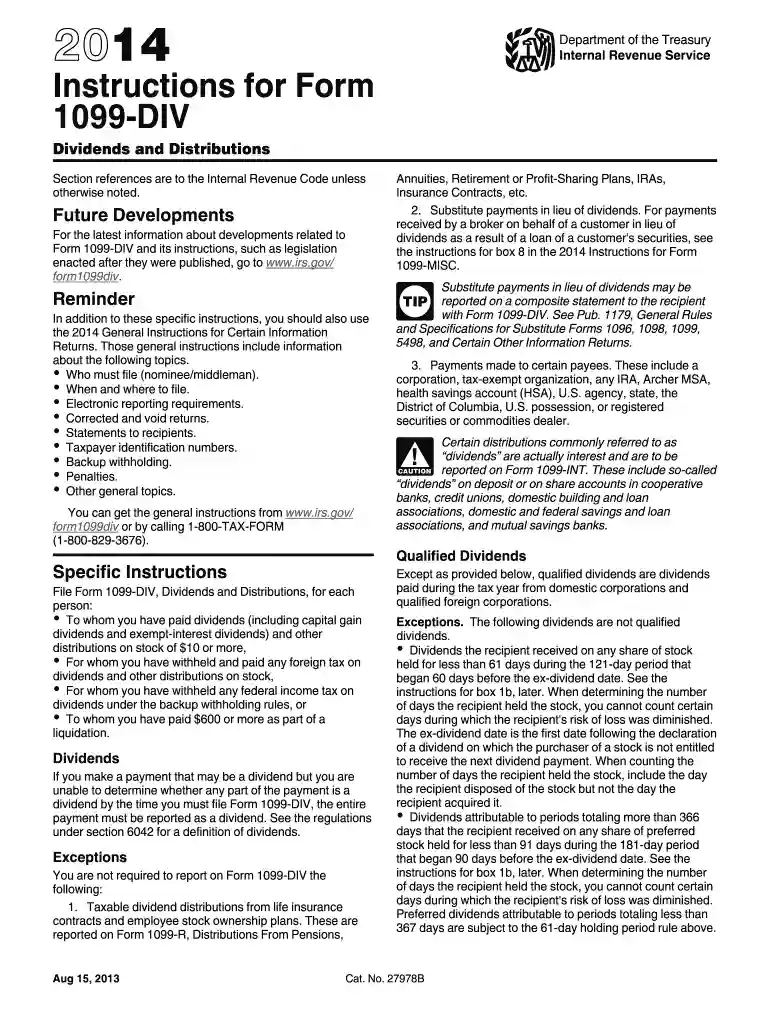
Definition and Purpose of Form 1099-DIV
Form 1099-DIV, Dividends and Distributions, is used to report income from dividends and certain other distributions to investors. In 2014, this form was vital for taxpayers who received dividend income from stocks and mutual funds. The form details various types of distributions, such as ordinary dividends, qualified dividends, and capital gains distributions, which must be reported on a taxpayer's income tax return.

Types of Dividends Reported
- Ordinary Dividends: These are the most common type of dividend income, reported in box 1a of the form.
- Qualified Dividends: These dividends qualify for a reduced tax rate and are reported in box 1b.
- Capital Gain Distributions: Often arising from mutual funds, these are reported in box 2a.
- Nondividend Distributions: These return a portion of the taxpayer's investment, not reported as income.
Steps to Complete the 2014 Instruction 1099-DIV Form
- Gather Required Documents: Collect all relevant financial documents, like statements from your investment accounts.
- Identify Reportable Transactions: Review transactions within the tax year to determine which payments need reporting on the Form.
- Complete the Form: Fill in each section with the appropriate financial information. Double-check the totals for accuracy.
- Verify Information with Recipients: Assure the information matches recipients' records to avoid discrepancies.
- File with IRS and Provide Copies to Recipients: Send the completed forms to both the IRS and investors by the filing deadline.
Common Errors to Avoid
- Incorrect or Missing Taxpayer Identification: Always verify SSNs or EINs.
- Misclassifying Distributions: Ensure correct reporting between ordinary and qualified dividends.
How to Obtain the 2014 Instruction 1099-DIV Form
Online and Offline Methods
- IRS Website: Download the latest PDF version free of charge.
- Tax Software: Many platforms offer downloadable forms as part of their service.
- Physical Copies: Request a hard copy from the IRS or check with your financial institution.
Who Typically Uses Form 1099-DIV
Applicable Taxpayer Scenarios
- Individual Investors: Those owning dividend-paying stocks and mutual funds.
- Self-Employed Individuals: Who receive investment income outside their business activities.
- Retired Individuals: Relying on dividends as part of their pension income.
Business Use Cases
- Corporations and Partnerships: Required if distributing dividends to shareholders.
- Investment Funds: Must issue 1099-DIV to individual investors each tax year.
Key Elements of the Form
Sections and Components
- Payer's Information: Includes the payer’s name, address, and taxpayer identification number.
- Recipient's Information: Details the recipient's full name, address, and taxpayer identification number.
- Distributions and Dividends: Detailed sections specifying the types and amounts of dividends paid.
Importance of Accurate Reporting
Accurate reporting ensures compliance with IRS guidelines and prevents potential audits or penalties.
Legal Use of the 2014 Instruction 1099-DIV Form
Compliance with IRS Regulations
- Reporting Requirements: It's mandatory to report dividend income exceeding specific thresholds.
- Penalties for Non-Compliance: Failure to file correct information can result in fines or additional IRS scrutiny.
Recommended Practices
- Timely Submissions: Meet all IRS deadlines for submission to avoid penalties.
- Keeping Records: Retain copies of all forms filed for at least three years as proof of income reporting.
IRS Guidelines for Form 1099-DIV
Detailed Compliance Instructions
- Backup Withholding: If applicable, withhold taxes at a percentage specified by IRS from dividend payments.
- Providing Recipient Statements: Ensure recipients receive their statement copies by January 31 of the following tax year.
Resources for Further Guidance
The IRS Publication 550 offers more comprehensive directions for various investment incomes.
Filing Deadlines and Important Dates
Critical Deadlines
- Recipient Copy: Must be provided by January 31.
- IRS Submission: File with the IRS by February 28 if mailed, or March 31 if filed electronically.
Planning and Preparation Tips
- Set Reminders: Utilize tax software to schedule reminders for key filing dates to maintain compliance.
- Review Changes: Stay updated annually for modifications in tax law affecting form filing requirements.
Penalties for Non-Compliance
Consequences of Failing to File Correctly
- Monetary Fines: Vary based on duration of the delay and severity of the errors.
- Increased Audit Risk: Consistently late or inaccurate filings may draw IRS audits.
Steps to Correct Filing Errors
- Amendments: File corrected forms promptly to minimize penalties.
- IRS Consultation: Seek guidance or clarification from the IRS when necessary.
Each section is curated to provide in-depth insights and actionable information for users handling the 2014 instruction 1099 DIV form, ensuring comprehensive understanding and compliance.