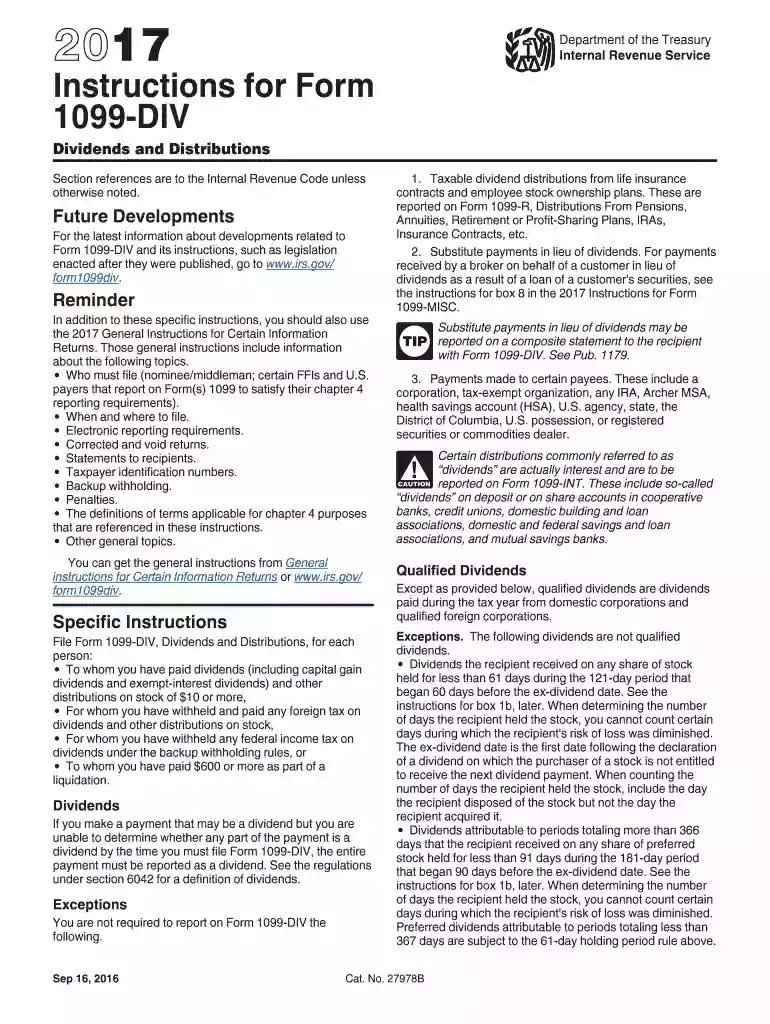
2015 1099 div instructions 2017 form-2026

Get Form
2015 1099 div instructions 2017 form Preview on Page 1

Here's how it works

01. Edit your form online
Type text, add images, blackout confidential details, add comments, highlights and more.

02. Sign it in a few clicks
Draw your signature, type it, upload its image, or use your mobile device as a signature pad.

03. Share your form with others
Send it via email, link, or fax. You can also download it, export it or print it out.

How to use or fill out 2015 1099-DIV instructions 2017 form with our platform

Form edit decoration
9.5
Ease of Setup
DocHub User Ratings on G2
9.0
Ease of Use
DocHub User Ratings on G2
  1. Click ‘Get Form’ to open the 2015 1099-DIV instructions 2017 form in the editor.
  2. Begin by entering the recipient's information in the designated fields, including their name, address, and taxpayer identification number (TIN). Ensure accuracy to avoid issues with IRS reporting.
  3. In Box 1a, report total ordinary dividends paid. This includes all dividends from stocks and mutual funds. If applicable, include reinvested dividends.
  4. For qualified dividends, enter the amount in Box 1b. These are dividends eligible for reduced capital gains rates; ensure you meet holding period requirements.
  5. Complete Boxes 2a through 11 as necessary, detailing capital gain distributions and any federal income tax withheld. Follow specific instructions for each box carefully.
  6. Review all entries for accuracy before saving your work. Utilize our platform’s features to easily edit or correct any mistakes.

Start using our platform today to fill out your forms online for free!

See more 2015 1099 div instructions 2017 form versions

We've got more versions of the 2015 1099 div instructions 2017 form form. Select the right 2015 1099 div instructions 2017 form version from the list and start editing it straight away!
Versions Form popularity Fillable & printable
2022 4.6 Satisfied (61 Votes)
2021 4.8 Satisfied (150 Votes)
2020 4.3 Satisfied (116 Votes)
2019 4.3 Satisfied (150 Votes)
2018 4.3 Satisfied (173 Votes)
2017 4.4 Satisfied (186 Votes)
2015 4.4 Satisfied (135 Votes)
2014 4.4 Satisfied (603 Votes)
2013 4 Satisfied (50 Votes)
2012 4 Satisfied (38 Votes)
be ready to get more

Complete this form in 5 minutes or less

Get form

Got questions?

We have answers to the most popular questions from our customers. If you can't find an answer to your question, please contact us.
Contact us
For ordinary dividends that arent qualified, which is equal to box 1a minus 1b, youll pay tax at ordinary rates. Qualified dividends are typically taxed as long-term capital gains. This means that if your highest income tax bracket is 15% or less, you receive these dividends tax-free.
If you had over $1,500 of ordinary dividends or you received ordinary dividends in your name that actually belong to someone else, you must file Schedule B (Form 1040), Interest and Ordinary Dividends. Please refer to the Instructions for Form 1040-NR for specific reporting information when filing Form 1040-NR.
These distributions represent a non-taxable return of capital. These distributions are a tax-free return of capital and should not be reported as income, whether received in cash or reinvested in stock. The distributions from return of capital will, however, reduce your cost basis in the shares.
Fortunately, the issuers of the Form 1099-DIV are required to report to you if the dividends are qualified or not. However, if youre not sure if a dividend is qualified, we recommend working with a tax advisor to properly report that income on your tax return.
These distributions are a tax-free return of capital and should not be reported as income, whether received in cash or reinvested in stock.

Security and compliance

At DocHub, your data security is our priority. We follow HIPAA, SOC2, GDPR, and other standards, so you can work on your documents with confidence.

Learn more
ccpa2
pci-dss
gdpr-compliance
hipaa
soc-compliance

People also ask

Both qualified and non-qualified (also known as ordinary) dividends are subject to taxation, but they are taxed at different rates. Taxes on qualified dividends are more favorable and mimic long-term capital gains tax rates, which are currently at 0%, 15%, and a maximum of 20%.
Nondividend Distributions - Report any amounts in excess of your basis in your mutual fund shares on Form 8949. Use Part II if you held the shares more than 1 year. Use Part I if you held your mutual fund shares 1 year or less.
You dont file the 1099-DIV with the IRS, but you need its information to prepare your tax return. The form includes several boxes that report different types of your income, such as ordinary dividends (Box 1a), qualified dividends (Box 1b), and capital gain distributions (Box 2a).

Related links