




01. Edit your form online
Type text, add images, blackout confidential details, add comments, highlights and more.

Type text, add images, blackout confidential details, add comments, highlights and more.

Draw your signature, type it, upload its image, or use your mobile device as a signature pad.

Send it via email, link, or fax. You can also download it, export it or print it out.
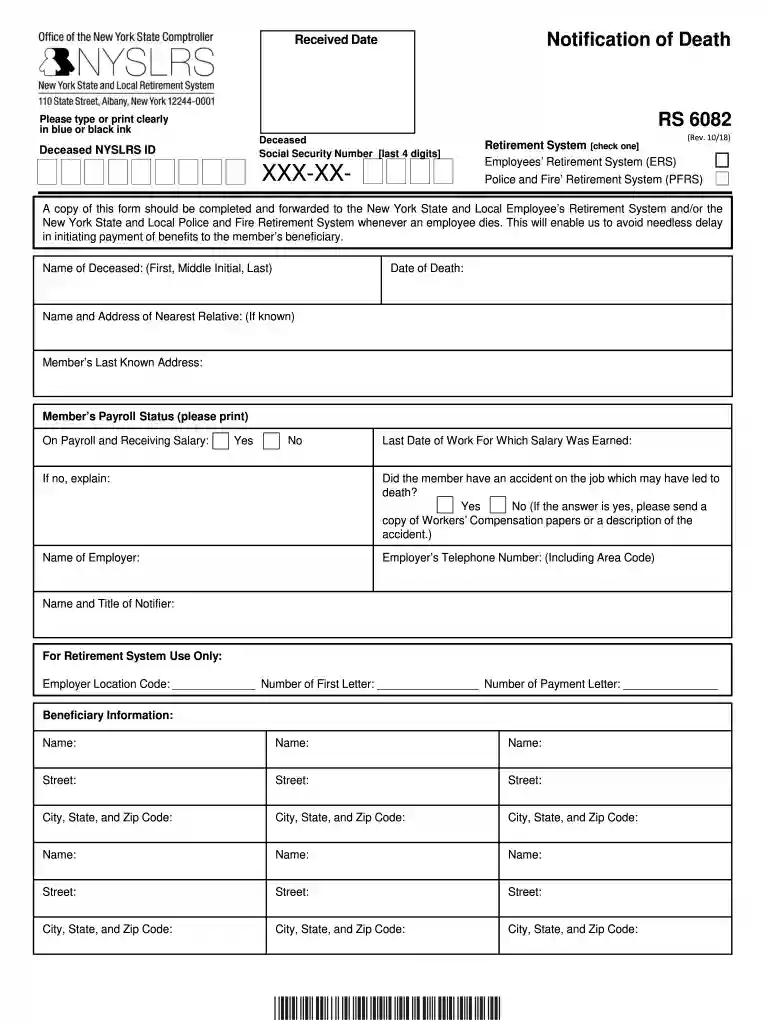
The Notification of Death (RS6082) is a critical document that must be completed and submitted to the New York State and Local Employee’s Retirement System (NYSLRS) or the Police and Fire Retirement System when an employee passes away. This form ensures that the deceased member's benefits are processed accurately and promptly. It collects crucial information about the deceased, including personal details, specifics about their death, payroll status, employer information, and beneficiary details. This facilitates the seamless continuation and distribution of entitled benefits to beneficiaries or estate representatives.
To procure the Notification of Death (RS6082) form, you can visit the official NYSLRS website where it is available for download. Alternatively, you might directly request it from the deceased member's affiliated employer or the retirement system's office. These channels ensure you're receiving the most recent version of the form, ensuring compliance with the procedural requirements. Employing these methods simplifies the process of acquisition and guarantees that all parties involved in the member's affairs can proceed without unnecessary delays.
Gather Required Information: Before completing the form, collect all necessary details such as the deceased’s personal information, including name, address, and Social Security number, details regarding their death, and payroll data.
Complete Member Sections: Fill out sections related to the deceased member accurately. This includes entering their identification numbers and employment details.
Provide Employer Information: Insert relevant employer data, ensuring the form reflects accurate records regarding employment history and pay status prior to death.
Detail Beneficiary Information: Clearly outline the beneficiaries or estate representatives to facilitate the distribution of benefits. Ensure each recipient's contact information is correct.
Verify and Submit: Double-check all entries for accuracy before submission. This review is crucial in minimizing errors that could impede the benefits distribution process.
The Notification of Death (RS6082) is mainly utilized by family members or executors of the deceased’s estate, employers, and the respective retirement systems. Executors or family members are responsible for initiating the benefits claims. Employers may need to provide additional employment details, while retirement systems use the form to process the cessation of retirement benefits and transition to beneficiaries or estate representatives.


Legally, the Notification of Death (RS6082) must be used in accordance with the New York State guidelines to ensure that benefits are distributed appropriately. It serves as an official record confirming the death of a retirement system member, thereby triggering the transition of benefits. Compliance with this form’s requirements upholds contractual obligations between the retirement system and its members, protecting all parties involved from legal discrepancies.
In New York, the Notification of Death (RS6082) abides by specific rules laid out by NYSLRS and related entities. These rules dictate the form’s completion, submission, and the timeframe in which it must be filed post-death. Compliance with these regulations ensures that the process of benefit distribution aligns with state laws and avoids potential delays attributed to regulatory non-compliance.
The form can be submitted in several ways to accommodate different user preferences:
Each method caters to different needs, providing flexibility and convenience for those handling the after-death administrative tasks.
We've got more versions of the Notification of Death (RS6082) To notify NYSLRS of a members death so that benefits can be paid, the form. Select the right Notification of Death (RS6082) To notify NYSLRS of a members death so that benefits can be paid, the version from the list and start editing it straight away!
At DocHub, your data security is our priority. We follow HIPAA, SOC2, GDPR, and other standards, so you can work on your documents with confidence.


