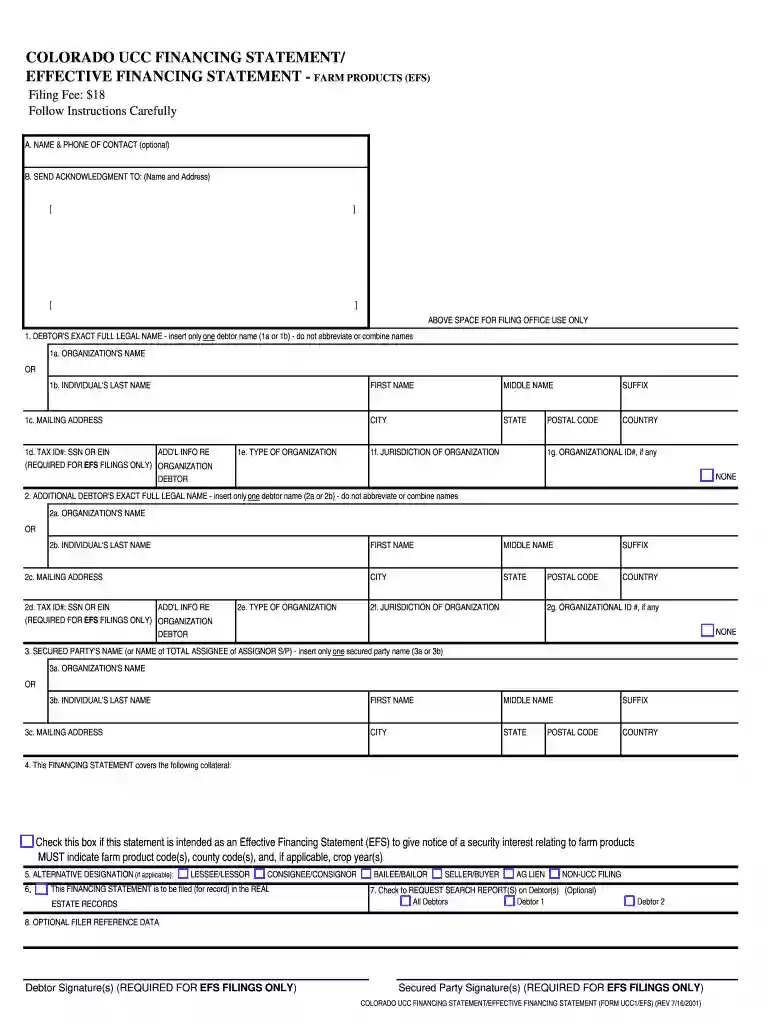
Ucc 1 filing colorado 2001 form-2026

Get Form
ucc 1 filing colorado 2001 form Preview on Page 1

Here's how it works

01. Edit your form online
Type text, add images, blackout confidential details, add comments, highlights and more.

02. Sign it in a few clicks
Draw your signature, type it, upload its image, or use your mobile device as a signature pad.

03. Share your form with others
Send it via email, link, or fax. You can also download it, export it or print it out.

Definition & Meaning

The "UCC 1 Filing Colorado 2001 Form" refers to a Uniform Commercial Code (UCC) financing statement used in Colorado to publicly declare a security interest in personal property or assets of the debtor. It serves as a legal notice filed by a secured party to announce their rights over collateral offered by the debtor. This notice is crucial in determining the priority of claims in case of debtor default. Importantly, the form primarily supports business transactions by ensuring secured parties are aware of pre-existing liens on a debtor's assets.

Key Elements of the UCC 1 Filing Colorado 2001 Form

Understanding the key elements is vital for accurately completing the UCC 1 Filing in Colorado. Essential components include:

  • Debtor Information: Complete, accurate details about the debtor, including full legal names and addresses. This ensures proper identification.
  • Secured Party Information: Information regarding the secured party, detailing names and contact information.
  • Collateral Description: A clear, detailed description of the collateral securing the debt. This might include machinery, inventory, receivables, or other personal property.
  • Filing Fee: As of 2001, Colorado mandates an $18 filing fee. Payment must accompany the form submission.
  • Optional Acknowledgements: Sections may include acknowledgements by the debtor or secured party that enhance the legal robustness of the filing.

Steps to Complete the UCC 1 Filing Colorado 2001 Form

Successfully completing the UCC 1 Filing involves several steps to ensure legal compliance and protection of interests:

  1. Gather Required Information: Compile debtor and secured party information, as well as detailed collateral descriptions.
  2. Fill Out the Form: Enter all necessary details accurately to avoid processing delays or rejections.
  3. Submit the Filing: Options include filing online, mailing, or delivering in person to the Colorado Secretary of State's office.
  4. Pay the Filing Fee: Ensure the $18 fee is paid at the time of submission using the acceptable payment methods.
  5. Receive Confirmation: After submission and processing, obtain a filing acknowledgment for records, which serves as proof of filing and ensures retrieval if needed.

Important Terms Related to UCC 1 Filing

Familiarizing with specific terms enhances clarity and ensures correct form application:

  • Debtor: The individual or entity offering collateral to secure a loan.
  • Secured Party: The lender or entity holding a security interest in the collateral.
  • Collateral: Assets or property pledged as security for a loan.
  • Security Interest: A legal claim or right on collateral that secures payment of debt.
  • Filing Jurisdiction: The state or office where the UCC filing is registered, in this case, Colorado.

Examples of Using the UCC 1 Filing Colorado 2001 Form

Practical examples demonstrate how and why businesses might use the UCC 1 Filing:

  • Agricultural Loans: Farmers may use UCC filings to secure loans by pledging farm products as collateral.
  • Business Equipment Financing: Companies obtaining financing against heavy machinery can file a UCC-1 to subordinate potential future liens.
  • Inventory Financing: Retail businesses can secure lines of credit using inventory as collateral, requiring a UCC-1 filing to protect the lender's rights.

State-Specific Rules for the UCC 1 Filing Colorado 2001 Form

Colorado has its unique nuances and legal considerations:

  • Filing Location: Secured parties must file with the Colorado Secretary of State. Variations in local rules can affect filings.
  • Name Accuracy: Discrepancies in debtor names can invalidate the filing; thus, attention to accurate state or legally recognized names is crucial.
  • Renewal and Amendments: UCC filings require renewal typically every five years to remain effective and relevant to current collateral.

Legal Use of the UCC 1 Filing Colorado 2001 Form

Legally, the UCC 1 form substantiates security interests:

  • Priority in Bankruptcy: Establishes priority rights against the debtor’s assets among multiple creditors.
  • Lien Perfection: Helps in perfecting a lien, thereby legally establishing the secured party’s claim over the collateral.
  • Public Notice: Acts as public notice, reducing the risk of lending against already-pledged collateral.

Application Process & Approval Time

Understanding this process aids in smooth filing and subsequent transaction processing:

  • Documentation Preparation: Careful preparation of debtor, secured party, and collateral information ensures completeness and accuracy.
  • Standard Processing Time: Typically, processing at state level may take a few business days post-submission, contingent on state workload and method of filing.
  • Verification and Corrections: Allow time for post-processing verification, ensuring accuracy and correction of any errors identified by parties involved.

See more ucc 1 filing colorado 2001 form versions

We've got more versions of the ucc 1 filing colorado 2001 form form. Select the right ucc 1 filing colorado 2001 form version from the list and start editing it straight away!
Versions Form popularity Fillable & printable
2007 4.8 Satisfied (103 Votes)
2001 4 Satisfied (34 Votes)
be ready to get more

Complete this form in 5 minutes or less

Get form

Got questions?

We have answers to the most popular questions from our customers. If you can't find an answer to your question, please contact us.
Contact us
They ensure your secured interest in a loan or lease, enabling you to stand at the front of the line of creditors should a debtor encounter financial difficulty or file bankruptcy during the life of your agreement. UCC-1s help you to mitigate risk and protect assets (collateral).
For instance, if a borrower takes out another loan from a second lender using the same assets as collateral, the second lender will not be permitted to recover the assets until the first lender is fully satisfied. Accordingly, UCC-1 filings are generally filed as soon as the loan is made.
Filing a UCC-1 reduces a creditors lending risks. It allows them to ensure their legal right to the personal property of a borrower should that borrower default on their loan. In addition, the UCC-1 elevates the lenders status to that of a secured creditor, ensuring that it will be paid.
For example, a drive-in movie theatre needs to borrow money from a creditor for a projector and stereo equipment. The creditor will record a UCC-1 and describe the projector and stereo equipment that was purchased with the loan.

Security and compliance

At DocHub, your data security is our priority. We follow HIPAA, SOC2, GDPR, and other standards, so you can work on your documents with confidence.

Learn more
ccpa2
pci-dss
gdpr-compliance
hipaa
soc-compliance