




01. Edit your crossover professional online
Type text, add images, blackout confidential details, add comments, highlights and more.

Type text, add images, blackout confidential details, add comments, highlights and more.

Draw your signature, type it, upload its image, or use your mobile device as a signature pad.

Send form map via email, link, or fax. You can also download it, export it or print it out.
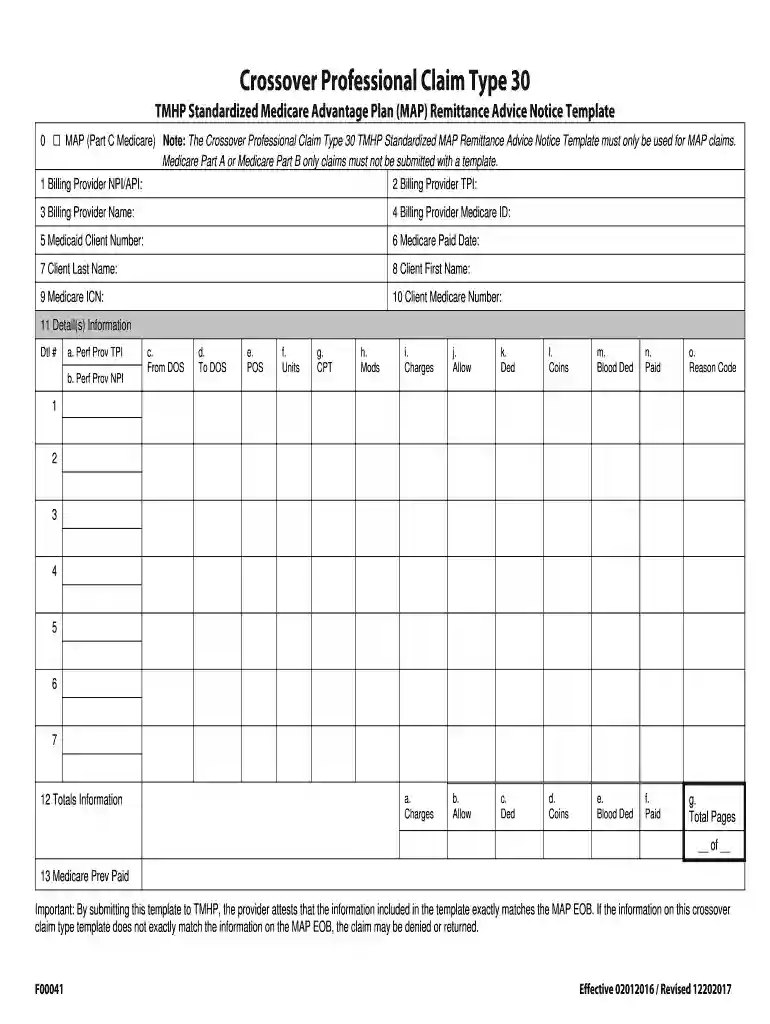
The crossover claim form is designed to streamline the billing and reimbursement process for Medicare Advantage Plan (MAP) services. It facilitates the provision of necessary information regarding the client's identity, healthcare provider details, and specific service charges. This form ensures that the claims are processed accurately, following the terms of the accompanying explanation of benefits (EOB). Its primary purpose is to simplify claim submissions by coordinating benefits between primary and secondary insurance providers, minimizing administrative burdens for healthcare providers.
Provider Information: Begin by entering the healthcare provider's details, including the National Provider Identifier (NPI) and contact information. Ensure these details match exactly with those on the client's EOB to avoid discrepancies.
Client Details: Next, provide the client's information, including name, date of birth, and their Medicare ID. Accurate client information is crucial for seamless processing.
Service Codes and Descriptions: List the relevant service codes and corresponding descriptions for each service billed. These should align with the standardized codes used in healthcare billing, such as CPT or HCPCS codes.
Dates of Service: Clearly indicate the start and end dates of the services provided. This helps in verifying the eligibility of the services under the client's current coverage period.
Charges and Payment Information: Finally, detail the charges associated with each service, including any amounts already paid or credited by other insurers. All financial details should match those outlined in the EOB to prevent claim denial.
The crossover claim form is typically available through Medicare Administrative Contractors (MACs) or directly from healthcare billing platforms. Forms can be downloaded from MAC websites or requested via mail for paper submissions. Additionally, platforms like DocHub often provide templates that can be filled out, edited, and submitted digitally, ensuring compliance with all relevant guidelines.
Proper use of the crossover claim form is governed by healthcare laws and regulations, including the Health Insurance Portability and Accountability Act (HIPAA). This form must be filled out with complete and accurate information to avoid legal issues, such as claims of fraud or non-compliance. Unauthorized disclosure of client information could lead to legal penalties under privacy regulations.
Form completion and submission processes are often facilitated by healthcare management software, such as QuickBooks and TurboTax, which integrate with billing systems to manage financial data effectively. Platforms like DocHub offer compatibility with these systems, providing flexible options for electronic form completion, signature, and submission, enhancing efficiency in document handling.
Eligibility to submit a crossover claim form mainly applies to healthcare providers offering services under a Medicare Advantage Plan. The client must hold a valid MAP and have received eligible health services that require coordination between multiple insurers. Providers must verify the details in the EOB to ensure the client meets all necessary eligibility requirements before submitting the claim.


We've got more versions of the crossover professional form. Select the right crossover professional version from the list and start editing it straight away!
At DocHub, your data security is our priority. We follow HIPAA, SOC2, GDPR, and other standards, so you can work on your documents with confidence.
Providers are required to submit a separate MS Medicare Crossover form for each payer that has processed the claim prior to Mississippi Medicaid.Read more
A crossover is defined as a claim for a member who has Medicare in addition to MassHealth, where Medicare has made a payment or has approved an amount


