




01. Edit your form online
Type text, add images, blackout confidential details, add comments, highlights and more.

Type text, add images, blackout confidential details, add comments, highlights and more.

Draw your signature, type it, upload its image, or use your mobile device as a signature pad.

Send it via email, link, or fax. You can also download it, export it or print it out.
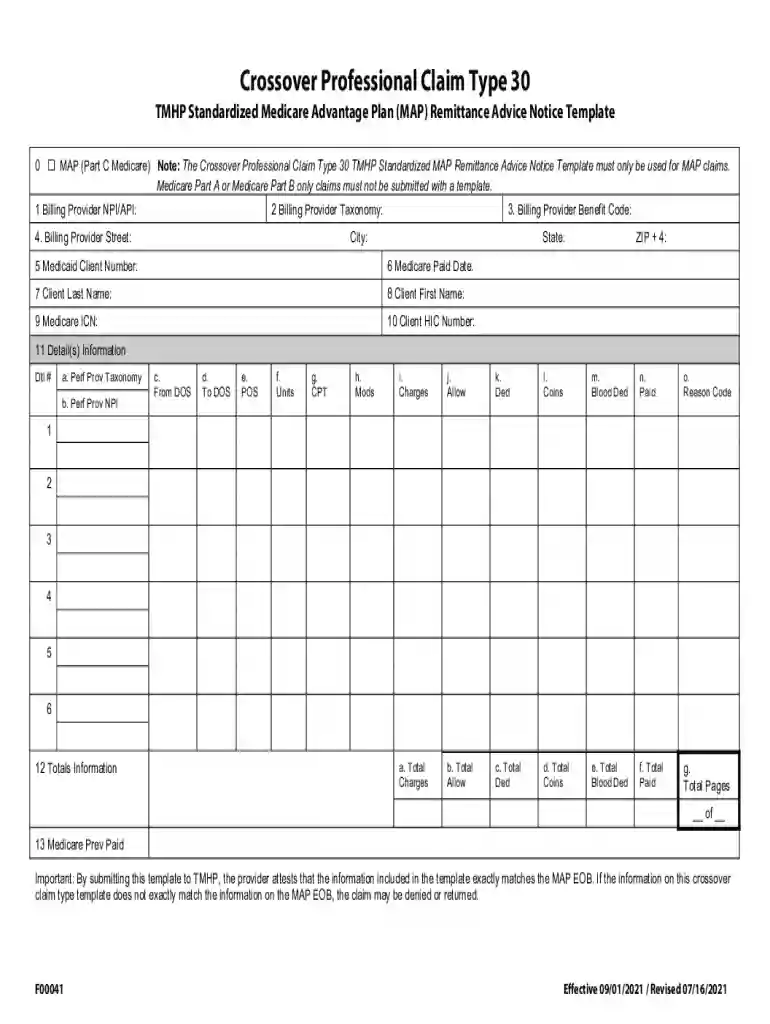
The "Crossover Professional Claim Type 30" is a specific form utilized in the medical billing process, primarily associated with Medicare Advantage Plans (MAP). This form facilitates the submission of healthcare claims where the claim crosses over from Medicare to a secondary insurance provider. The core aim of this form is to streamline the reimbursement process, ensuring that claims are processed promptly and accurately while maintaining compliance with Medicare and secondary insurance requirements.
Crossover claims typically occur when a patient is covered under multiple insurance plans. The use of the Claim Type 30 form ensures that after Medicare processes the primary portion of the claim, the remainder is automatically forwarded to the secondary insurance carrier, eliminating the need for manual intervention by the healthcare provider or billing department.
Using the Crossover Professional Claim Type 30 involves several steps designed to ensure accuracy and efficiency:
Gather Patient Information: Ensure all patient details, including insurance information, are correct. The form requires this information to match the Medicare Advantage Plan explanation of benefits (EOB) exactly.
Complete Provider Information: Accurately fill in your provider details such as name, address, and NPI number to ensure the claim is processed under the correct provider profile.
Detail the Services Provided: Include a comprehensive list of the services or treatments provided. Each service should be coded appropriately using current coding standards (e.g., CPT codes).
Submit Electronically: Utilize electronic submission methods to ensure a quick and efficient crossover process between Medicare and secondary insurance.
Monitor the Process: After submission, keep track of the claim status to ensure it transitions smoothly from Medicare to the secondary insurer, resolving any issues that arise promptly.
The process to complete the Claim Type 30 form incorporates the following steps:
Verify Information: Carefully verify every section of the form for accuracy, focusing on patient identifiers and insurance details.
Document Submission: Prepare all necessary documents including previous EOBs to support your claim submission.
Electronic Fillable Forms: Utilize fillable electronic forms provided by document management platforms such as DocHub to ensure all necessary fields are completed. Required fields must be filled or specified as mandatory to avoid processing delays.
Check for Errors: Look out for common errors such as missing signatures or incorrect codes which could lead to claim denial.
Submit for Processing: Once confident of the form’s accuracy, submit it via an approved electronic submission method. Manual submissions are generally discouraged due to higher error rates and longer processing times.
Understanding the key components of the Crossover Professional Claim Type 30 ensures comprehensive and correct submissions:
Provider Information: Essential details including the provider’s contact information, tax ID, and NPI must be accurately filled out.
Patient Demographics: Complete entries for the patient’s name, address, Medicare ID, and other relevant identifiers.
Service Codes and Descriptions: Accurate CPT and HCPCS codes describing the services provided are critical for processing.
Billing Codes and Amounts: Specify the billed amount and any already known reimbursement amounts.
Familiarity with specific terminology is crucial when handling crossover claims:
Medicare Advantage Plan (MAP): A type of health insurance plan in the United States that provides Medicare benefits through private-sector health insurers.
Explanation of Benefits (EOB): A document sent by an insurance company to a patient explaining what medical treatments and/or services were paid for on their behalf.
CPT Codes: Current Procedural Terminology codes used to describe medical, surgical, and diagnostic services.
Legal compliance is fundamental when utilizing the Claim Type 30:
Adherence to Medicare Guidelines: All claims must strictly follow Medicare regulations to remain compliant and avoid audit issues.
Electronic Signatures: Use legally binding electronic signatures for authentications whenever necessary, adhering to the ESIGN Act.
Data Security Protocols: Implement robust security measures such as encryption and password protection when handling sensitive patient information.
Timely submission of claims is necessary for reimbursement:
Medicare Deadlines: Ensure submissions fall within the Medicare filing guidelines to prevent denial due to late submissions.
Secondary Insurance Timelines: Different insurers may have various deadlines that need to be met post-Medicare processing.
Efficient submission channels enhance processing speeds:
Electronic Submissions: Preferred due to their speed and reliability. Platforms like DocHub allow for seamless document completion and submission without the need for paper copies.
Mail: While possible, mailing forms may delay the process and is often less secure than electronic options.
In-Person: Generally not applicable for crossover claims which are designed to be electronically submitted.
Understanding penalties encourages adherence:
Claim Denial: Incorrect or incomplete submissions can result in claims being denied or delayed, affecting cash flow.
Audit Risks: Non-compliance with Medicare or secondary insurer guidelines could lead to audits and potential penalties.
Credentialing Issues: Persistent non-compliance may affect a provider’s standing with insurance networks, impacting their ability to practice under certain plans.
Through a clear understanding and careful execution of these processes, handling the Crossover Professional Claim Type 30 form can be managed effectively, ensuring compliance, timely reimbursements, and continued alignment with insurance and Medicare policies.
We've got more versions of the crossover professional claim type 30 form. Select the right crossover professional claim type 30 version from the list and start editing it straight away!
At DocHub, your data security is our priority. We follow HIPAA, SOC2, GDPR, and other standards, so you can work on your documents with confidence.
Providers are advised to wait 30 days before billing for claims submitted to Medicare to allow time for the automatic crossover process to complete. IfRead more
Header Transaction Type Code. Char. 20. 0 = ORIGINAL CLAIM. 1 = VOID/CREDIT. 2 = ADJUSTMENT CREDIT. 3 = ADJUSTMENT DEBIT. 17. HDRTYPCD. Claim Type Code. Char.Read more


