




01. Edit your form online
Type text, add images, blackout confidential details, add comments, highlights and more.

Type text, add images, blackout confidential details, add comments, highlights and more.

Draw your signature, type it, upload its image, or use your mobile device as a signature pad.

Send it via email, link, or fax. You can also download it, export it or print it out.
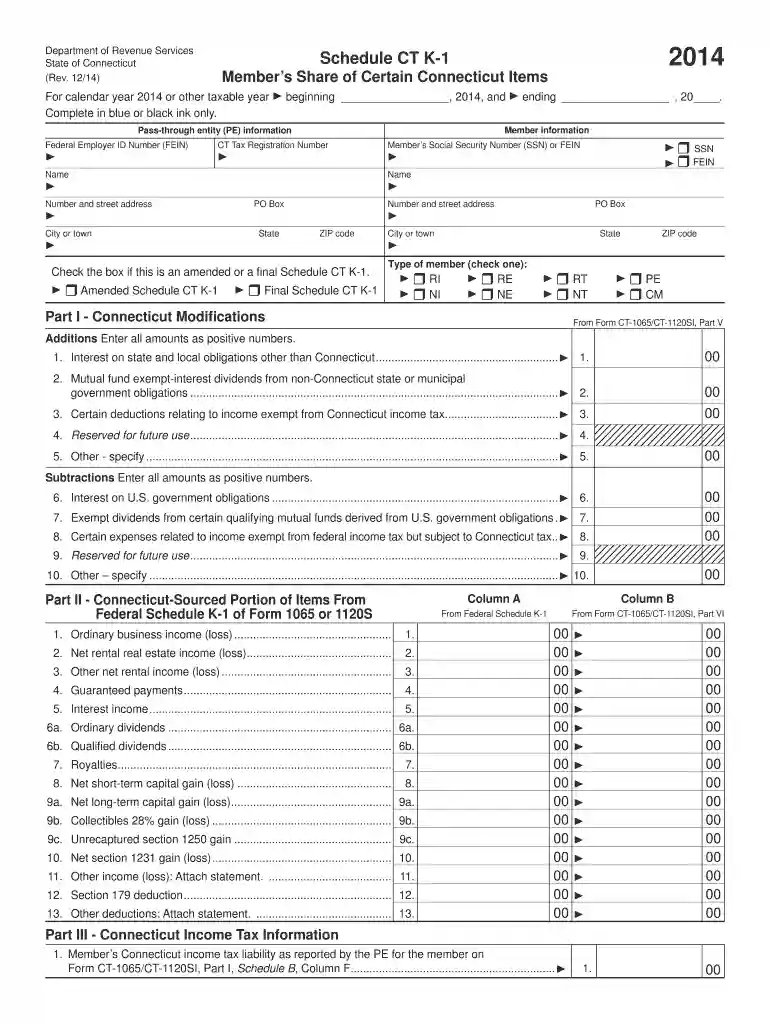
The Schedule CT K-1 form is a tax form used for the State of Connecticut. It provides details about a member's share of specific Connecticut items for the tax year 2014. This form is integral for pass-through entities (PEs) as they report member-related income, modifications, and tax credits. It ensures that members receive an accurate distribution of these financial items to correctly report on their individual tax returns. This form is part of the broader Connecticut state tax filing system and interacts with federal tax schedules to source income accurately.
Understanding key terms related to the CT K-1 2014 form is essential for accurate completion and compliance.
These terms help clarify the form's purpose and the financial implications for users.
Completing the CT K-1 2014 form requires a systematic approach to ensure accuracy.
Gather Necessary Information:
Fill in Member Information:
Report State Income:
Calculate and Apply Tax Credits:
Review and File the Form:
Adhering to deadlines ensures compliance and avoids penalties. The Schedule CT K-1 form for 2014 typically aligns with the corresponding federal tax deadlines, but state-specific deadlines might differ.
The CT K-1 2014 form is mainly utilized by individuals or entities participating in pass-through entities (PEs).


Several crucial components are captured within the CT K-1 form, ensuring comprehensive data representation.
Each element is vital to achieving transparency and ensuring all fiscal obligations are met.
Failure to properly complete or submit the CT K-1 2014 form can lead to significant penalties.
Understanding these penalties highlights the importance of precise and timely form submission.
Connecticut has unique regulations that affect how the CT K-1 form is to be filled out and interpreted.
These rules necessitate careful attention to detail when translating federal data to state requirements.
We've got more versions of the ct k1 2014 form form. Select the right ct k1 2014 form version from the list and start editing it straight away!
| Versions | Form popularity | Fillable & printable |
|---|---|---|
| 2023 | 4.8 Satisfied (52 Votes) | |
| 2022 | 4.5 Satisfied (40 Votes) | |
| 2021 | 4.7 Satisfied (67 Votes) | |
| 2020 | 4.4 Satisfied (107 Votes) | |
| 2019 | 4.3 Satisfied (181 Votes) | |
| 2018 | 4 Satisfied (40 Votes) | |
| 2016 | 4.3 Satisfied (164 Votes) | |
| 2015 | 4 Satisfied (55 Votes) | |
| 2014 | 4.4 Satisfied (60 Votes) | |
| 2013 | 4 Satisfied (42 Votes) | |
| 2012 | 4 Satisfied (45 Votes) |
At DocHub, your data security is our priority. We follow HIPAA, SOC2, GDPR, and other standards, so you can work on your documents with confidence.
federal Schedule K-1 (Form 1041), Beneficiarys Share of Income, Deductions, Credits, etc., Cornerstone Ct. 309-671-7264 Peoria, IL 61614
CT is known to inhibit its own metabolism (referred to as suicide inhibition). TCA was used as a biomarker to assess the inhibition of the cytochrome P450
A PE must furnish Schedule CT K-1 on or before the fifteenth day of the fourth month following the close of the taxable year (April 15 if the PEs taxable yearRead more


