




01. Edit your form online
Type text, add images, blackout confidential details, add comments, highlights and more.

Type text, add images, blackout confidential details, add comments, highlights and more.

Draw your signature, type it, upload its image, or use your mobile device as a signature pad.

Send it via email, link, or fax. You can also download it, export it or print it out.
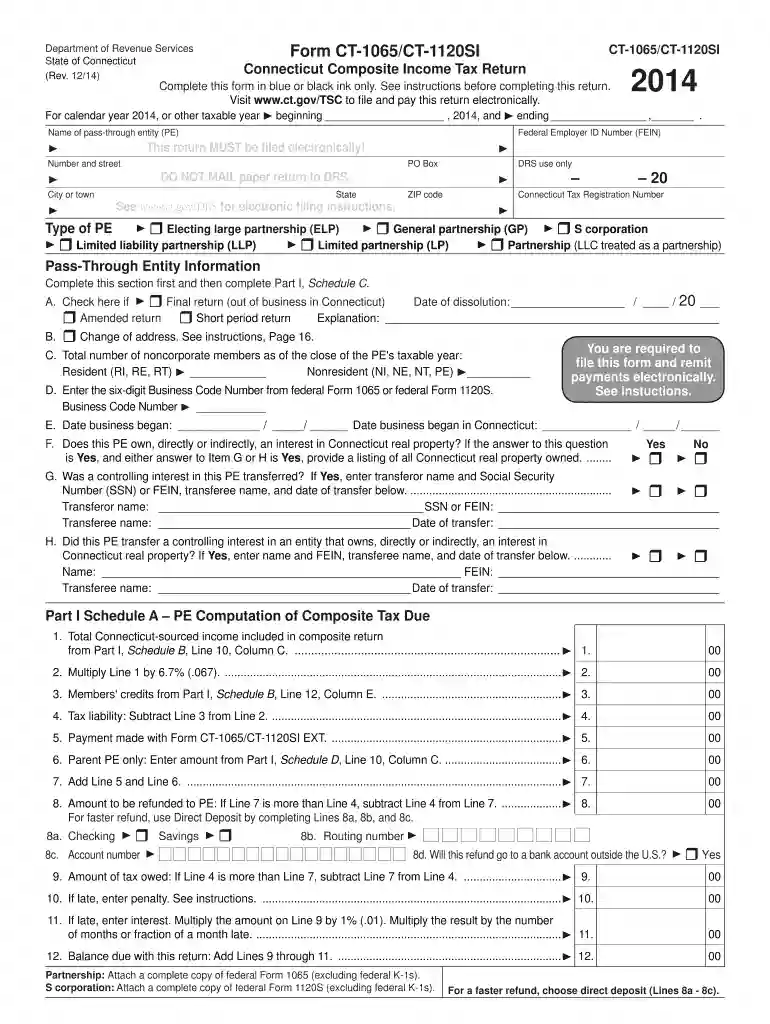
The 2014 CT-1065/CT-1120SI form is the Connecticut Composite Income Tax Return used by pass-through entities such as partnerships and S corporations. It facilitates the reporting of Connecticut-source income on behalf of nonresident members. This form ensures that entities accurately compute taxes and provide necessary member information for compliance with state tax laws.


We've got more versions of the 2014 ct 1065 form form. Select the right 2014 ct 1065 form version from the list and start editing it straight away!
| Versions | Form popularity | Fillable & printable |
|---|---|---|
| 2025 | 4.5 Satisfied (31 Votes) | |
| 2024 | 4.6 Satisfied (20 Votes) | |
| 2022 | 4.1 Satisfied (31 Votes) | |
| 2021 | 4.3 Satisfied (46 Votes) | |
| 2020 | 4.9 Satisfied (58 Votes) | |
| 2019 | 4.2 Satisfied (50 Votes) | |
| 2018 | 4.3 Satisfied (132 Votes) | |
| 2016 | 4.4 Satisfied (406 Votes) | |
| 2015 | 4 Satisfied (57 Votes) | |
| 2014 | 4.4 Satisfied (66 Votes) | |
| 2013 | 4.3 Satisfied (46 Votes) | |
| 2012 | 4.3 Satisfied (60 Votes) | |
| 2011 | 4 Satisfied (21 Votes) |
At DocHub, your data security is our priority. We follow HIPAA, SOC2, GDPR, and other standards, so you can work on your documents with confidence.
Transcripts are only available for the following returns: Form 1040 series,. Form 1065, Form 1120, Form 1120A, Form 1120H, Form 1120L, and Form 1120S. ReturnRead more
Connecticut Composite Income Tax Return Instructions. Attachement Form 2014 CT-1065/CT-1120SI. Transmittal of Schedule. Connecticuts Official State Website
UUT imaging (urography, computed tomography [CT]) may be indicated ・ role in the differential diagnosis of women with LUTS ・ such as abdominal, transvaginal,


