




01. Edit your form online
Type text, add images, blackout confidential details, add comments, highlights and more.

Type text, add images, blackout confidential details, add comments, highlights and more.

Draw your signature, type it, upload its image, or use your mobile device as a signature pad.

Send it via email, link, or fax. You can also download it, export it or print it out.
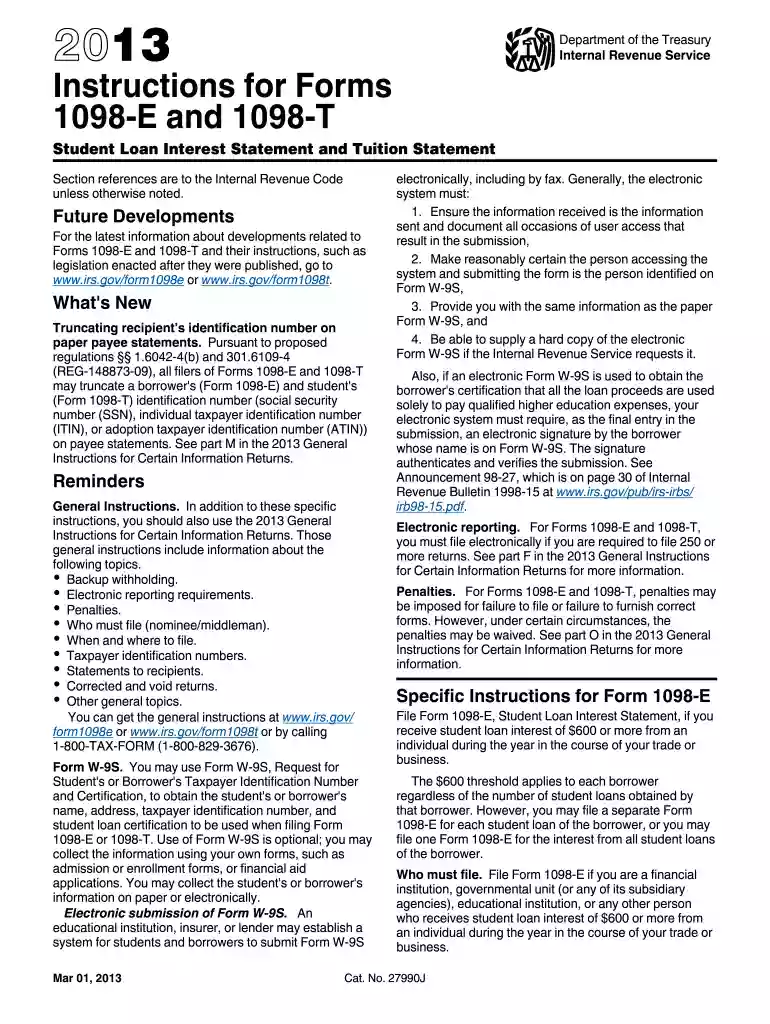
Form 1098-E, officially known as the "Student Loan Interest Statement," is an IRS tax form used to report interest paid on qualified student loans during the given tax year. Lenders provide this form to borrowers who have paid $600 or more in interest, allowing them to potentially deduct up to $2,500 of student loan interest from their taxable income. Deducting this interest lowers a taxpayer's adjusted gross income (AGI), which might lead to a reduced tax bill or an increased refund. This form is integral in ensuring borrowers can claim all allowable deductions when filing their federal tax returns.
Educational loan lenders are responsible for issuing Form 1098-E to their borrowers. If you paid $600 or more in interest on your student loans within a year, you should automatically receive this form. Typically, these forms are sent via mail or electronically by January 31, following the end of the tax year. In cases where you have not received it, borrowers should contact their loan servicer directly to request a copy. Many servicers also offer online access to tax documents through account login portals.
While Form 1098-E itself is issued by the lender and not filled out by borrowers, the information provided on it is essential for completing your tax returns.
To claim the student loan interest deduction associated with Form 1098-E:


The form consists of several important fields:
The IRS has specific guidelines regarding Form 1098-E. It mandates that all lenders must provide this form to borrowers who paid $600 or more in interest. The form encourages compliance among educational institutions and lenders, promoting transparency and accuracy in interest reporting. Additionally, adhering to these guidelines ensures that borrowers can accurately report and claim their deductions, potentially reducing their taxable income.
For Form 1098-E, lenders must send your copy by January 31st each year, allowing the borrower sufficient time to include this information in their tax filings. Taxpayers usually have until the April 15th deadline to file their taxes with the information provided. It's essential to keep these dates in mind to ensure timely tax submissions and to avoid penalties or missed opportunities for deductions.
Failure to appropriately use the information on Form 1098-E could result in inaccurate tax filings and potential fines from the IRS. Individuals who falsely claim deductions without meeting eligibility requirements might also face audits or penalties. Lenders who do not issue the form or provide incorrect amounts to borrowers may be subject to regulatory actions or penalties.
Most lenders offer Form 1098-E in both paper and digital formats. The digital version often provides the benefit of quicker access, especially through lender portals. Borrowers should ensure their contact information and account settings are up-to-date to receive digital notifications or physical copies of the form, as per their preference. Secure handling of either format is crucial to protect sensitive information.
We've got more versions of the gov form1098e or www form. Select the right gov form1098e or www version from the list and start editing it straight away!
| Versions | Form popularity | Fillable & printable |
|---|---|---|
| 2025 | 4.9 Satisfied (46 Votes) | |
| 2024 | 4.7 Satisfied (42 Votes) | |
| 2023 | 4 Satisfied (33 Votes) | |
| 2022 | 4.8 Satisfied (60 Votes) | |
| 2021 | 4.8 Satisfied (46 Votes) | |
| 2020 | 4.3 Satisfied (99 Votes) | |
| 2019 | 4.3 Satisfied (57 Votes) | |
| 2018 | 4.4 Satisfied (136 Votes) | |
| 2016 | 4.4 Satisfied (91 Votes) | |
| 2015 | 4 Satisfied (32 Votes) | |
| 2014 | 4 Satisfied (22 Votes) | |
| 2013 | 4 Satisfied (50 Votes) | |
| 2012 | 4.4 Satisfied (59 Votes) | |
| 2010 | 4.4 Satisfied (164 Votes) | |
| 2005 | 4.4 Satisfied (64 Votes) |
At DocHub, your data security is our priority. We follow HIPAA, SOC2, GDPR, and other standards, so you can work on your documents with confidence.


