




01. Edit your form online
Type text, add images, blackout confidential details, add comments, highlights and more.

Type text, add images, blackout confidential details, add comments, highlights and more.

Draw your signature, type it, upload its image, or use your mobile device as a signature pad.

Send it via email, link, or fax. You can also download it, export it or print it out.
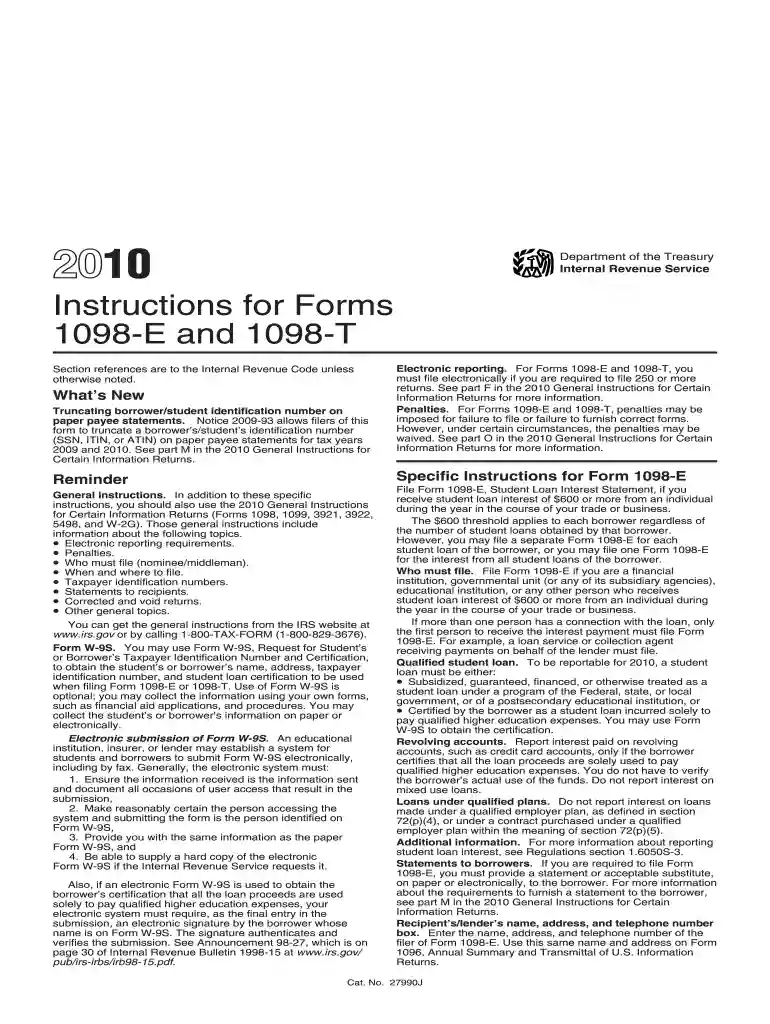
The "2010 Instruction 1098-E and T - Internal Revenue Service - irs" refers to guidelines provided by the IRS to assist taxpayers in accurately reporting student loan interest (Form 1098-E) and qualified tuition and related expenses (Form 1098-T) for the 2010 tax year. These instructions are crucial for both the individuals paying the expenses and the institutions responsible for issuing the forms. Form 1098-E helps borrowers who have paid interest on student loans to claim a deduction or credit, while Form 1098-T is used by educational institutions to report tuition payments and related information, assisting students or families to claim educational tax credits.
Form 1098-E:
Form 1098-T:
Reporting Requirements:
Receiving the Forms:
Reviewing and Cross-Checking:
Reporting on Tax Returns:
Maintaining Copies:
The IRS provides comprehensive guidelines to assist taxpayers and institutions in the submission and application of Forms 1098-E and 1098-T. Some key directives include:
Data Integrity:
Identification Numbers:
Electronic Filing:
Compliance Mandate:
Verification:
Evidence:
Information Gathering:
Verification:
Form Fill-Out:
Submission:
Non-compliance with the instruction's filing and reporting requirements can lead to several penalties:
Failure to Furnish Correct Payee Statements:
Intentional Disregard:
1098-E:
1098-T:


Form 1098-E/T:
Personal Financial Records:
Student Loan Interest Deduction:
Educational Tax Credits:
We've got more versions of the 2010 Instruction 1098-E and T - Internal Revenue Service - irs form. Select the right 2010 Instruction 1098-E and T - Internal Revenue Service - irs version from the list and start editing it straight away!
| Versions | Form popularity | Fillable & printable |
|---|---|---|
| 2025 | 4.9 Satisfied (46 Votes) | |
| 2024 | 4.7 Satisfied (42 Votes) | |
| 2023 | 4 Satisfied (33 Votes) | |
| 2022 | 4.8 Satisfied (60 Votes) | |
| 2021 | 4.8 Satisfied (46 Votes) | |
| 2020 | 4.3 Satisfied (99 Votes) | |
| 2019 | 4.3 Satisfied (57 Votes) | |
| 2018 | 4.4 Satisfied (136 Votes) | |
| 2016 | 4.4 Satisfied (91 Votes) | |
| 2015 | 4 Satisfied (32 Votes) | |
| 2014 | 4 Satisfied (22 Votes) | |
| 2013 | 4 Satisfied (50 Votes) | |
| 2012 | 4.4 Satisfied (59 Votes) | |
| 2010 | 4.4 Satisfied (164 Votes) | |
| 2005 | 4.4 Satisfied (64 Votes) |
At DocHub, your data security is our priority. We follow HIPAA, SOC2, GDPR, and other standards, so you can work on your documents with confidence.
2010 Instructions for Forms 1098-E and 1098-T Electronic reporting. For Forms 1098-E and 1098-T, you Section references are to the Internal Revenue Code unless
The 1098-T form is a Tuition Payment Statement that all higher educational institutions are required to provide to eligible students and to the IRS.


