




01. Edit your form online
Type text, add images, blackout confidential details, add comments, highlights and more.

Type text, add images, blackout confidential details, add comments, highlights and more.

Draw your signature, type it, upload its image, or use your mobile device as a signature pad.

Send it via email, link, or fax. You can also download it, export it or print it out.
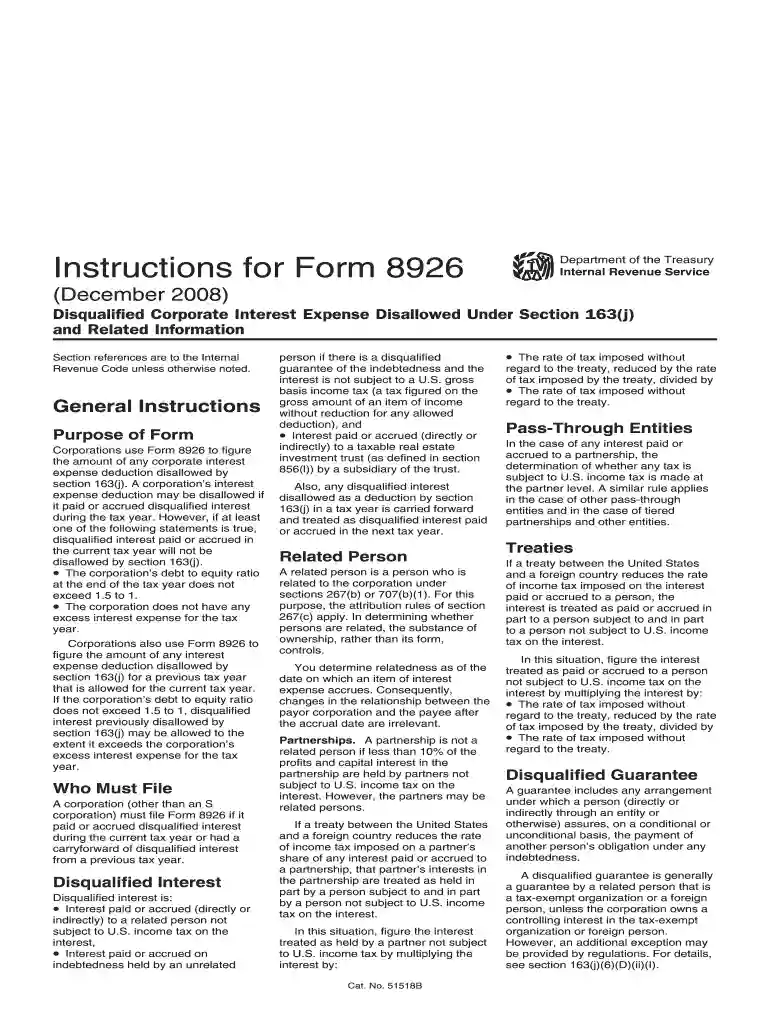
Form 8926, titled "Disqualified Corporate Interest Expense Disallowed Under Section 163(j) and Related Information", is an essential document used by corporations to navigate complex tax regulations related to interest expense restrictions. This form is necessary for calculating disallowed corporate interest expense deductions under Section 163(j) of the Internal Revenue Code. It applies primarily to those corporate entities with high debt-to-equity ratios, aiding them in ensuring compliance with statutory limits by detailing specific calculations for disqualified interest.
Corporations must accurately complete Form 8926 to report any interest expenses that are not deductible according to the limitations imposed by Section 163(j). Here’s a brief guide on its usage:
Completing Form 8926 involves a meticulous review of financial data and adherence to IRS instructions. Here is a step-by-step procedure to guide you:
Form 8926 is most commonly used by:


This form contains critical elements essential for proper completion:
The IRS provides specific guidelines for completing Form 8926, outlining definitions, instructions, and examples of disqualified interest. These guidelines are crucial for understanding how to calculate and report interest expenses accurately and ensure full compliance with federal tax laws.
Corporations must file Form 8926 along with their corporate tax return, with adherence to the established IRS tax filing deadlines. Typically, filing this form coincides with the standard corporate tax return deadline, typically March 15 or April 15, depending on fiscal years and extensions.
Failure to properly complete and file Form 8926 may result in steep IRS penalties, including fines and interest on unpaid tax amounts. Non-compliance may also trigger audits, leading to further scrutiny of financial statements and corporate records.
To accompany Form 8926, corporations should prepare and submit:
These documents provide the necessary support and validation for the calculations and claims made within Form 8926.
We've got more versions of the form 8926 example 2008 form. Select the right form 8926 example 2008 version from the list and start editing it straight away!
At DocHub, your data security is our priority. We follow HIPAA, SOC2, GDPR, and other standards, so you can work on your documents with confidence.
Form 8926 (December 2008) Disqualified Corporate Interest Expense. Form 8926 to figure accrued to a partnership, the investment trust. Example 1: would be used
The System x3250 M4 single-socket 1U rack server is designed for small businesses and first-time server buyers looking for a solution to improve businessRead more
10a b Charitable contributions if you take the standard deduction. See instructions 10b c Add lines 10a and 10b. These are your total adjustments to income . .Read more


