
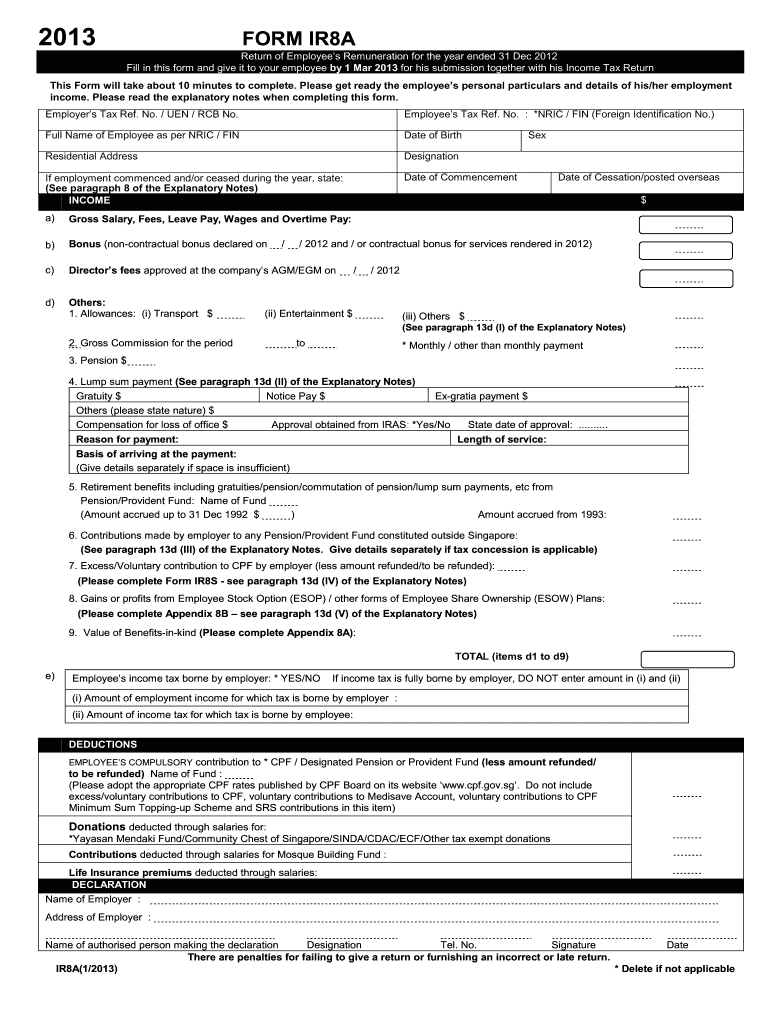







Definition and Purpose of the IR8A Form
The IR8A form is a crucial document used by employers in Singapore to report the income of their employees for tax purposes. It provides a comprehensive record of an employee's earnings, including wages, bonuses, and other benefits, ensuring that the necessary information is accurately submitted to the Inland Revenue Authority of Singapore (IRAS). This form enables efficient tax filing and compliance with local tax laws.
Key Details Captured in the IR8A Form
- Income Details: The form includes salary, bonuses, allowances, and other compensations received by the employee.
- Deductions and Contributions: It accounts for deductions like CPF contributions, donations, and any employee benefit plans.
- Employee Information: Personal details such as the employee’s name, identification number, and job title are recorded.
- Employer Declaration: An affirmation by the employer to validate the accuracy and completeness of the information provided.
Obtaining and Using the IR8A Form
Employers can obtain the IR8A form through the myTax Portal, an official online platform provided by IRAS. The process of completing and submitting the form is now streamlined through digital solutions, reducing paperwork and increasing efficiency.
Online Submission Process
- Access myTax Portal: Log in with your corporate account to access the required forms.
- Complete the Form: Input the necessary details, ensuring accuracy and completeness.
- Review and Submit: Double-check for errors before submitting the form electronically.
- Confirmation: Receive a submission acknowledgment from IRAS.
Benefits of Digital Submission
- Efficiency: Streamlines tax filing processes, saving time for employers.
- Accuracy: Minimizes errors with built-in checks and validations.
- Security: Ensures information is handled safely with encryption protocols.
Steps to Complete the IR8A Form
Completing the IR8A form involves several critical steps that ensure compliance with tax requirements and clarity in information provided:
- Gather Necessary Documents: Collect pay slips, CPF contribution records, and previous year’s tax details.
- Fill in Employee's Personal Details: Enter identification details and employment information.
- Document Earnings: Accurately list salary, bonuses, allowances, and other compensations.
- Account for Deductions: Include CPF contributions and any personal tax reliefs.
- Employer's Declaration: Affirm the accuracy of the information provided.
Common Challenges and Their Solutions
- Calculation Errors: Utilize calculators or accounting software to ensure figures are accurate.
- Missing Information: Establish a checklist of required documents and details.
- Submission Delays: Use reminders to stay ahead of deadlines.
Legal and Compliance Considerations
The IR8A form plays a crucial role in ensuring that employers comply with Singapore’s tax regulations. Non-compliance can result in significant penalties, highlighting the importance of accurate and timely submission.
Penalties for Non-Compliance
- Late Submission: Financial penalties and potential legal action.
- Inaccurate Reporting: Additional taxes or penalties, audits, and reputation damage.
- Failure to Submit: Legal consequences and possible enforcement actions by IRAS.
Important Dates and Filing Deadlines
Staying informed of important deadlines ensures compliance and avoids penalties:
- Submission Deadline: The IR8A form must be submitted by March 1st for the preceding calendar year.
- End of Financial Year: December 31st marks the cut-off for income accrual.
Preparing for Filing
- Set Calendar Reminders: Use digital tools to set deadline reminders.
- Schedule Regular Reviews: Periodically verify employee earnings and deductions.
Who Typically Uses the IR8A Form
The IR8A form is primarily used by employers with salaried or full-time employees. It is essential for businesses ranging from small enterprises to large corporations in various sectors, ensuring that employee taxation is appropriately reported.


Occupations and Industries
- Corporate Sector: Large firms in finance, manufacturing, and technology.
- Small and Medium Enterprises (SMEs): Businesses with a smaller workforce.
- Public Sector: Government and public service entities.
Software Compatibility & Integration
For businesses using payroll or accounting software, ensuring compatibility with IRAS’s platforms is vital for smooth integration and reporting.
Popular Software Solutions
- QuickBooks and Xero: Offers IRAS-compliant solutions to automatically generate and submit IR8A forms.
- Customized Business Software: Integration of IR8A form processing into existing enterprise solutions.
Benefits of Integration
- Streamlined Processes: Automatically populates fields with employee data from existing databases.
- Reduced Errors: Minimizes manual data entry and associated errors.
- Scalability: Suitable for businesses of various sizes.
Taxpayer Scenarios and Edge Cases
Different employment scenarios can impact the completion and submission of the IR8A form. Understanding these variations ensures proper compliance.

Unique Situations
- Part-Time Employees: Adjust calculations based on pro-rated income.
- Overseas Assignments: Report earnings in foreign jurisdictions appropriately.
- Contractual Workers: Determine if IR8A is applicable or if other forms are needed.
Providing comprehensive, detailed explanations and guiding through practical examples, this structured overview offers maximum utility and relevance for users dealing with the IR8A form.




