







Definition and Meaning of Income Tax Forms for Employers in Singapore
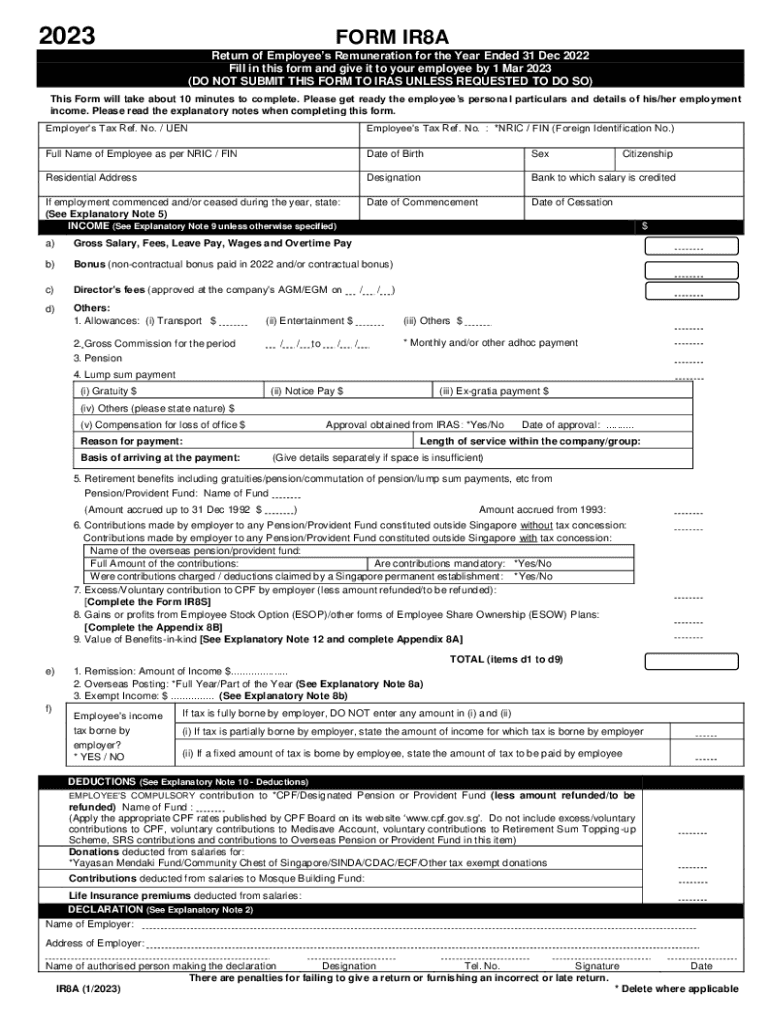
Income tax forms for employers in Singapore, like Form IR8A, are official documents used to report employee income information for the fiscal year. These forms capture comprehensive details pertaining to remuneration, complying with statutory tax obligations under the Inland Revenue Authority of Singapore (IRAS). Employers utilize these forms to ensure accurate withholding and reporting of employees’ taxable income.
Key Elements of Form IR8A
- Personal Particulars: Includes employee's name, identification number, and other necessary personal information.
- Income Details: Breaks down different types of compensation, including salaries, bonuses, and allowances.
- Deductions: Lists mandatory deductions and contributions such as CPF or other approved deductions, if applicable.
- Employer Declaration: Confirms the accuracy and completeness of the information provided.
How to Obtain Income Tax Forms for Employers in Singapore
Employers in Singapore can download income tax forms from the IRAS website. It is essential that businesses utilize the latest version to ensure compliance with current regulations. Various digital platforms like DocHub and other accounting software also offer functionalities to fill and manage these forms.
Filing Deadlines and Important Dates
- Submission to Employees: Forms should be completed and provided to employees by 1 March each year.
- Corrections and Amendments: Employers must report and correct any discrepancies promptly, as advised by IRAS guidelines.
Steps to Complete Income Tax Forms for Employers in Singapore
- Gather Necessary Information: Collect all relevant data, including personal details, income components, and CPF contributions.
- Fill Out Form IR8A:
- Enter employee and employer details.
- Itemize each component of remuneration.
- Include any deductions or reimbursements.
- Verify Information: Ensure all data matches financial records and complies with IRAS regulations.
- Submit the Form: Provide a copy to each employee and retain records for future reference.
Common Errors to Avoid
- Incorrect Personal Details: Double-check identification numbers and names.
- Misstated Income Figures: Correct any discrepancies in salary reporting.
- Missed Deadlines: Adhere to submission timelines to avoid penalties.
Legal Use and Compliance with Singapore Tax Regulations
The use of income tax forms for employers in Singapore is a legal requirement to ensure proper tax reporting and compliance. These forms are mandated by IRAS and must be accurately completed to avoid fines or penalties.
Penalties for Non-Compliance
- Fines: Imposed for late submissions or incorrect information.
- Legal Consequences: Additional actions may be taken for intentional misreporting.
Digital vs. Paper Versions: Compliance and Efficiency
Employers can choose between digital filing and traditional paper forms. Digital submissions offer increased efficiency and faster processing. Platforms like DocHub simplify form completion and filing processes, ensuring data security and compliance through encrypted document handling.
Benefits of Digital Submission
- Real-time Data Updates: Automatically syncs any changes or updates.
- E-signature Capability: Facilitates quick approval processes.
Considerations for Paper Forms
- Manual Processing: Requires accurate manual entry and physical submission.
- Storage Needs: Ensures compliance with records retention requirements.
Important Terms Related to Income Tax Forms for Employers in Singapore
Understanding specific terminology is crucial for accurate form completion:
- Remuneration: Refers to the total compensation received by an employee.
- CPF Contribution: Central Provident Fund deduction applicable as per employee benefits.
- IRAS: Governing body responsible for overseeing income tax regulations in Singapore.
Definitions of Critical Terms
- Form IR8A: Specific designation for the return of employee remuneration form.
- Deduction: Financial amounts subtracted from gross income, either by statutory requirement or agreement.
Business Entity Types Needing Income Tax Forms in Singapore
Various business entities require income tax forms to report employment-related income accurately. These include:
- Private Limited Companies: Typically have multiple employees and extensive payroll.
- Partnerships: Need to report partner remuneration subject to tax.
- Limited Liability Partnerships: Must adhere to similar regulatory reporting requirements.
Advantages for Different Entity Types
- Compliance Assurance: Minimizes risk of regulatory breaches.
- Financial Transparency: Enhances clarity on business and employee financial dealings.
Examples and Scenarios Using Income Tax Forms for Employers in Singapore
In practical terms, a multinational corporation with a regional office in Singapore uses Form IR8A to compile annual employee earnings and benefits data. This approach ensures the corporation remains compliant with IRAS regulation and accurately assess total employment costs.
Real-world Applications
- Audit Preparation: Provides a transparent record for financial reviews.
- HR Processes: Facilitates seamless salary verifications and employee records management.




