




01. Edit your form online
Type text, add images, blackout confidential details, add comments, highlights and more.

Type text, add images, blackout confidential details, add comments, highlights and more.

Draw your signature, type it, upload its image, or use your mobile device as a signature pad.

Send it via email, link, or fax. You can also download it, export it or print it out.
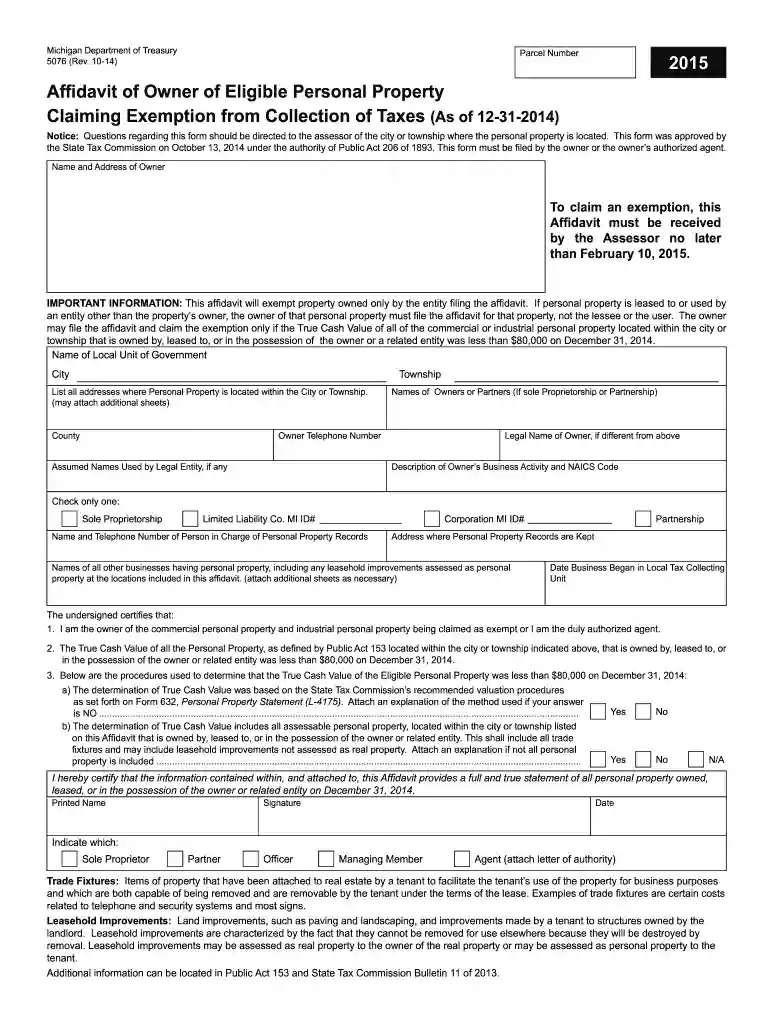
Form 5076, Affidavit of Owner of Eligible Personal Property Claiming, is a critical document issued by the Michigan Department of Treasury. It serves the purpose of allowing property owners to claim an exemption from the tax collections imposed on personal property. This exemption is specifically applicable to properties whose total cumulative value does not exceed $80,000 as of the benchmark date of December 31, 2014. Owners must present this affidavit to acknowledge their eligibility and state their claim for the exemption. The affidavit is fundamental in preventing unnecessary tax expenses on specified personal belongings.
Utilizing Form 5076 involves a precise understanding of its structure and requirements. Typically, property owners who believe their personal property’s total combined value falls below the stipulated threshold must complete and submit this form. The form is fundamentally structured to capture various essential details, including ownership status, valuation assessments, and business activities under which the property is used. By correctly filling out the necessary sections, applicants can legally assert their claim for this targeted tax exemption, ensuring compliance and avoidance of unwarranted tax liabilities.
Collect Relevant Information: Gather all ownership documentation and valuation details to ensure accuracy in reporting.
Complete Ownership Details: Fill in the ownership section, stating the legal owner(s) of the personal property.
Assess and Report Value: Use the valuation method prescribed by the Michigan Department of Treasury to calculate and report the property's total value as of December 31, 2014.
Describe Business Activity: Indicate the nature of business activities associated with the personal property, if applicable.
Sign and Date: Affix your signature to the form to verify that all provided information is true and accurate. Make sure to provide the date of completion.
Submission: Ensure that the form is filed by the stipulated deadline, February 10, to avoid penalties.
To be eligible for the exemption claimed using Form 5076, property owners must meet certain conditions:


Failing to submit Form 5076 on time or providing inaccurate information can lead to several consequences:
The crucial filing deadline for Form 5076 is February 10 every year. The form must account for property values as of December 31 of the previous year. This window is critical to ensuring property owners’ compliance and ensuring the exemption for the upcoming fiscal year.
Michigan facilitates several channels for submitting Form 5076, ensuring that owners can choose the option that best suits their convenience:
The Michigan Department of Treasury is responsible for issuing Form 5076. This department plays a crucial role in managing state taxes and providing resources and support to property owners seeking this tax exemption. The department ensures compliance with established guidelines and maintains oversight of the information provided in these affidavits.
We've got more versions of the Form 5076, Affidavit of Owner of Eligible Personal Property Claiming - michigan form. Select the right Form 5076, Affidavit of Owner of Eligible Personal Property Claiming - michigan version from the list and start editing it straight away!
| Versions | Form popularity | Fillable & printable |
|---|---|---|
| 2025 | 4.2 Satisfied (32 Votes) | |
| 2024 | 4.1 Satisfied (28 Votes) | |
| 2023 | 4.3 Satisfied (71 Votes) | |
| 2022 | 4.4 Satisfied (87 Votes) | |
| 2021 | 4.4 Satisfied (353 Votes) | |
| 2020 | 4.3 Satisfied (121 Votes) | |
| 2019 | 4.4 Satisfied (239 Votes) | |
| 2018 | 4.4 Satisfied (261 Votes) | |
| 2016 | 4.3 Satisfied (139 Votes) | |
| 2015 | 4 Satisfied (31 Votes) |
At DocHub, your data security is our priority. We follow HIPAA, SOC2, GDPR, and other standards, so you can work on your documents with confidence.


