




01. Edit your mi exemption form online
Type text, add images, blackout confidential details, add comments, highlights and more.

Type text, add images, blackout confidential details, add comments, highlights and more.

Draw your signature, type it, upload its image, or use your mobile device as a signature pad.

Send mi exemption via email, link, or fax. You can also download it, export it or print it out.
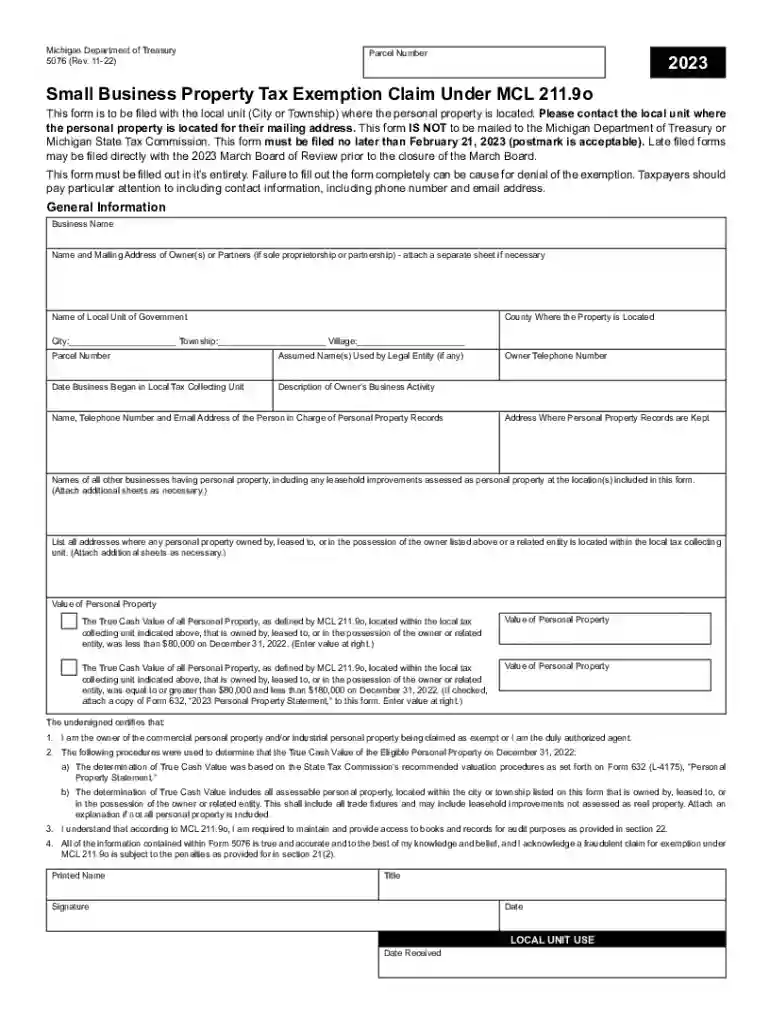
The "MI exemption" refers to a Small Business Property Tax Exemption, made available under Michigan's legislative act, MCL 211.9o. This exemption is designed to alleviate some of the tax burdens for small business owners by exempting eligible personal property from local property taxes. The primary goal is to support small businesses by reducing their financial responsibilities, thereby encouraging economic growth and stability within the state. Business owners need to determine if they qualify for this exemption and understand the implications it has on their financial obligations.
Utilizing the MI exemption involves understanding the form's requirements and submitting all necessary documentation to the appropriate local unit. Start by evaluating your business's personal property to determine if it meets the eligibility criteria. Then, gather all pertinent information about your business and prepare any required financial statements. Familiarity with the form and you will have positioned yourself for successful submission. Once you submit the exemption form, it is crucial to maintain records of your submission as it is part of your tax history.
Eligibility for the MI exemption requires business owners to evaluate their personal property's total value. Initially, the exemption is available for properties valued under $80,000. Businesses need to maintain accurate records of their property values to prove their eligibility. Companies within Michigan that adhere to these value limitations and meet other criteria laid out by the Michigan Department of Treasury can apply for this exemption. Understanding your eligibility is vital to ensuring compliance and avoiding future tax-related issues.


Assess Property Value: Begin by calculating the personal property's true cash value. This includes equipment, machinery, and other tangible assets used in business operations.
Collect Necessary Information: Gather all relevant business documentation, including previous tax returns and statements verifying property ownership and value.
Fill Out Form 5076: Acquire the 5076 form from the Michigan Department of Treasury and complete it accurately. Double-check all entries to ensure precision.
Submit to Local Unit: Deliver the completed form to the local unit where the property is located by February 21. Ensure submissions occur within the specified timeframe to qualify.
Maintain Records: Keep copies of the submission for your records. Documentation will be invaluable in case of future audits or tax assessments.
The critical filing deadline for the MI exemption is February 21 of each year. Failing to meet this deadline results in ineligibility for the exemption for that tax year, which may lead to paying full property taxes. Business owners should schedule reminders leading up to this deadline to guarantee timely submission. It is also important to remain updated on any legislative changes that might affect these dates or add additional requirements.
This exemption is primarily targeted toward small business entities operating within Michigan. Corporations, partnerships, and sole proprietorships that own qualifying tangible personal property can benefit significantly. The exemption helps businesses dealing with equipment-heavy operations, as these entities often endure larger tax burdens. Recognizing which business types benefit most aids businesses in financial planning and resource allocation.

Understanding the form is crucial:
These elements are instrumental in successfully applying for the exemption and ensuring ongoing compliance.
The exemption operates under the legal framework set by the Michigan Department of Treasury, ensuring small business owners pay taxes only on qualifying values. Adherence to legal expectations involves accurately reporting property values and maintaining proper documentation. Misuse or misreporting can result in penalties or disqualification from future exemptions. Engaging with legal counsel or a financial advisor knowledgeable in Michigan property tax laws can be beneficial for businesses navigating the exemption process.
We've got more versions of the mi exemption form form. Select the right mi exemption form version from the list and start editing it straight away!
| Versions | Form popularity | Fillable & printable |
|---|---|---|
| 2025 | 4.2 Satisfied (32 Votes) | |
| 2024 | 4.1 Satisfied (28 Votes) | |
| 2023 | 4.3 Satisfied (71 Votes) | |
| 2022 | 4.4 Satisfied (87 Votes) | |
| 2021 | 4.4 Satisfied (353 Votes) | |
| 2020 | 4.3 Satisfied (121 Votes) | |
| 2019 | 4.4 Satisfied (239 Votes) | |
| 2018 | 4.4 Satisfied (261 Votes) | |
| 2016 | 4.3 Satisfied (139 Votes) | |
| 2015 | 4 Satisfied (31 Votes) |
At DocHub, your data security is our priority. We follow HIPAA, SOC2, GDPR, and other standards, so you can work on your documents with confidence.
Sellers are required to maintain records, paper or electronic, of completed exemption certificates for a period of four years. Michigan does not issue taxRead more
Contents 1 Introduction 2 Text of Exemption 7(A) 3 Applicability. 3.1 Generally; 3.2 Generic determinations 4 Strategies for challenging Exemption 7(A)Read more


