




01. Edit your form online
Type text, add images, blackout confidential details, add comments, highlights and more.

Type text, add images, blackout confidential details, add comments, highlights and more.

Draw your signature, type it, upload its image, or use your mobile device as a signature pad.

Send it via email, link, or fax. You can also download it, export it or print it out.
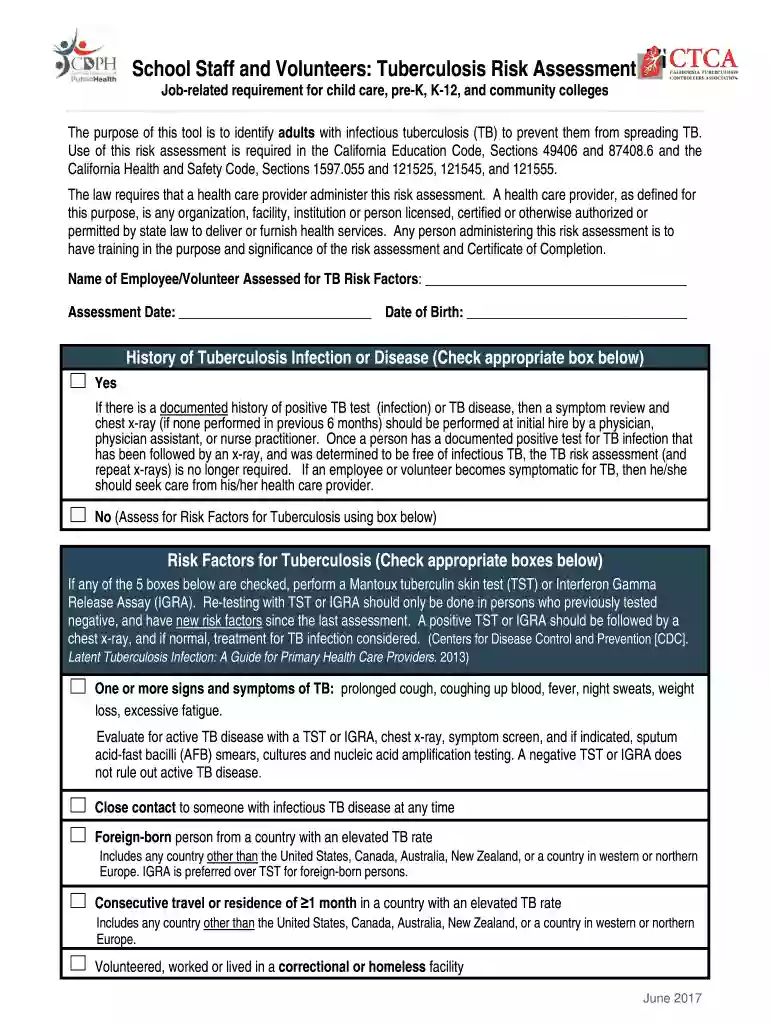
The California Tuberculosis Risk Assessment for School Staff and Volunteers is a tool designed to identify individuals at risk of developing infectious tuberculosis (TB) to prevent its spread within school environments. It is mandated by California Education and Health Codes, requiring school staff and volunteers to undergo the assessment as a precautionary measure to safeguard public health. The document includes a series of questions and criteria that help in evaluating the individual's risk based on medical history, potential exposure to TB, and any relevant symptoms.
Acquire the Form: School staff and volunteers must first obtain the assessment form, which may be available through their school district or local health department.
Consultation with Health Care Provider: Schedule an appointment with a health care provider who will administer the assessment. This may involve discussing your medical history and any potential exposure to TB.
Complete the Questionnaire: Answer the assessment questions, which focus on TB-related symptoms and risk factors, such as recent travel to countries with high TB incidence or close contact with someone with active TB.
Undergo Tests if Needed: If risk factors are identified, the health care provider may recommend further testing, such as a TB skin test or a blood test, to confirm if the disease is active or dormant.
Receive and Submit Results: Once the assessment and any additional testing are completed, ensure that the results are documented and submitted to the appropriate school authority for record-keeping and follow-up.
The assessment is primarily used by school staff and volunteers across California who are required by law to demonstrate they are not at risk of spreading tuberculosis. This group includes teachers, administrative staff, custodial workers, and any individuals who have regular contact with students. The assessment helps ensure the health and safety of both staff and the student community.
Medical History Review: The form requires a review of an individual’s personal and family medical history related to tuberculosis exposure and past TB infections, if any.
Symptom Checklist: This includes an evaluation of symptoms such as persistent cough, chest pain, unexplained weight loss, fever, and night sweats.
Follow-up Procedures: If the assessment reveals potential risk factors, additional steps including diagnostic tests like a Mantoux tuberculin skin test (TST) or Interferon Gamma Release Assays (IGRAs) may be required.
Compliance and Documentation: Proper documentation of the assessment, including any test results, must be maintained and submitted as proof of compliance with state health regulations.
The TB Risk Assessment for school staff and volunteers is legally mandated under California law as part of the effort to control and prevent the spread of tuberculosis in educational settings. Compliance is vital to ensure not only the well-being of the individual employee or volunteer but also the larger student body and school community. Non-compliance could result in penalties or exclusion from school activities.
Eligibility for the assessment is straightforward. Any adult who wishes to work or volunteer in a school setting must undergo this assessment. The requirement applies to new staff and volunteers before they commence their duties and periodically thereafter, in line with local health department regulations.


California's specific regulations ensure a standardized approach to tuberculosis risk assessment, differing from other states’ protocols due to varying TB prevalence rates and public health strategies. It's important for individuals involved in school settings to be aware of these differences to ensure full compliance and understanding of their obligations.
The assessment form may be available in both digital and paper formats, providing flexibility in how individuals and institutions choose to complete and file their documentation. Utilizing the digital version may integrate with systems like DocHub for editing, filling out, and signing forms online, thereby streamlining the process while ensuring data security and compliance with legal standards.
We've got more versions of the California Tuberculosis Risk Assessment for School Staff and Volunteers form. Select the right California Tuberculosis Risk Assessment for School Staff and Volunteers version from the list and start editing it straight away!
At DocHub, your data security is our priority. We follow HIPAA, SOC2, GDPR, and other standards, so you can work on your documents with confidence.
Compared to a point estimate risk assessment, a probabilistic risk assessment based on the same state of knowledge can provide a more complete characterizaRead more
Feb 27, 2026 California School Employee Tuberculosis (TB) Risk Assessment Questionnaire (for pre-K, K-12 schools and community college employees, volunteers


