




01. Edit your form online
Type text, add images, blackout confidential details, add comments, highlights and more.

Type text, add images, blackout confidential details, add comments, highlights and more.

Draw your signature, type it, upload its image, or use your mobile device as a signature pad.

Send it via email, link, or fax. You can also download it, export it or print it out.
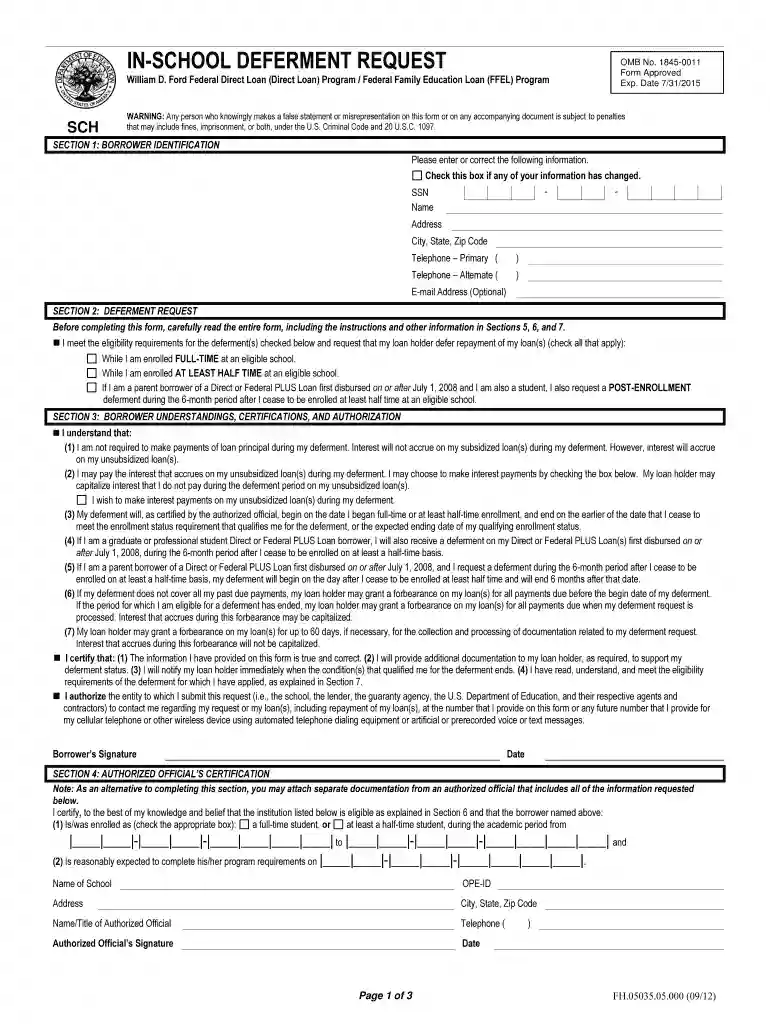
The In-School Deferment 2012 Form is used by borrowers who have taken loans under the William D. Ford Federal Direct Loan and Federal Family Education Loan programs. It allows eligible borrowers to request a deferment of their loan repayments while they are enrolled at least half-time at an eligible institution. This form provides a way for students to manage their educational debt effectively by postponing repayments during their study period.
Securing the In-School Deferment 2012 Form involves contacting your loan servicer or accessing the form via official educational loan websites. Availability of the form is designed to be straightforward to ensure borrowers can easily get the paperwork needed to apply for deferment.
Completion of the In-School Deferment 2012 Form requires attention to specific details to prevent processing delays. Borrowers should ensure all sections are accurately filled out, including personal identification and certification parts.
The form is divided into several vital sections, each crucial to the deferment request process. Understanding each element ensures comprehensive completion.
Eligibility for deferment under this form requires that the borrower meets specific conditions related to their enrollment and loan status.


The form is used within a legal framework defined by federal guidelines, ensuring that borrowers’ deferment requests comply with regulations.
Several terms are critical to understanding the deferment process. Familiarity with these will aid in accurate form completion.
Submitting the In-School Deferment 2012 Form can be done through multiple channels, ensuring accessibility for all borrowers.
Consider a student pursuing a master’s degree who wishes to temporarily suspend loan payments while studying. By utilizing this form, they can legally defer repayments and focus on their education.
Utilizing the form involves a defined application process with corresponding timelines for approval.
While the 2012 form remains a primary tool, other versions may cater to different deferment needs or be updated over time.
Each section on the In-School Deferment 2012 Form is integral to ensuring borrowers can manage their loan repayments efficiently while continuing their education. Accurate fulfillment and submission of this form help maintain financial stability and focus during academic pursuits.
We've got more versions of the in school deferment 2012 form form. Select the right in school deferment 2012 form version from the list and start editing it straight away!
At DocHub, your data security is our priority. We follow HIPAA, SOC2, GDPR, and other standards, so you can work on your documents with confidence.
The following deferment request forms are included as attachments to this letter, in both Microsoft Word and PDF format: In-School Deferment Request (SCH)
Climate Change 2001: Synthesis Report forms the fourth volume of the International Panel on Climate Change (IPCC) Third. Assessment Report, and is composed ofRead more


