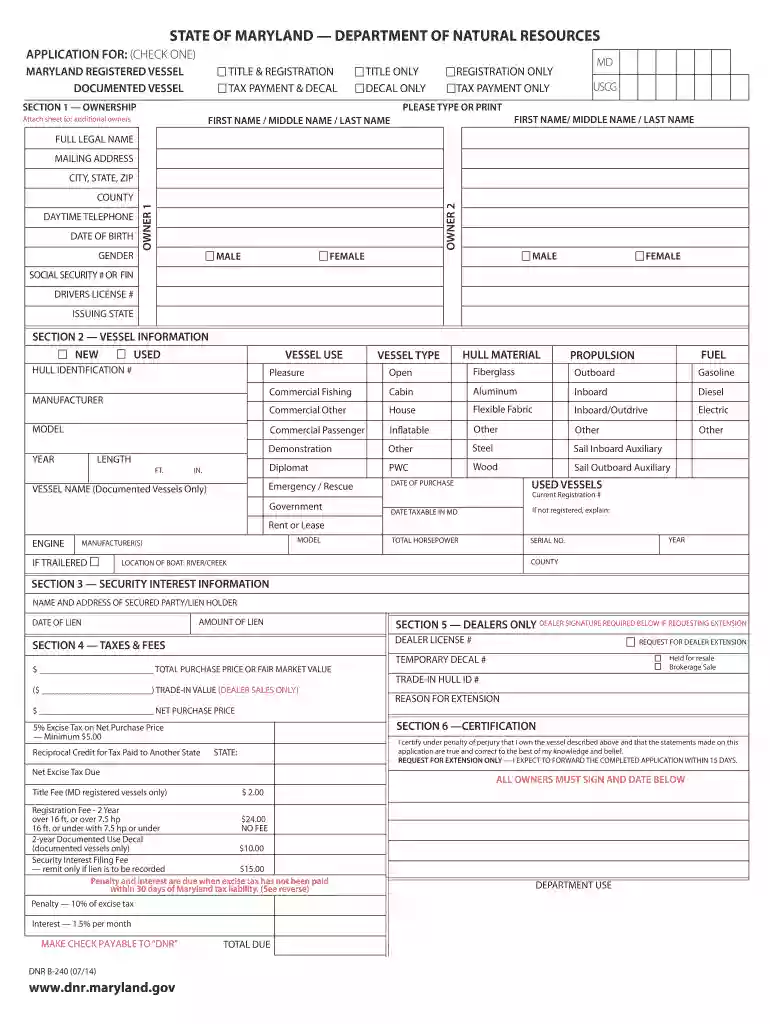
Definition and Meaning of TITLE and REGISTRATION
Title and registration are essential components in the legal documentation of vessels, ensuring both ownership verification and authority to operate the vessel legally. The title serves as the official document indicating ownership, much like a deed for a home, while the registration acts as an acknowledgment from the state that the vessel is listed for public operation. This dual-component system provides clarity and assurance, especially during transactions or legal inquiries, affirming who legally owns and is responsible for the vessel.
Ownership Documentation
- Titles confirm legal ownership of the vessel.
- Required for selling or transferring ownership.
- Protects against fraudulent claims on the vessel.
Public Operation Acknowledgment
- Registration allows legal operation on public waters.
- Typically requires annual renewal to stay current.
- Includes display of registration numbers on the vessel.
Obtaining and Using TITLE and REGISTRATION
To navigate owning or operating a vessel legally, acquiring the title and registration is a foundational step. They serve as vital legal documents for vessel owners in the U.S., offering a streamlined process to affirm ownership and legal operation privileges.
How to Acquire
- Application Submission: Complete the required state-specific application form with precise information.
- Ownership Proof: Provide a bill of sale or previous title demonstrating ownership.
- Fee Payment: Remit applicable fees for processing and issuance.
Practical Use
- Display the registration number on the vessel as proof of compliance.
- Utilize the title to facilitate sales, transfers, or securing loans using the vessel as collateral.
Steps to Complete the TITLE and REGISTRATION Process
Successfully completing the title and registration process requires precise following of outlined steps. Understanding the nuances of each step ensures compliance and avoids potential legal or operational hurdles.
Detailed Steps
- Gather Required Documents: Compile necessary ownership proofs and state-specific forms.
- Form Completion: Fill out all sections of the title and registration forms accurately; any errors can delay processing.
- Submit Application: Present completed forms and documents either by mail, online submission, or in person at the relevant authority, often the Department of Motor Vehicles (DMV).
- Process Payment: Ensure full payment of any related fees.
- Verification and Issuance: Await processing and issuance of title and registration, which may require an inspection in some states.
Edge Cases and Variations
- Some states might have additional environmental or safety compliance steps.
- Navigating co-ownership or commercial use may introduce further documentation requirements.
Importance of TITLE and REGISTRATION
The significance of titling and registering a vessel extends beyond simple compliance, offering multiple layers of legal, financial, and operational benefits.
Legal Compliance
- Required by state law for operating on public waters.
- Protects against fines and legal action for non-compliance.
Financial Protection
- Establishes clear ownership, crucial for sales and transfers.
- Protects owners from fraudulent claims or disputes.
Operations and Safety
- Ensures the vessel meets safety and environmental standards.
- Provides recognition by state and federal authorities for traveling across jurisdictions.
Key Elements of TITLE and REGISTRATION
Understanding the components and documentation involved in title and registration processes clarifies their function and streamlines acquisition and use.
Core Components
- Ownership Details: Includes owner(s) information and proof of purchase.
- Vessel Specifications: Requires details like hull identification number, make, model, and year.
- Security Interest: Documentation related to loans secured by the vessel.
- Taxes and Fees: Information and calculations regarding applicable taxes and processing fees.
- Certification: Owner or authorized party signature certifying accurate information presentation.
Additional Considerations
- Security interest sections are critical where loans against the vessel exist.
- Accurate vessel information helps prevent registration delays or issues.
State-Specific Rules for TITLE and REGISTRATION
Title and registration rules can significantly vary between states. Vessel owners must acquaint themselves with local requirements to ensure compliance and smooth processing.
Common Variations
- States like Maryland may impose specific tax obligations on vessel ownership.
- Certain states might require additional environmental compliance documentation for registration.
- Renewal processes can differ; some states offer online renewals while others may require in-person visits.
Practical Examples
- Maryland requires vessel owners to pay a state excise tax as part of the registration process.
- California necessitates expanded environmental compliance due to stringent state-level regulations.
Required Documents for TITLE and REGISTRATION
The meticulous preparation and collection of required documents streamline the registration process, eliminating potential delays or rejections.
Necessary Documents
- Bill of Sale: Demonstrates the transfer of ownership.
- Previous Title (if applicable): Needed for previously owned vessels.
- Owner Identification: Copies of driver’s license or other state-issued ID.
- Proof of Payment for Taxes and Fees: Receipt or confirmation showing applicable payments made.
Real-World Scenarios
- First-time vessel owners may need dealer-provided documents for new vessels.
- Transfers among family members might necessitate additional relationship verification documents.
Penalties for Non-Compliance with TITLE and REGISTRATION
Vessel owners must adhere to title and registration regulations to avoid potential consequences that can impact legal standing, financial security, and operational capability.
Common Penalties
- Fines: Monetary penalties for operating an unregistered vessel or failing to renew registration.
- Legal Action: Lawsuits or court actions resulting from non-compliance or operation without title.
- Operational Restrictions: Inability to legally operate or sell the vessel until compliance is achieved.
Mitigation Strategies
- Regularly check state regulations to remain compliant.
- Set reminders for timely registration renewals and updates.