
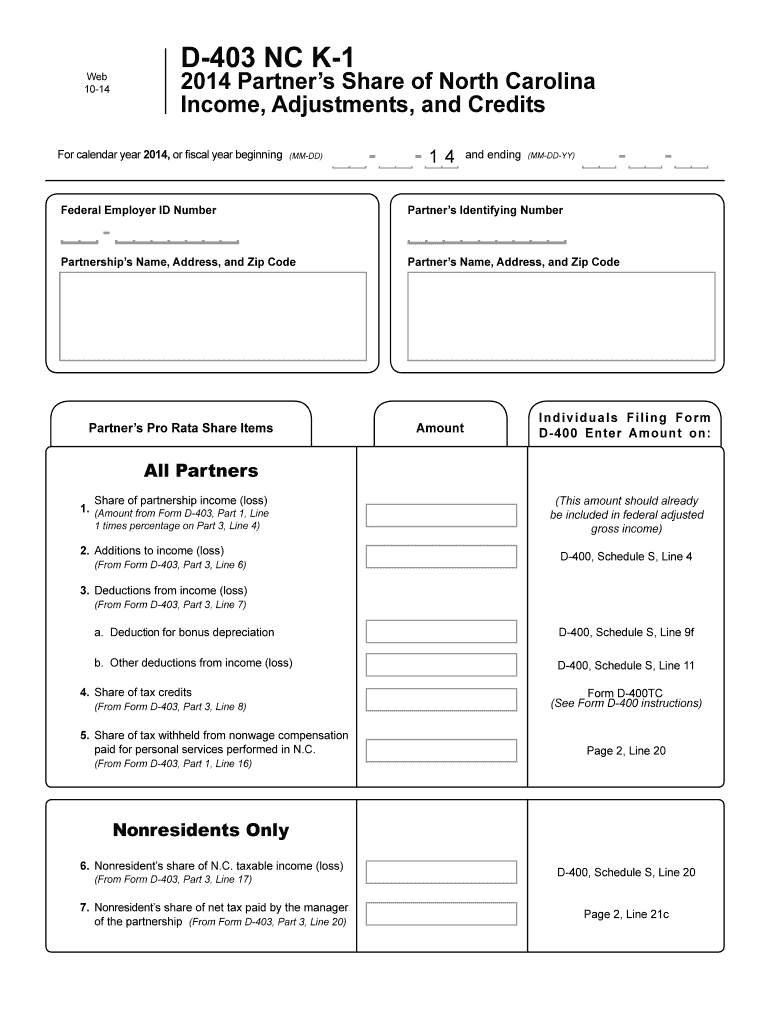







Definition and Purpose of the D-403 North Carolina 2014 Form
The D-403 is a partnership tax form used in North Carolina for the year 2014. It is primarily utilized by partnerships to report the distributive shares of income, adjustments, and credits attributable to each partner. This form is essential for both resident and nonresident partners as it indicates their share of the partnership's income or loss, which impacts their individual tax returns. The form includes sections for reporting partnership income, deductions, tax credits, and specific instructions for computing tax liabilities for both resident and nonresident partners.
How to Use the D-403 North Carolina 2014 Form
To properly utilize the D-403 form, partnerships must accurately report their financial operations to the North Carolina Department of Revenue. Here are the steps involved:
-
Identification Information: Provide the partnership’s name, address, and federal employer identification number (FEIN).
-
Income Reporting: Record the total income generated by the partnership. This includes ordinary business income, interest, dividends, and any other forms of income.
-
Adjustments and Deductions: List allowable deductions and adjustments related to the partnership’s operations. This may involve special deductions specific to North Carolina tax laws.
-
Partner’s Share Allocation: Clearly outline each partner's share of income, deductions, credits, etc.
-
Tax Credits: Include any applicable tax credits that the partnership can claim, affecting the partners' taxable income.
-
Final Review and Signature: Ensure all information is accurate and complete. The D-403 must be signed by a general partner or LLC member before submission.
Steps to Complete the D-403 North Carolina 2014 Form
Completing the D-403 involves several key steps to ensure compliance with North Carolina tax regulations:
-
Gather Required Documents: Collect all necessary financial records, such as the partnership's income statement and balance sheet.
-
Fill in Basic Information: Enter the partnership's identification details, including the FEIN and business name.
-
Report Income and Deductions: Carefully fill out sections related to the partnership's overall income, deductions, and net business income or loss.
-
Allocate to Partners: Distribute the shares of income, losses, and credits to each partner according to their partnership agreement.
-
Complete Supplementary Schedules: Attach any required supplemental schedules that provide detailed breakdowns of specific income or deduction items.
-
Review and File: Ensure the form is accurate, complete, and signed before filing it with the North Carolina Department of Revenue by the specified deadline.
Who Typically Uses the D-403 North Carolina 2014 Form
The D-403 form is predominantly used by partnerships and limited liability companies (LLCs) that are treated as partnerships for tax purposes. It is essential for entities registered in North Carolina with any income, deductions, or credits that need to be reported to the state's taxation authority. Both individuals and entities that have a stake in partnerships based in North Carolina, regardless of their resident status, must utilize this form to accurately report their share of the partnership's taxable income.


Filing Deadlines and Important Dates
The D-403 form has specific filing deadlines that must be adhered to prevent penalties. Typically, the form is due by the 15th day of the fourth month following the end of the taxable year, usually making the deadline April 15 for calendar-year taxpayers. Partnerships requiring an extension can submit Form D-410P to receive an additional six months, provided it is filed before the original deadline. Staying aware of these dates is crucial for maintaining compliance and avoiding late fees.
Required Documents for Filing
Prior to filing the D-403, partnerships must ensure that they have the supporting documentation needed to back up the entries on the form:
- Partnership Agreement: To verify the allocation of income and deductions among partners.
- Financial Statements: Income statement and balance sheet outlining the partnership's financial position for the year.
- Tax Credit Documentation: Evidence supporting any claimed tax credits.
- Prior Year’s Tax Returns (if applicable): Useful for comparative purposes and ensuring consistency from year to year.
Form Submission Methods
The D-403 form can be submitted through multiple channels to accommodate different preferences and technological capabilities:
Online Submission
Filing online through the North Carolina Department of Revenue's official website offers convenience and quick processing. The system provides a confirmation receipt upon successful submission.
Mail Submission
Partnerships may prefer traditional paper filing via mail. Completed forms should be mailed to the address specified by the North Carolina Department of Revenue, and it's advisable to use a service with package tracking.
In-Person Submission
For those who prefer face-to-face transactions, in-person submissions can be made at authorized North Carolina Department of Revenue locations.
Penalties for Non-Compliance
Failure to file the D-403 form on time or inaccurately completing it can result in penalties. North Carolina imposes late filing penalties, typically calculated as a percentage of taxes due, along with possible interest accruing daily from the extended due date. In extreme cases of deliberate non-compliance, more severe penalties or legal action could be pursued by the state tax authorities. Ensuring thorough and timely submissions helps avoid these repercussions.
Important Terms Related to the D-403 North Carolina 2014 Form
Familiarity with the following terms is crucial for accurate completion and understanding of the D-403 form:
- Distributive Share: The portion of partnership income or loss allocated to each partner.
- Nonresident Partner: A partner who resides outside the state of North Carolina but receives income from a partnership located within the state.
- FEIN (Federal Employer Identification Number): A unique identification number assigned to business entities for tax filing purposes.
- Pass-through Entity: A business structure where income is not taxed at the entity level, but rather passed through to owners or partners.
This structured information will enable a comprehensive understanding of the D-403 North Carolina 2014 form, ensuring accurate reporting and compliance with state tax regulations.




