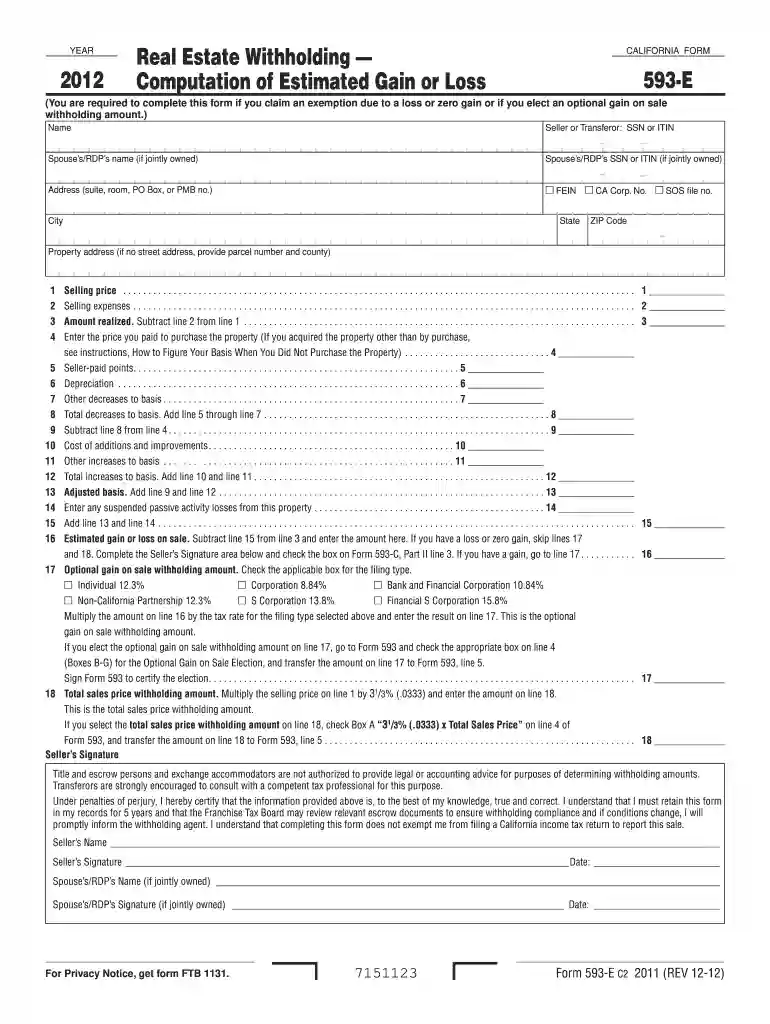
593 e 2012 form-2026

Get Form
593 e 2012 form Preview on Page 1

Here's how it works

01. Edit your form online
Type text, add images, blackout confidential details, add comments, highlights and more.

02. Sign it in a few clicks
Draw your signature, type it, upload its image, or use your mobile device as a signature pad.

03. Share your form with others
Send it via email, link, or fax. You can also download it, export it or print it out.

Definition and Purpose of California Form 593-E

California Form 593-E is used specifically for real estate withholding at the time of selling or transferring property. This form is required to calculate and document the estimated gain or loss from the sale, helping ensure compliance with California's tax regulations. The form aids sellers or transferors in declaring the necessary details, which include the selling price, various expenses, and any adjustments made to the basis of the property. It plays a critical role in protecting both the state's interest in tax revenue and the seller's right to exemptions.

How to Obtain the Form

Acquiring California Form 593-E can be done through multiple channels. The form is readily available for download from the Franchise Tax Board’s official website. Additionally, tax professionals often have access to this form and can provide a copy to their clients. Sometimes, real estate brokers or attorneys involved in a property transaction can supply the form as part of the closing paperwork. It is essential to ensure the form version is up-to-date, reflecting any recent tax law changes.

Steps to Complete California Form 593-E

  1. Gather Necessary Information:

    • Start with basic details such as names, addresses, and taxpayer identification numbers of both the seller and the buyer.
    • Document the selling price and any associated expenses.
  2. Calculate Adjustments and Gains:

    • List and compute any adjustments to the property’s basis.
    • Deduce permitted exemptions and calculate the estimated gain or loss from the sale.
  3. Fill in the Form:

    • Complete the form fields carefully, inserting calculated figures where required.
    • Be sure to double-check entries for accuracy to prevent submission errors.
  4. Review and Attachments:

    • Attach any required documents that substantiate the figures and calculations.
    • Review the whole form for completeness and accuracy.
  5. Submission:

    • Submit the completed form as per the outlined method — either electronically or via mail.
    • Retain a copy for personal records.

Who Typically Uses California Form 593-E

Primarily, California Form 593-E is utilized by individuals or entities involved in the sale or transfer of real estate property within California. This includes homeowners, corporations, LLCs, and partnerships selling property that witnesses a gain or loss. Real estate agents and brokers may also use this form to assist clients in complying with state tax requirements. Additionally, tax professionals engage with this form regularly to provide services to their clients during property transactions.

Key Elements of the Form

  • Personal and Transactional Details: Identifying information about the seller, buyer, and property.
  • Computation of Estimated Gain or Loss: Important calculations summarizing financial aspects of the transaction.
  • Exemption Clauses: Sections allowing for potential exemption claims based on certain criteria.
  • Declaration and Signatures: Concluding parts of the form where parties involved affirm the accuracy of the details provided.

Important Terms Related to California Form 593-E

  • Withholding: The portion of the selling price retained to cover potential tax liabilities.
  • Exemption Threshold: Specific conditions under which sellers may avoid withholding.
  • Basis Adjustment: Changes made to the original price or value of the property that affects gain calculations.

Legal Use and Compliance

The correct completion and submission of California Form 593-E are critical to staying in compliance with state laws. Real estate withholding ensures that taxes on gains from property sales are managed appropriately. Non-compliance can lead to penalties or additional scrutiny from tax authorities. It's advisable for sellers to consult with a qualified tax professional to navigate any complexities and ensure that all legal obligations are met during a property sale.

State-Specific Rules for Real Estate Transactions

California imposes specific rules for real estate transactions, particularly those involving nonresident sellers. These rules mandate withholding to make sure taxes on capital gains are accurately reported and paid. Sellers should be aware that even if they qualify for exceptions, proper documentation and Form 593-E filing is critical. Differences in regulations compared to other states underline the necessity for state-focused financial advice and diligent form documentation.

See more 593 e 2012 form versions

We've got more versions of the 593 e 2012 form form. Select the right 593 e 2012 form version from the list and start editing it straight away!
Versions Form popularity Fillable & printable
2019 4.8 Satisfied (141 Votes)
2018 4.3 Satisfied (140 Votes)
2017 4.4 Satisfied (940 Votes)
2016 4.3 Satisfied (104 Votes)
2015 4.2 Satisfied (51 Votes)
2014 4 Satisfied (47 Votes)
2013 4.2 Satisfied (50 Votes)
2012 4.3 Satisfied (55 Votes)
2011 4 Satisfied (36 Votes)
be ready to get more

Complete this form in 5 minutes or less

Get form

Got questions?

We have answers to the most popular questions from our customers. If you can't find an answer to your question, please contact us.
Contact us
The rate of withholding is 3 1/3 percent of the sales price, but the seller/transferor may elect an alternative withholding calculation based on the gain required to be recognized from the sale as set forth in FTB Form 593, Real Estate Withholding Statement, or any successor form designated by the Franchise Tax Board
The amount is withheld by the Settlement Agent from the Sellers account at the closing of the transaction and sent to the Franchise Tax Board (FTB). The amount is considered a prepayment of income taxes on the potential gain.
To claim exemption from state income tax withholding, employees must submit a W-4 or DE-4 docHubing that they did not have any federal tax liability for the preceding year and that they do not anticipate any tax liability for the current taxable year.
Withholding is not required when any of the following is true: The total sale price does not exceed $100,000. The seller is a bank acting as a fiduciary for a trust. The property is being foreclosed upon (see question 28). The seller meets a full exemption on FTB Form 593 -C.
Any remitter (individual, business entity, trust, estate, or REEP) who withheld on the sale/transfer of California real property must file Form 593 to report the amount withheld. If this is an installment sale payment after escrow closed, the buyer/transferee is the responsible person.

Security and compliance

At DocHub, your data security is our priority. We follow HIPAA, SOC2, GDPR, and other standards, so you can work on your documents with confidence.

Learn more
ccpa2
pci-dss
gdpr-compliance
hipaa
soc-compliance
be ready to get more

Complete this form in 5 minutes or less

Get form

People also ask

If the sale price is $300,000 or less Properties bought and sold for no more than $300,000 do not require a FIRPTA withholding, as long as the buyer or a member of the buyers family intends to live at the property for at least half of the first two years after the purchase.
Sole proprietors and general partnerships dont have to pay the California Franchise Tax, but they also dont have any personal liability protection. For some small businesses that have a low likelihood of being sued, operating as a sole proprietorship or general partnership may be good idea.

Related links