




01. Edit your form online
Type text, add images, blackout confidential details, add comments, highlights and more.

Type text, add images, blackout confidential details, add comments, highlights and more.

Draw your signature, type it, upload its image, or use your mobile device as a signature pad.

Send it via email, link, or fax. You can also download it, export it or print it out.
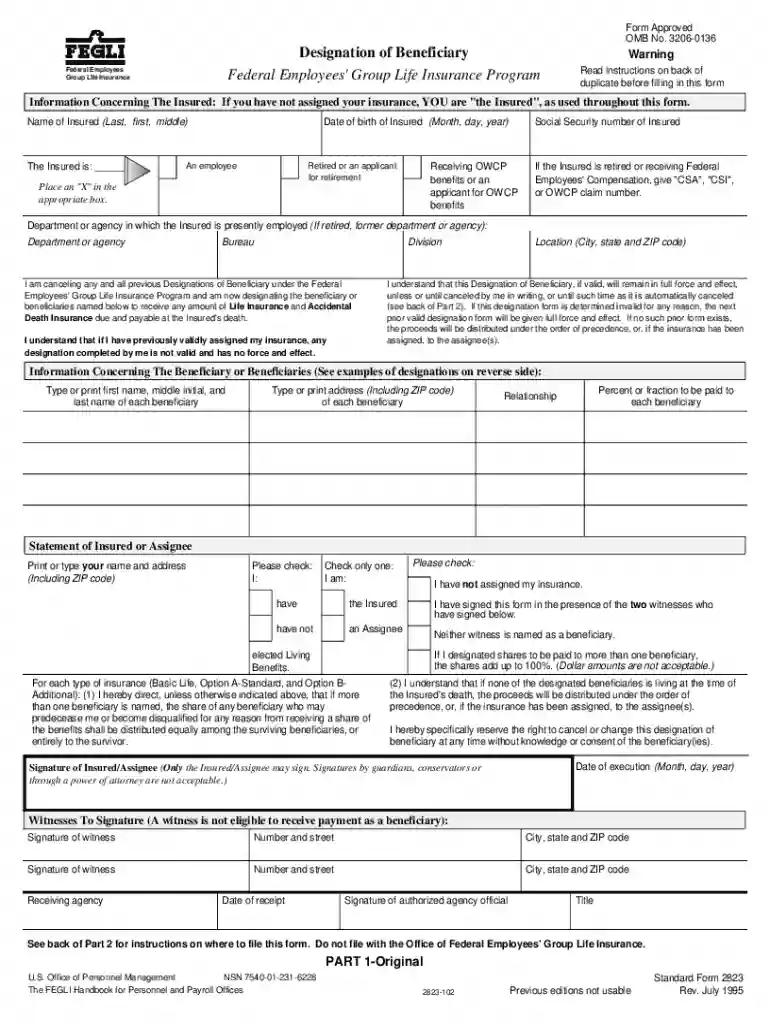
The 1995 OPM SF 2823, officially known as the Designation of Beneficiary form, is crucial for federal employees who participate in the Federal Employees' Group Life Insurance (FEGLI) Program. This document allows policyholders to designate who should receive the life insurance and accidental death benefits in the event of their passing. The primary purpose of this form is to ensure that beneficiaries receive benefits according to the insured's intentions, which may differ from the automatic legal order of distribution.
Understanding the critical components of the SF 2823 is essential for accurate completion:
Federal employees enrolled in the FEGLI program are the primary users of the SF 2823 form. It is also utilized by retired federal employees who wish to update their beneficiary information. This form is vital for those with dependents or specific individuals they want to prioritize over the default order of precedence.


Completing the SF 2823 ensures legal documentation of a policyholder’s wishes regarding benefit distribution. It overrides the standard legal order when validly filed. The legal enforceability of this form provides peace of mind that beneficiaries will receive assets according to the insured's explicit instructions.
The SF 2823 can be accessed through various means:
Once completed, the SF 2823 can be submitted through multiple channels:
While there is no strict filing deadline for the SF 2823, timely updates are crucial after life changes such as marriage, divorce, or the birth of a child. Ensuring the form reflects current beneficiary choices avoids future complications for heirs. Maintain a routine check to verify the form’s accuracy, especially after any major life events.
We've got more versions of the 1995 OPM SF 2823 form. Select the right 1995 OPM SF 2823 version from the list and start editing it straight away!
At DocHub, your data security is our priority. We follow HIPAA, SOC2, GDPR, and other standards, so you can work on your documents with confidence.
1995 SUBJECT: Federal Employees Group Life Insurance Revision of SF 2823, Designation of Beneficiary. The revised form is dated March 1995. ed SF 2823 will be
GLMol Visualization chain spectrum. SF FILE CONTAINS FRIEDEL PAIRS UNDER I/ REMARK 3 FMINUS AND I/FPLUS COLUMNS. ATOM 1995 OG1 THR A 272


