




01. Edit your form online
Type text, add images, blackout confidential details, add comments, highlights and more.

Type text, add images, blackout confidential details, add comments, highlights and more.

Draw your signature, type it, upload its image, or use your mobile device as a signature pad.

Send it via email, link, or fax. You can also download it, export it or print it out.
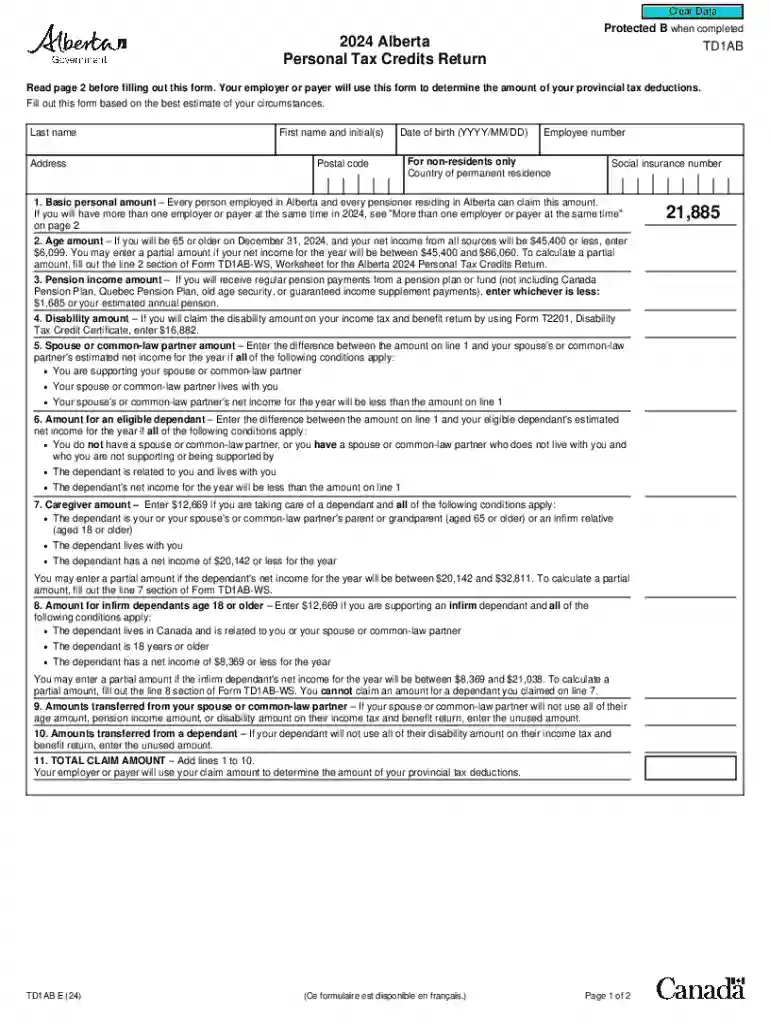
The "Worksheet for the 2024 Alberta Personal Tax Credits Return," often referred to as the TD1AB, is an essential document used by residents of Alberta to calculate their personal tax credits. It serves as a tool to establish the amount of provincial tax deductions one is eligible for based on various personal circumstances. This worksheet helps ensure individuals claim all possible credits, such as the basic personal amount, age amount, pension income amount, and caregiver amount. By accurately completing the form, taxpayers can effectively manage their provincial tax obligations and maximize their available credits.
To effectively use the TD1AB worksheet, individuals should gather all relevant personal and income information before starting. This includes:
Reviewing the checklist of personal tax credits and determining which apply to their situation.
Accurately entering income details and other financial data that impact their credit eligibility.
Following specific instructions on the form to calculate each applicable tax credit.
Summing the amounts to find the total tax credits they can claim.
By carefully following these steps, users ensure the worksheet's figures are precise, facilitating accurate deductions when filing their provincial taxes.
Completing the TD1AB involves a structured, step-by-step approach:
Personal Information: Begin by filling in your basic personal details, such as name, address, and Social Insurance Number (SIN).
Basic Personal Amount: Enter the basic personal amount indicated for the 2024 tax year.
Additional Credits: Identify additional credits relevant to your situation, like the age amount if you’re 65 or older.
Total Calculation: Add the eligible credits to calculate your total personal tax credits.
Final Review: Double-check each entry for accuracy to avoid any errors that could affect your tax outcome.
Completing each section accurately ensures compliance and helps to efficiently maximize tax benefits.
Several key components influence the TD1AB form’s structure:
Basic Personal Amount: The foundational credit for all Alberta residents.
Age Amount: A credit available for those who are 65 or older.
Pension Income Amount: Applicable for individuals receiving eligible pension income.
Caregiver Amount: For those providing care to dependents with impairments.
Each element requires specific criteria to be met, and understanding these criteria is crucial for accurate completion of the worksheet.
Familiarizing yourself with terms used in the worksheet can streamline the completion process:
Tax Credits: Amounts that can be subtracted from the amount you owe in taxes, reducing your tax liability.
Dependent: A person who relies on you financially and for whom you may be eligible to claim additional credits.
Impairment: A condition where a dependent has a physical or mental disability that qualifies for a tax credit.
Clarifying these terms can dispel confusion, leading to more precise entries on the form.
Having the correct documentation streamlines the TD1AB completion process:
Identification: Personal ID forms such as a SIN card or driver’s license.
Income Statements: Official documents like T4 slips reflecting your income.
Previous Year’s Tax Return: Useful for reference to compare credits claimed previously.
Gathering these documents in advance prevents delays and errors during form completion.
The TD1AB form has specific legal implications:
Legally Binding: Once submitted, the information provided is binding and used to calculate your owed provincial tax.
Accuracy Obligations: Providing false information can result in penalties under Canadian tax laws.
Compliance: Ensures that all tax credits are claimed lawfully and respects Alberta's tax regulations.
Understanding these legal aspects emphasizes the importance of precise and truthful reporting.
Paying attention to deadlines is crucial in tax form submission:
Filing Due Date: Typically, personal tax returns must be filed by April 30th of the following year.
Amendments: Any changes to the submitted TD1AB should be made before filing deadlines to reflect accurate calculations.
Notification Dates: Stay informed about any changes in form requirements or credit amounts through official announcements.
Adhering to these timeframes avoids late penalties and ensures a smooth tax filing process.
We've got more versions of the Worksheet for the 2024 Alberta Personal Tax Credits Return form. Select the right Worksheet for the 2024 Alberta Personal Tax Credits Return version from the list and start editing it straight away!
At DocHub, your data security is our priority. We follow HIPAA, SOC2, GDPR, and other standards, so you can work on your documents with confidence.
To calculate a partial amount, fill out the line 2 section of Form TD1AB-WS, Worksheet for the Alberta 2024 Personal Tax Credits Return. 3. Pension incomeRead more
Dec 12, 2024 Column A: On lines 1 through 18, enter the amount of each item of income or deduction reported on Form IT-201 or the amount of income reportedRead more


