




01. Edit your petition resentencing response order county online
Type text, add images, blackout confidential details, add comments, highlights and more.

Type text, add images, blackout confidential details, add comments, highlights and more.

Draw your signature, type it, upload its image, or use your mobile device as a signature pad.

Send petition resentencing response order via email, link, or fax. You can also download it, export it or print it out.
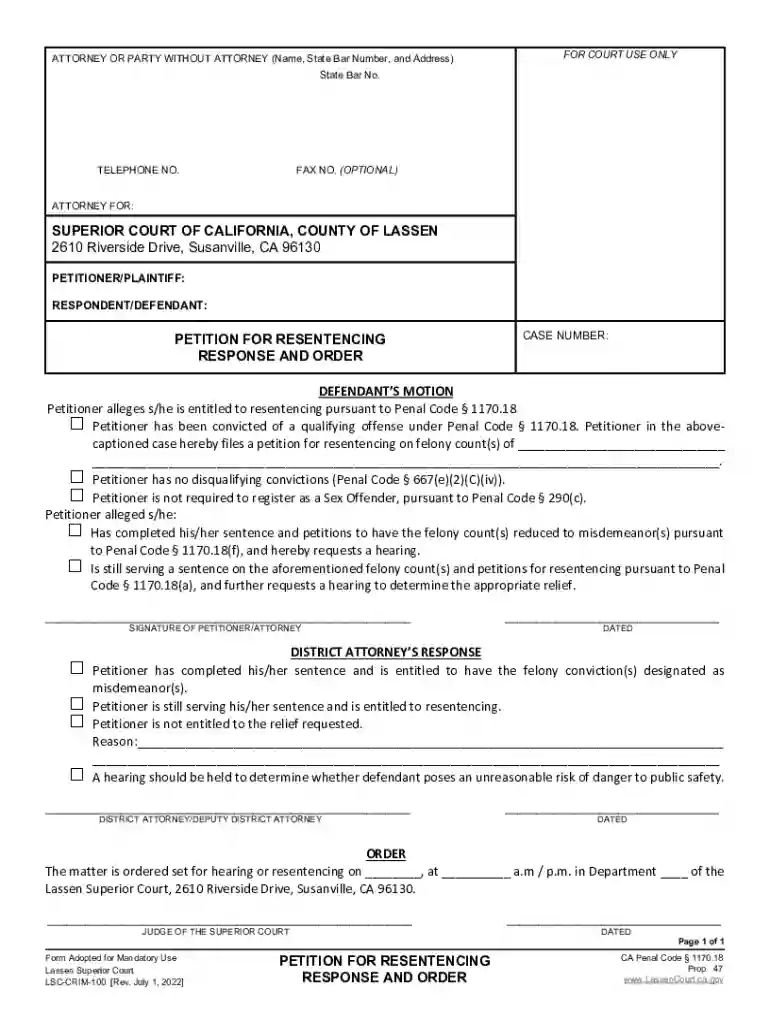
The "Petition for Resentencing Response and Order" is a legal document used within the Superior Court of California, specifically in the County of Lassen, to request a formal reconsideration of a criminal sentence. This petition falls under Penal Code § 1170.18, which allows individuals convicted of certain offenses to seek a modification of their sentence. This process can provide opportunities for individuals to benefit from changes in law that may retroactively reduce their sentences, reflecting evolving standards of justice and fairness.
Resentencing petitions are critical within the legal framework, as they offer a pathway to rectify overly harsh penalties and align past convictions with updated legal criteria. The petition facilitates communication between the petitioner, the court, and the district attorney, ensuring that all parties involved can present their positions and arguments regarding the potential resentencing.
Utilizing the Petition for Resentencing Response and Order involves several key steps that ensure proper adherence to legal procedures:
Eligibility Assessment: Determine if the convicted offense qualifies under Penal Code § 1170.18. Not all convictions are eligible for resentencing, so it is crucial to verify compatibility with the code's criteria.
Completion of the Form: Fill out the petition with accurate information, including personal details, conviction specifics, and the relief sought. This documentation must clearly articulate the basis for requesting resentencing.
Submission to the Court: Once completed, submit the petition to the Superior Court of California, County of Lassen. Ensure compliance with local procedural rules, which may include filing fees or specific submission formats.
Awaiting Response: The district attorney's office will review the petition and respond, either consenting to or opposing the resentencing request.
Court Hearing: Depending on the petition and response, a court hearing may be scheduled, where arguments will be presented, and the judge will make a determination on the petition.
Writing a thorough Petition for Resentencing Response and Order requires careful attention to detail and an understanding of legal processes:
Gather Personal and Case Information: Begin with collecting all necessary documents related to the original conviction, including the case number, court details, and any previous judgments or rulings.
Drafting the Petition: Clearly outline the reasons for seeking resentencing, highlighting any changes in law or circumstances that warrant reconsideration. Provide supporting evidence or references to legal precedents when applicable.
Proofread for Accuracy: Legal documents require precision, so ensure there are no errors in personal details or legal citations. Mistakes can lead to delays or dismissal of the petition.
File the Petition: Submit the petition to the appropriate court office and provide copies to the district attorney. Remember to keep copies for personal records.
Prepare for a Hearing: If a hearing is scheduled, prepare to present your case in person or through legal representation, emphasizing the key points outlined in the petition.
The legal use of the petition is primarily focused on rectifying sentences that no longer align with current legal standards. It serves multiple purposes:
Address Overly Punitive Sentences: It offers relief for individuals who may have received disproportionately severe sentences for offenses that are now deemed less severe by law.
Adapt to Changes in Law: As statutes evolve, this petition allows for up-to-date application of justice, reflecting modern societal values and penal philosophies.
Promote Fairness and Rehabilitation: By providing a mechanism for sentence modification, it supports rehabilitative efforts for eligible individuals, offering them a chance at reduced penalties and reintegration into society.
The petition form consists of several critical components:
Petitioner Information: This section captures the personal and contact details of the individual filing the petition.
Conviction Details: It requires precise information about the original conviction, including the offense, sentencing date, and current penal status.
Resentencing Justification: A crucial segment where the petitioner must outline the legal arguments and justifications for resentencing, supported by references to Penal Code § 1170.18.
District Attorney's Response: This part records the district attorney's stance on the petition, whether in agreement or opposition, accompanied by rationale and legal arguments.
Understanding the conditions for eligibility is essential to filing a successful petition:
Nature of the Offense: Only certain offenses qualify under Penal Code § 1170.18, primarily focusing on non-violent felonies that have been reclassified or are eligible for reduction to misdemeanors.
Sentencing Status: The petitioner must demonstrate that the sentence in question exceeds what would currently be imposed under revised laws.
Impact of Legal Changes: Eligibility may depend on specific legislative amendments that have redefined or restructured sentencing guidelines applicable to the original conviction.


While the primary focus remains on the Superior Court of California, County of Lassen, different counties within California might have specific rules regarding petition submission or hearing scheduling. It is important to be aware of:
Local Court Procedures: Each county might have distinct filing procedures, documentation requirements, or timeliness rules for processing petitions.
County Supplementary Forms: Some counties might require additional local forms or affidavits to accompany the standard petition.
Appointment of Legal Counsel: Depending on the complexity of the case, legal representation may be advisable, and counties may offer resources for public defenders or legal aid services.
To adeptly navigate the resentencing process, familiarize yourself with several key legal terms:
Petition: The formal written application submitted to a court, outlining the request for resentencing and its justifications.
Resentencing: The act of reevaluating and potentially altering a previously imposed sentence under newly applicable laws.
District Attorney: The public official responsible for representing the state in prosecuting criminal offenses, who also responds to petitions for resentencing.
Penal Code § 1170.18: The specific legal statute under which petitions for resentencing are processed, providing the legislative framework for sentence modification.
We've got more versions of the petition resentencing response order county form. Select the right petition resentencing response order county version from the list and start editing it straight away!
At DocHub, your data security is our priority. We follow HIPAA, SOC2, GDPR, and other standards, so you can work on your documents with confidence.
Petitioner must complete the petition and indicate whether a request is made for resentencing or reduction to misdemeanor.Read more
Mar 18, 2025 File 1437 Petition requesting appointment of counsel (no filing deadline). DA will respond within 60 days. Defense reply 30 days later. (Note:Read more


